


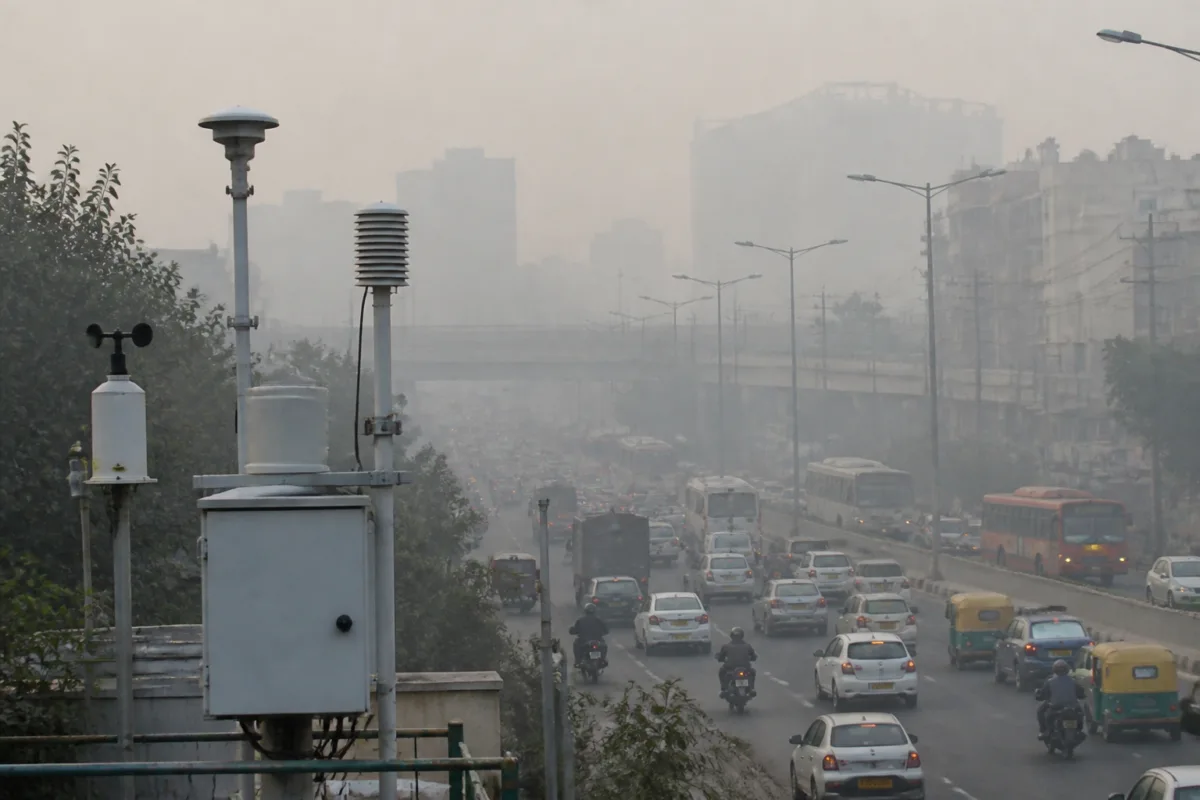
Delhi air pollution is not produced only by visible smoke, road dust or waste burning. Initial analysis from a new Indian Institute of Tropical Meteorology laboratory indicates that gases released into the atmosphere are reacting to form fine secondary aerosol particles, adding a less visible but significant layer to the capital’s pollution problem.
The finding matters because it changes how the city’s air-quality challenge must be understood. Some particulate matter is emitted directly by vehicles, industries and fuel burning. Other particles are created after gases interact in the atmosphere. These secondary aerosols can remain suspended for long periods and enter the body through breathing, according to the report published by Jagran – New Delhi.
The early analysis was carried out by IITM Pune at its Atmospheric Chemistry and Aerosol Toxicity Analysis Lab, or AATAL, established in New Rajendra Nagar. The laboratory has been set up at an estimated cost of about Rs 80 crore and contains 25 advanced instruments. Its stated purpose is to examine the composition of pollutants, identify their sources and assess their potential health effects.
That institutional shift is important. Conventional pollution-control measures often focus on what can be seen or directly traced: vehicle exhaust, construction dust, road dust, open waste burning and industrial emissions. But the chemistry of the atmosphere means that emissions do not remain in their original form. Gases released by urban activity can become new particulate pollutants after entering the air.
The report describes PM2.5 as particles measuring 2.5 micrometres or less. Because of their small size, they can travel deep into the respiratory system. Directly emitted particles may include dust, smoke and soot. Secondary aerosols, by contrast, are formed in the atmosphere from precursor gases.
Volatile organic compounds released by vehicles and industries can contribute to secondary organic aerosols. Sulphur dioxide, nitrogen oxides and ammonia can react to form secondary inorganic particles such as sulphates and nitrates. This means that controlling particulate pollution requires attention not only to the particles themselves but also to the gases that help create them.
The initial figures cited in the report show why this distinction matters for Delhi’s policy response. Vehicles accounted for 25 per cent of PM2.5 pollution in the analysis. Secondary organic aerosols contributed 18.4 per cent, while secondary inorganic aerosols accounted for 16.5 per cent. Road dust contributed 10.9 per cent and waste burning five per cent.
These figures should not be read as a permanent annual source inventory. The report specifically notes that they are based on an initial analysis for a particular day and that the contribution of different sources can change from one day to another. Weather, atmospheric conditions, emissions patterns and chemical reactions can alter the composition of the air over time.
Even with that limitation, the numbers point to a central weakness in a pollution strategy built around visible sources alone. The combined contribution attributed to secondary organic and inorganic aerosols in this initial analysis was 34.9 per cent. That does not mean that a single source can be assigned responsibility for all of these particles. It does mean that a substantial part of the pollution load is linked to atmospheric processes involving precursor gases.
For city administration, this complicates both diagnosis and enforcement. A road-cleaning operation can address dust that has accumulated on a surface. Water sprinkling and mechanised sweeping can be used as responses to road dust. Vehicle checks and pollution-under-control certification can target emissions from transport. Action against open burning can address a direct source. But none of these measures, by itself, captures the full chemical pathway through which gases turn into new particles.
Delhi’s existing response includes controls on vehicle emissions, pollution-under-control checks, mechanised road cleaning, water sprinkling, measures to control construction dust, action against waste and biomass burning, and efforts to promote public transport. Additional restrictions are imposed under the Graded Response Action Plan when pollution levels rise.
The new laboratory’s role is therefore not simply scientific. It can help connect urban emissions with the air residents ultimately breathe. Identifying the chemical composition of particles and their precursor gases can support more targeted decisions about transport, industry, fuel use, construction activity and other emission sources. The report does not establish that the laboratory’s initial findings have already changed government policy, but it makes clear that such source analysis is intended to inform pollution control.
The institutional challenge is coordination. Vehicle emissions may fall within transport and enforcement systems, industrial emissions within regulatory oversight, construction dust within municipal and development authorities, and waste burning within local administration. Secondary aerosols do not belong neatly to one department because their formation can involve emissions from multiple sectors and occur after those emissions have travelled through the urban atmosphere.
This also explains why a city can experience severe pollution even when one immediately visible source appears to have been controlled. Pollution is not only a matter of what is emitted at a particular location. It is also a matter of how emissions mix, react and persist under prevailing atmospheric conditions. The early IITM analysis brings that process into the centre of Delhi’s pollution debate.
The data available in the report remains preliminary and day-specific. It does not provide a complete seasonal source-apportionment picture, nor does it establish the health impact of each identified aerosol category in Delhi. It does, however, show that secondary organic and inorganic aerosols formed a sizeable share of the measured PM2.5 burden in the initial analysis. That is enough to raise a clear administrative question: whether pollution-control plans are measuring and reducing the gases that generate particles, rather than focusing only on particles after they have formed.
Delhi’s air-quality problem is therefore both an emissions problem and a chemical-conversion problem. The AATAL laboratory has been created to study that connection through detailed analysis of pollutant composition, sources and possible toxicity. The next stage will depend on how consistently such data is collected across different days and conditions, and how effectively the findings are translated into action across the agencies responsible for the city’s air.

