


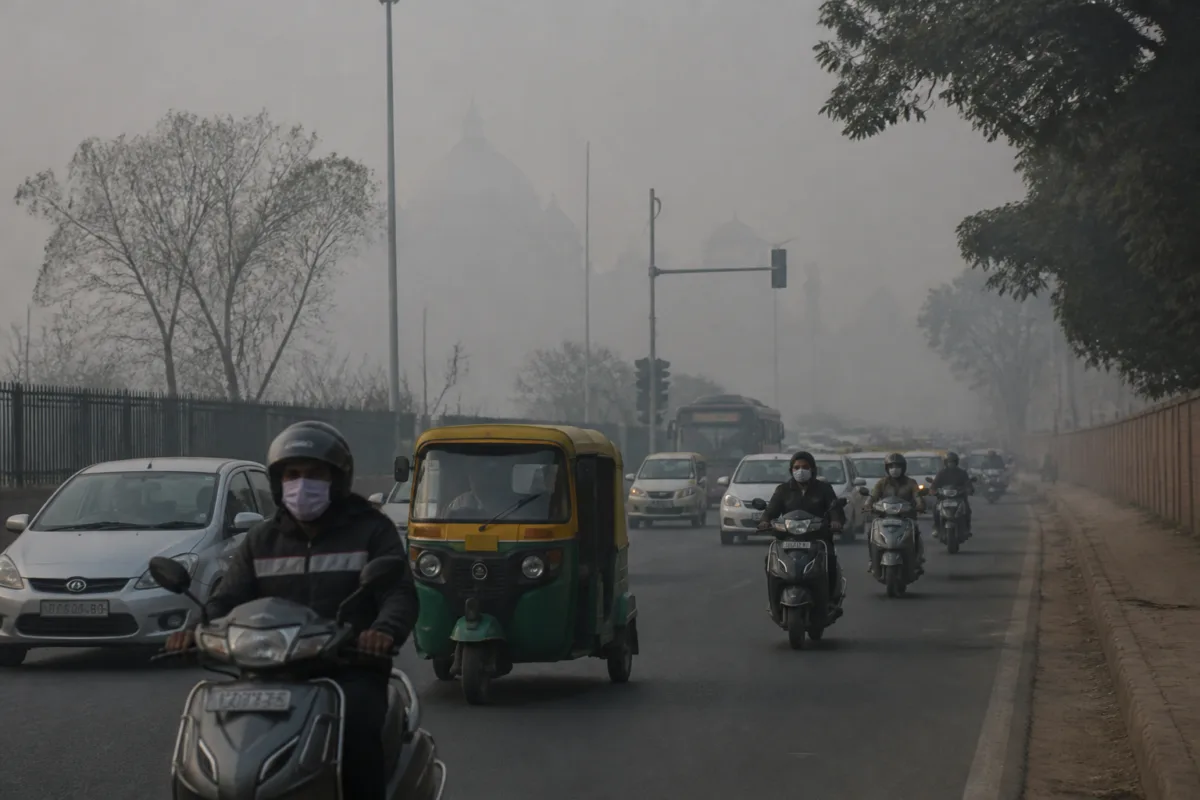
Delhi’s worsening air pollution has triggered a fresh confrontation between the Bharatiya Janata Party and the Aam Aadmi Party over crop-burning data, AQI monitoring and the responsibility of neighbouring states for the capital’s air quality.
Environment Minister Manjinder Singh Sirsa accused the Punjab government of concealing stubble-burning figures and said fires in the state were undermining efforts by the Delhi government to reduce pollution. His comments targeted the AAP-led Punjab administration and included allegations of political appointments in the Punjab Pollution Control Board.
According to figures cited by Sirsa, satellite data recorded 933 stubble-burning incidents in Punjab between October 26 and November 1, with 175 cases reported on November 1 alone. He also alleged that there was a significant difference between Punjab Police records and government data. Sirsa further claimed that Punjab had not submitted a utilisation certificate for central funds provided for crop-residue management.
The allegations come as Delhi enters a period in which smoke from agricultural fires, local emissions, dust and unfavourable weather conditions can combine to sharply reduce air quality. The report did not provide an independent assessment of the satellite figures or the alleged discrepancy between the different sets of Punjab data.
The AAP rejected the BJP’s accusations and said Punjab had reduced stubble-burning incidents by 90 to 95 per cent with the cooperation of farmers. AAP leaders Saurabh Bharadwaj and Anurag Dhanda said the number of cases had fallen from about 5,000 last year to approximately 1,000 this year. They also argued that Madhya Pradesh accounted for 52 per cent of stubble-burning incidents nationally and that cases were increasing in Uttar Pradesh.
The party said the BJP was blaming Punjab’s farmers instead of addressing Delhi’s pollution-control failures. It also accused the Delhi government of manipulating air-quality readings at monitoring stations. In a claim linked to a video shared by the party, AAP leaders alleged that water was being sprayed near the AQI monitoring station in Jahangirpuri, close to the Indian Institute of Technology, to lower recorded pollution levels. They said wetting the area could settle dust particles and affect the accuracy of readings.
Bharadwaj called for an impartial inquiry into the alleged water spraying and monitoring practices. The report did not state that any government agency had independently confirmed the allegation. The competing claims leave two questions central to the immediate pollution response: how crop-burning figures are being counted across states, and whether Delhi’s monitoring network is producing readings that accurately reflect conditions experienced by residents. The next steps identified in the report are the demand for an inquiry into the Jahangirpuri monitoring station and continued action by governments on crop-residue burning and urban pollution control.

