


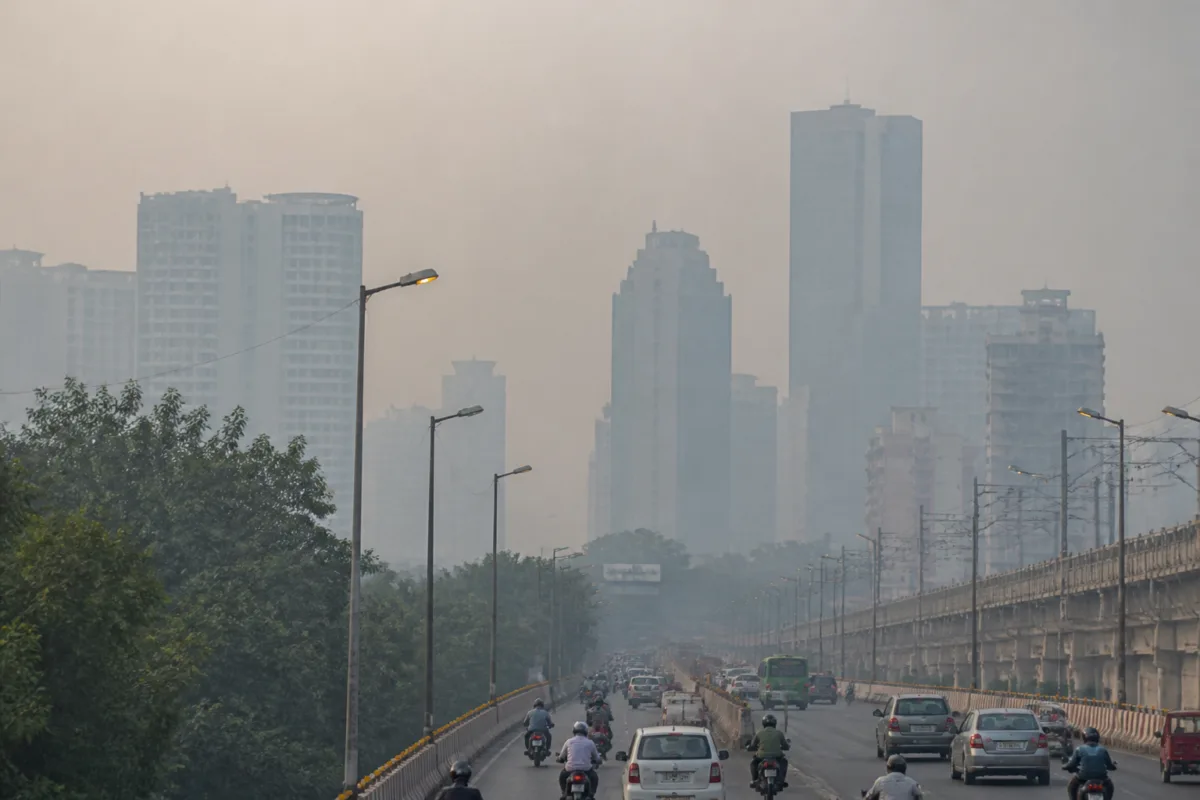
Delhi air pollution levels fell across several key pollutants in October compared with previous years, but average PM2.5 and PM10 concentrations recorded up to October 25 remained above India’s national annual standards, according to data cited by environmental think tank Envirocatalysts.
The figures, based on data from the Central Pollution Control Board and the Commission for Air Quality Management, show that the average levels of PM2.5, PM10, nitrogen dioxide and ozone were lower this October than in previous years. Carbon monoxide levels, however, remained at about the same level as last year.
Envirocatalysts compared the average recorded up to October 25 this year with the full-month October averages from earlier years. The comparison shows that Delhi’s average PM2.5 concentration fell to 67 micrograms per cubic metre, from 147 micrograms per cubic metre in October 2016.
PM10 levels also declined, falling to 172 micrograms per cubic metre from 345 micrograms per cubic metre over the same comparison. The report did not provide the corresponding numerical values for the changes in nitrogen dioxide and ozone, but said both pollutants recorded lower average levels this year.
Despite the improvement, the data does not indicate that Delhi’s air has reached safe levels. The average PM2.5 concentration recorded this year was above the national annual standard of 40 micrograms per cubic metre, while PM10 was above the prescribed annual standard of 60 micrograms per cubic metre.
PM2.5 consists of extremely fine particles that can travel deep into the lungs and increase the risk of respiratory and cardiovascular illnesses. PM10 can also worsen breathing-related problems, making the continued exceedance relevant to residents even when pollution levels are lower than in previous years.
Sunil Dahiya, chief analyst and founder of Envirocatalysts, said pollution levels are influenced by wind speed, temperature, humidity and rainfall. These weather conditions can affect how pollutants disperse or remain concentrated close to the ground.
Dahiya said winter weather conditions can become unfavourable for dispersion, allowing pollutants to accumulate near the surface and causing pollution levels to rise rapidly. The observation comes as Delhi moves towards the colder months, when changes in atmospheric conditions can affect air quality across the city.
The data therefore records an improvement in October averages but does not establish compliance with national air-quality standards. The next phase of monitoring will determine how pollution levels develop as winter conditions set in and whether the lower concentrations recorded up to October 25 continue.

