


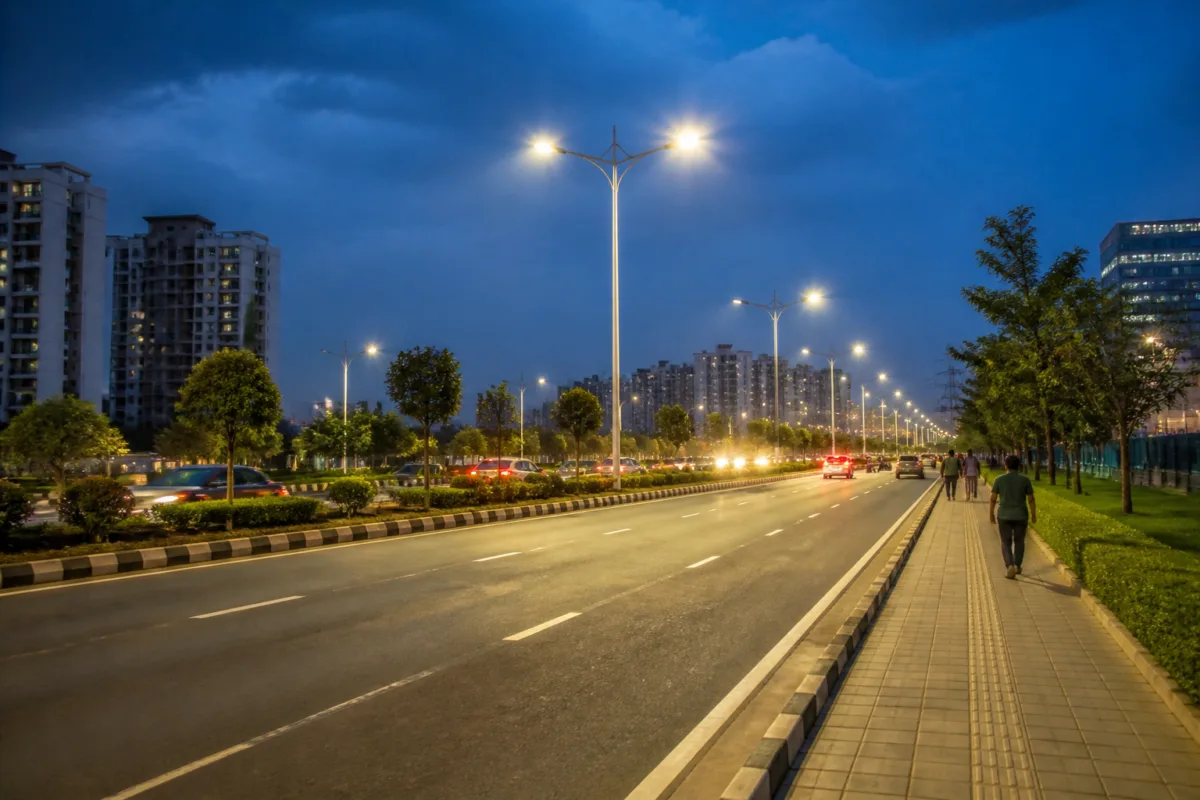
The Gurugram Municipal Corporation is preparing to install 2,480 street lights on 19 major roads to improve visibility at night and reduce the risk of accidents linked to poorly lit stretches, an official said on Monday.
The project will be implemented in two phases. The first phase will cover 2,050 lights on footpaths, while the second phase will add 430 lights on central road medians, according to the official information reported by Live Hindustan.
The civic body said improved lighting would make it easier for pedestrians to use footpaths after dark and help motorists navigate the city’s major roads. Work on installing lights along the footpath on Medanta Road has already been completed.
The footpath-lighting plan covers several important routes across Gurugram. These include the stretch from Huda City Centre to Signature Chowk, Golf Course Extension Road and Bakhtawar Singh Chowk; the road from Bakhtawar Singh Chowk to the Medanta traffic light; the route between Hero Honda Chowk and Bakhtawar Singh Chowk; and the road connecting Mayfield Garden with the Southern Peripheral Road.
Footpath lights are also planned along the stretch from Park Hospital on Sohna Road to Mayfield Garden and on Dharam Marg. The listed roads serve residential, commercial, institutional and hospital-linked areas, making night-time visibility relevant to both pedestrians and vehicles.
The second phase will focus on central medians along several sector-dividing roads. These include roads between sectors 45 and 46, 45 and 53, 51 and 52-57, 53 and 56, 44 and 52, 51 and 52, 45 and 48, as well as Gurugram University Road and the road between sectors 51 and 46.
The project’s two-part design separates lighting for pedestrians from lighting on road medians. The municipal corporation has not disclosed a completion timeline or the total cost of the work in the information available. It has also not specified the technical standards, maintenance arrangement or energy efficiency specifications for the fixtures.
The announcement comes as Gurugram continues to depend on a mix of footpaths, divided roads and high-capacity corridors connecting residential sectors, offices, hospitals and commercial areas. In such a network, lighting gaps can affect more than driving conditions: they can make footpaths difficult to use and reduce visibility at junctions, crossings and roadside access points.
The municipal corporation has asked residents to report other roads where lighting remains seriously inadequate, particularly stretches not included in the first phase. Based on the suggestions received, the civic body will consider adding more roads to the second phase.
Residents’ submissions are expected to help the corporation identify lighting gaps beyond the routes already mapped in the project. The next steps are the completion of the planned installations and the consideration of additional roads based on public feedback.

