


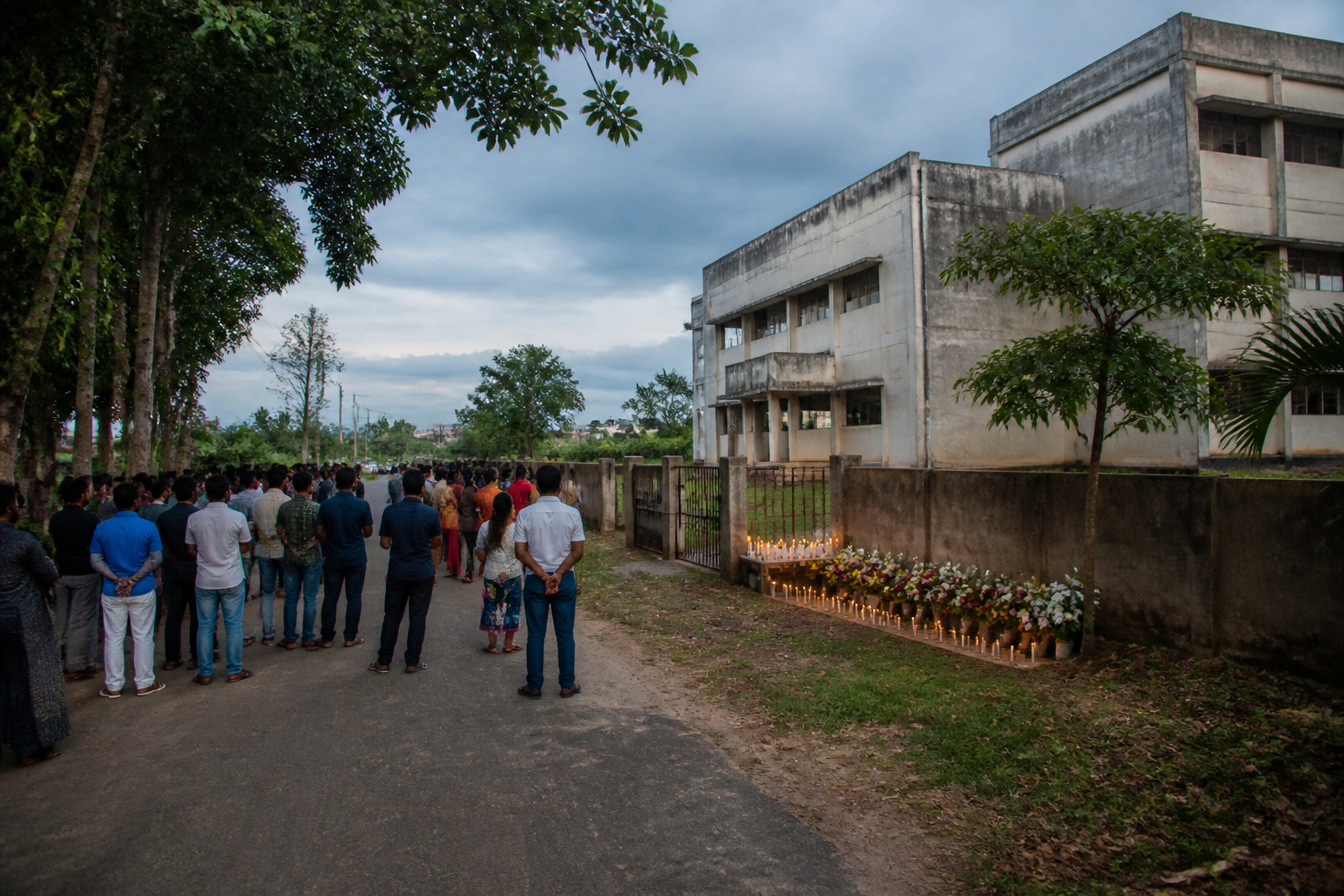
Eight years after two young men were killed during a protest at Daribhit High School in North Dinajpur, the families’ renewed demand for justice has exposed a deeper institutional problem: the transfer of an investigation does not, by itself, demonstrate that accountability is moving forward.
The case returned to public attention when the families of Rajesh Sarkar, 19, and Tapas Barman, 22, expressed anguish at an event organised by the Akhil Bharatiya Vidyarthi Parishad in Daribhit. The two former students were killed during firing on September 20, 2018, when students were protesting the appointment of teachers at the school. Another youth, Biplab Sarkar, was injured.
The immediate dispute concerned the appointment of an Urdu teacher and a Sanskrit teacher. The protesting students wanted a Bengali teacher to be posted instead. What began as a conflict over staffing at a government school escalated into protests, clashes and strikes, followed by a long-running dispute over who should investigate the deaths and whether those responsible would be prosecuted.
That trajectory matters because the Daribhit case is not only about an incident at one school. It shows how a local dispute can become a test of the relationship between public institutions, policing, political parties and families seeking criminal accountability. The families’ current complaint is not that no institution has acted. It is that the actions taken so far have not produced a visible conclusion.
The first institutional response came from the then Trinamool Congress government, which ordered a Criminal Investigation Department inquiry. The families rejected that arrangement and demanded a Central Bureau of Investigation probe, along with punishment for police officers they alleged were involved in the firing. They also refused to cremate the bodies, buried them near their homes and later approached the Calcutta High Court.
On May 10, 2023, the High Court handed the investigation to the National Investigation Agency. An NIA team subsequently visited Daribhit, inspected the school premises and spoke to the families of Rajesh and Tapas as well as to Biplab, the injured youth. Murarimohan Mandal, then the district inspector of secondary schools, was also questioned for several hours at the NIA office in Rajarhat, according to the report.
The transfer to the NIA is an important procedural development, but it is not the same as a finding of guilt or a completed prosecution. The supplied account does not establish whether a chargesheet has been filed, whether arrests have been made, whether the firing has been conclusively attributed to particular individuals, or when the investigation is expected to end. That gap between investigative activity and a publicly established outcome is central to the families’ continuing frustration.
Manju Barman, Tapas’s mother, said she had expected the judicial process to accelerate after the change of government. She alleged that the Bharatiya Janata Party had supported the families during their agitation but that this support had weakened after the party came to power. She also said the Daribhit issue had not received significant attention from the new chief minister, while other old files had been reopened.
Those allegations are political claims made by a bereaved family, not findings established in the supplied material. They nevertheless reveal how families experience prolonged investigations: not simply as legal processes, but as a continuing measure of whether governments remember the event after the original mobilisation has ended. In Daribhit, the question of political support has become inseparable from the question of institutional progress.
The BJP and the ABVP have offered different forms of response. Manju Barman said the ABVP had continued to stand by the families, even as she criticised the BJP’s post-election support. At the rally, ABVP state secretary Deep Datta said the organisation was optimistic that justice would be served and appealed to the chief minister to declare September 20 as Bangla Bhasha Dibas, or Bengali Language Day.
The demand for official recognition of September 20 adds another layer to the dispute. The date is remembered by the families and supporters not only as the day two youths died, but also as the day a language-related disagreement over teacher appointments became a deadly confrontation. Recognition would give the incident a formal place in public memory, but it would not resolve the underlying criminal investigation. These are related but distinct demands: one concerns commemoration, the other legal accountability.
The state government’s response, as reported, has been limited to an assurance that the probe is in progress. Koushik Choudhury, the state minister for fire and emergency services and education, visited Daribhit, paid homage to the deceased and said the families would get justice. The statement indicates that the government recognises the continuing sensitivity of the case, but it does not provide details about the investigation’s status, its remaining steps or a timeline for completion.
That absence of detail is significant in a case that has already passed through several institutional stages. The CID inquiry ordered by the earlier government did not satisfy the families. The High Court later moved the investigation to the NIA. The NIA conducted site and witness-related activity, including questioning a former district education official. Yet the account available here does not say what conclusions have emerged from those actions.
The case therefore illustrates a recurring administrative distinction between process and outcome. A probe can be ordered, transferred, conducted and periodically acknowledged while the central public question remains unanswered: who was responsible for the deaths, and what legal action follows? Until an investigation produces a formal finding or prosecution, each procedural step can appear to families as movement without closure.
The numbers in the Daribhit timeline make the delay difficult to ignore. The protest took place in 2018. Two young men died, one was injured, and the case reached the High Court before the investigation was transferred to the NIA in 2023. The families were still demanding justice in 2026, nearly eight years after the firing. The duration is not merely a background detail; it is the principal fact shaping the current dispute.
The school itself remains the starting point of the story. Students protested over which language teachers should be appointed, seeking a Bengali teacher instead of the approved Urdu and Sanskrit teachers. The source material does not establish the formal rules behind those appointments or explain how the staffing decision was made. It does, however, show how a decision inside a public education system became entangled with language, representation, policing and partisan mobilisation.
That institutional chain matters beyond Daribhit. Schools are administered through multiple layers of authority, while policing and criminal investigation operate through separate structures. When a protest at a school ends in deaths, responsibility becomes distributed across those systems. The education dispute, the police firing, the investigation and the political response may be connected in public memory, but they require different forms of official action.
The case also demonstrates why a change of government does not automatically settle the credibility of an investigation. The families had hoped that a new political administration would give the case fresh momentum. Instead, their public statements show that they continue to judge the government by whether the investigation produces visible accountability. The BJP’s earlier support, as described by the family, has become part of that assessment.
At the same time, the current government’s assurance that the probe is continuing cannot be treated as a final answer. A continuing investigation may involve legal and evidentiary constraints that are not described in the supplied report. But without a clear public account of its status, the families’ perception of neglect is likely to remain. The available evidence does not establish why the investigation has taken so long; it establishes that the delay remains unresolved and politically consequential.
Daribhit’s present significance lies in this unfinished space between remembrance and justice. An annual rally can keep the deaths in public view. A ministerial visit can signal recognition. An investigation transfer can alter institutional responsibility. None of these, on the evidence available, confirms that the people responsible have been identified or punished.
The next meaningful developments will be formal ones: the NIA’s eventual findings, any prosecution or court action, and a clear decision on the request to recognise September 20 as Bengali Language Day. Until those steps occur, the Daribhit case will remain a reminder that the passage of time can deepen, rather than resolve, the public demand for accountability.

