


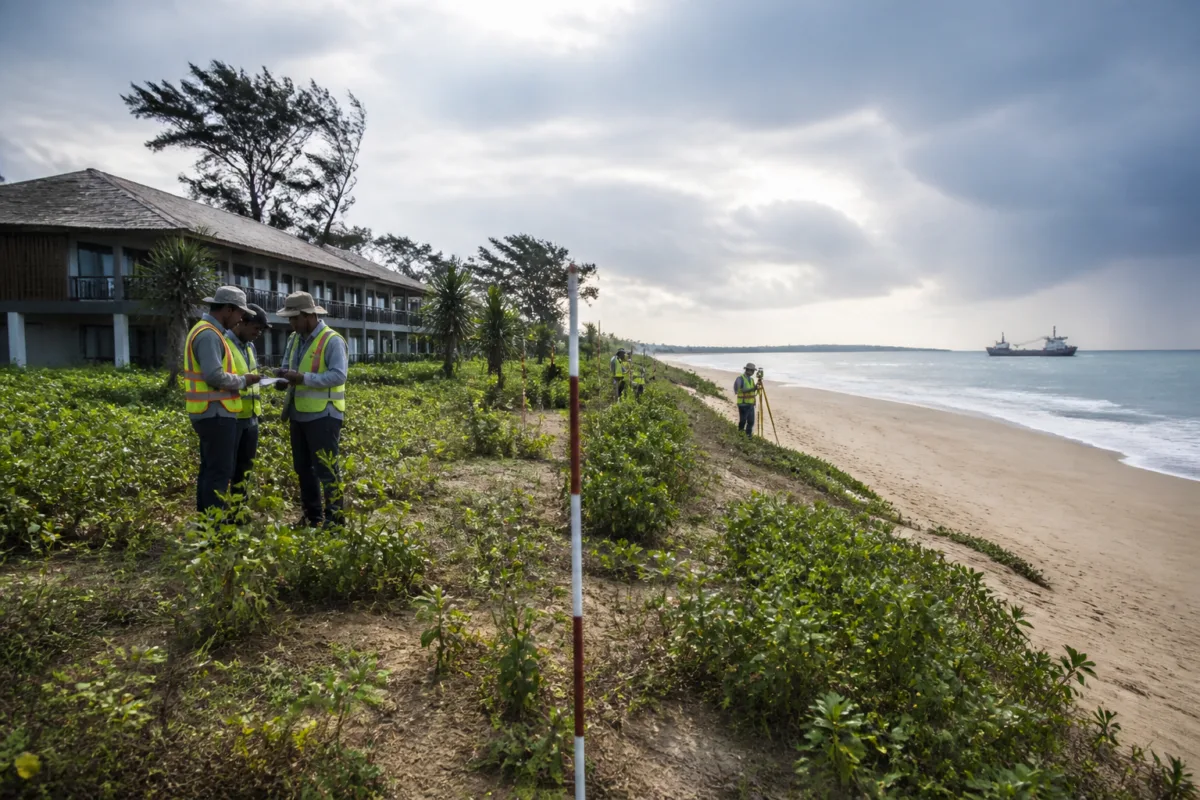
A coastal investment seminar in Mahabalipuram has placed regulatory compliance and environmental preparedness at the centre of proposed beachfront development along Tamil Nadu’s East Coast Road. The discussion brought legal experts, government regulators, scientists and industry representatives together to examine how the Coastal Regulation Zone framework, shoreline management and marine oil-spill response should shape investment decisions.
The significance of the discussion lies in what it says about the changing expectations placed on coastal development. Beachfront resorts are not only construction projects. They sit within a regulatory and environmental system that includes coastal classification, mandatory clearances, state-level authorities, shoreline risks and the possibility of marine pollution affecting seawater, beaches, ships and industrial sites. The speakers at the seminar argued that these considerations must be built into development planning rather than treated as separate compliance exercises.
Organised by Hubert Enviro Care Systems Ltd in association with the Institute for Ocean Management at Anna University, the seminar was titled “Unlocking Beachfront CRZ Investment Potentials in East Coast Road – Bayfront”. Its stated focus was to examine the investment potential of beachfront development while addressing the legal and environmental conditions attached to such projects.
The event also reflects the institutional complexity of coastal development. The panel included a Supreme Court advocate, a scientist from the Union Ministry of Environment, Forest and Climate Change, an academic institution focused on ocean management, an IIT Madras professor, an industry representative and a former adviser to the environment ministry. Their participation brought together several parts of the system that are often approached separately: law, government regulation, scientific assessment, project design and operational preparedness.
CRZ compliance is therefore not simply a document required before construction begins. The seminar’s legal and regulatory presentations described a framework that determines how coastal areas are classified and how proposals are assessed. Supreme Court advocate Siddhant Kohli explained the evolution of coastal regulations from the 1991 notification to the 2019 framework and highlighted the role of courts in enforcing environmental safeguards.
Kohli also cautioned investors against starting construction without obtaining mandatory clearances. That warning identifies one of the central governance risks in environmentally sensitive development: investment ambition can move faster than the approvals and assessments required to establish whether a project can proceed lawfully. The source does not identify a specific project that has violated these requirements, but the warning makes clear that construction before clearance was treated as a serious compliance concern at the seminar.
Dr H. Kharkwal, Scientist-F at the Union environment ministry, outlined the procedures for CRZ clearance, coastal classification and the role of State Coastal Zone Management Authorities. This is a critical part of the institutional architecture. It means that coastal investment proposals are assessed within a defined regulatory process, with state-level coastal authorities playing a role in the management and approval framework.
For developers, this process affects project planning before construction activity begins. A resort proposal must be considered in relation to its coastal classification and the clearances applicable to that location. For public authorities, the process creates a responsibility to examine development proposals through the lens of environmental safeguards rather than treating beachfront construction as a conventional real estate decision. For local communities and visitors, the quality of that process can influence how coastal land and marine environments are used, although the supplied report does not provide a specific assessment of local impacts from any individual project.
The discussion of an eco-resort model by HECS CEO Dr J.R. Moses shows how industry participants are attempting to present environmental safeguards as part of project design. HECS released a book titled “Approaching the Eco-Resort Concept”, offering guidance to resort developers. The source does not detail the model’s technical specifications or performance outcomes, so its importance in this account is as an example of an industry-led attempt to connect resort development with regulatory compliance and environmental protection.
That distinction matters. A project may be described as an eco-resort, but the label itself does not establish whether all legal requirements have been met or whether the project’s environmental safeguards are effective. The seminar’s legal and regulatory sessions placed mandatory clearances and coastal classification alongside the industry’s development model, suggesting that environmental positioning must operate within the formal approval system rather than replace it.
Marine oil-spill preparedness added another layer to the discussion. Jae-Soo Kim, CEO of South Korean company Ever Green Plus Co. Ltd, presented methods for removing oil from seawater, shorelines, ships and industrial sites. Oil-spill response is not limited to cleaning a visible patch of polluted water. The areas identified in the presentation—marine waters, shorelines, vessels and industrial locations—show the range of environments that may need to be addressed when coastal pollution occurs.
The seminar did not report a specific oil spill or announce a new response system for the East Coast Road. Its contribution was to place preparedness within the investment conversation. That is an important shift in framing: coastal development must consider not only what is built on the shore, but also how environmental incidents affecting nearby marine and shoreline systems would be managed.
The participation of scientists and academic experts broadened the discussion beyond approvals. Institute for Ocean Management Director Dr Krishnaveni Muthiah, IIT Madras professor Nilanjan Saha and former environment ministry adviser Dr M.V. Ramana Murthy discussed beachfront development, sea-level rise and shoreline management. These issues connect project-level decisions to wider coastal processes.
Sea-level rise and shoreline management are not presented in the source as forecasts for a particular resort or as evidence that any named project is at risk. They are, however, identified as subjects that need to be considered in discussions about beachfront development. This places coastal investment within a longer-term environmental setting rather than limiting the debate to land use, construction permissions or tourism demand.
The regulatory history mentioned at the seminar is also significant. The reference to the 1991 notification and the 2019 framework indicates that coastal regulation has evolved over several decades. The source does not provide a detailed comparison of the two frameworks, but the timeline shows that the rules governing coastal development are not static. Investors and regulators must therefore work with the framework currently applicable to a proposal, while understanding the legal and institutional history that has shaped it.
This creates a practical challenge for project delivery. Developers need clarity on classification and approvals before construction. Regulators need the capacity to examine proposals and enforce safeguards. Legal institutions, including courts, remain part of the system when disputes arise or when environmental protections are challenged. Scientists and academic institutions contribute evidence and technical understanding, while companies involved in environmental services provide project models and pollution-response methods.
The seminar’s composition illustrates why coastal development cannot be managed by a single institution. Investment decisions, environmental clearance, shoreline conditions, pollution preparedness and legal compliance overlap, but each is handled through different forms of expertise and authority. Coordination among these actors becomes as important as the individual requirements discussed at the event.
The available evidence does not establish how many beachfront projects are planned along the East Coast Road, how much investment is involved, whether any proposal has received clearance, or what specific shoreline data has been used in project assessments. It also does not provide measurements of sea-level rise, pollution risk or the capacity of existing emergency-response systems. Those gaps limit what can be concluded about the performance of coastal development in the region.
What the seminar does establish is the direction of the debate. Coastal investment is being discussed alongside legal compliance, environmental safeguards, coastal classification, state regulatory authorities, oil-spill response, sea-level rise and shoreline management. The public significance lies in whether these subjects remain conference themes or become visible requirements in project planning, approvals and operations.
For the East Coast Road, the larger urban question is how development can proceed in a coastal setting without separating economic ambition from environmental risk. The seminar’s speakers did not announce a new government policy or a specific construction project. Instead, they highlighted the conditions that must shape such investment if beachfront development is to operate within the law and respond to the physical realities of the coast.
The next developments to monitor are therefore concrete: whether proposed projects secure the required CRZ clearances, how State Coastal Zone Management Authorities apply coastal classifications, whether eco-resort models translate into documented safeguards, and how oil-spill preparedness and shoreline management are incorporated into project operations. The evidence currently confirms the importance of these systems, but not the compliance status or environmental performance of any particular East Coast Road development.

