


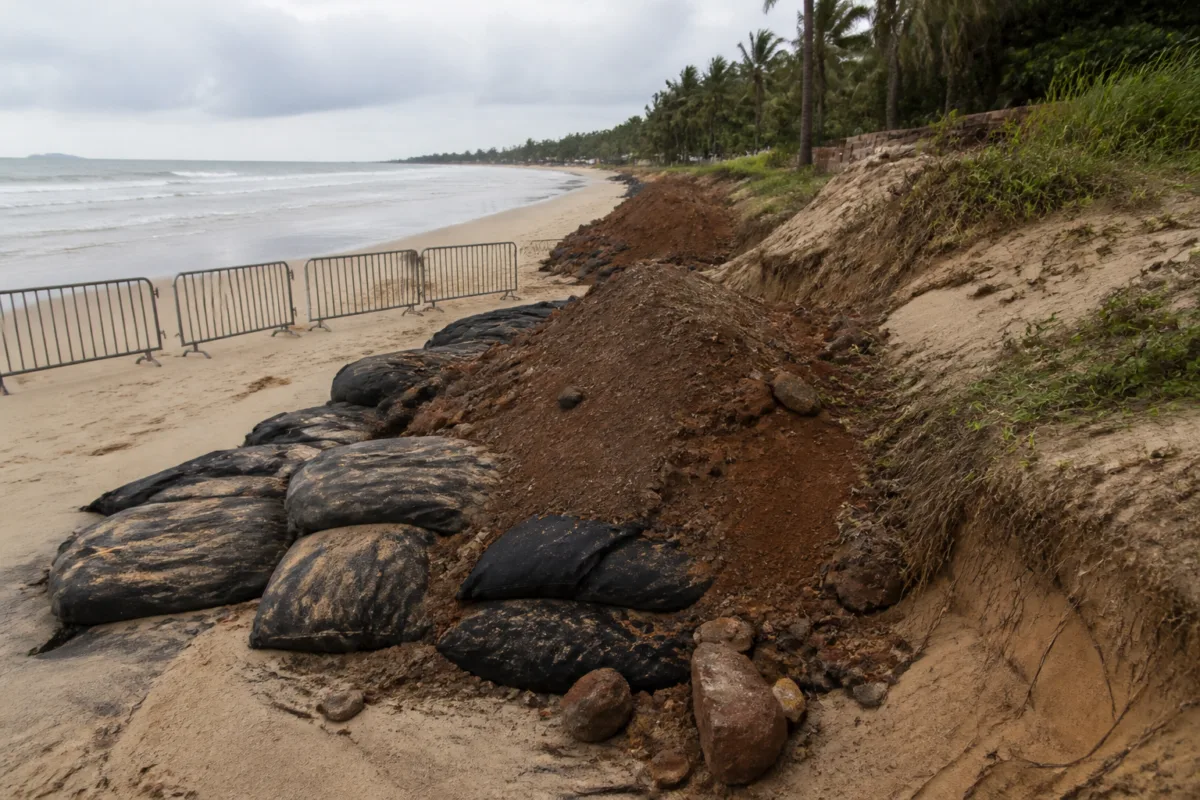
The Goa Coastal Zone Management Authority’s order to restore a damaged stretch of Varca beach is more than a dispute over illegal sand extraction. It shows how coastal protection can weaken when enforcement depends on identifying violators, serving notices and recovering restoration costs from parties who cannot be reached at the addresses available to the authorities.
The case concerns property bearing Survey No. 177/2 in Varca village, where the GCZMA found sand allegedly extracted from a dune, laterite soil dumped across the site, a permanent platform, temporary structures and metal barricades in the beach intertidal zone. The authority has directed the deputy collector to restore the land to its original condition and recover the cost from the alleged violator.
The action followed a complaint by the tourism department in June last year about an earthmover allegedly being used on Varca beach. The GCZMA inspected the site at Pedda, Dumottem, and recorded what its inspection report described as “gross violations of CRZ Notification 2011”. The authority began hearings in September 2025, according to the report, but the respondents did not appear.
The immediate administrative response is clear: the deputy collector is responsible for carrying out restoration, while the costs are to be recovered from the parties identified in the proceedings. The practical difficulty is that the enforcement process has not yet established a reliable route to the respondents. The GCZMA said notices to Nazareth Rebello and Pascoal Rebello could not be served because of an incorrect or incomplete address. A subsequent personal hearing notice sent through the talathi of the village panchayat, Varca, was returned unclaimed.
That sequence is important because coastal enforcement has two distinct stages. The first is detection: an authority must receive a complaint, inspect a site and document the alleged violation. The second is implementation: the authority must stop the activity, restore the affected land and ensure that the financial burden does not remain with the public administration. In the Varca case, the first stage produced a detailed site record. The second now depends on action by the deputy collector and the eventual recovery of costs.
The inspection findings describe damage that was not limited to the removal of sand. The report said sand was extracted from the dune and mixed with red murram, or laterite soil, at the site. It also recorded extensive dumping of red murram, which altered the natural landscape. A permanent platform and temporary structures were observed on the property.
In the intertidal zone, the report noted metal-fabricated barricades and large black bags filled with sand. These were allegedly dumped and stacked in a manner that obstructed free beach access. The inspection report further stated that the arrangement affected the natural movement of water, sand and marine life. These details make the case a question of coastal function and public access, not merely one of unauthorised construction or private land use.
Dunes are part of the physical form of a beach. In the evidence presented by the GCZMA, the alleged extraction changed that form, while laterite dumping and sand-filled bags introduced additional material into the coastal landscape. The authority’s description also links the intervention to the movement of water, sand and marine life. That creates a wider administrative challenge: restoration cannot be measured only by removing visible structures. It must also address the altered landform and the materials placed in the coastal zone.
The case therefore places the deputy collector in a technically and administratively sensitive position. The direction is to restore the land to its original condition, but the supplied material does not specify the restoration method, the estimated cost, the agency that will execute the work, or the timeline for completion. It also does not state whether the restoration plan will require further technical assessment. These are not minor implementation details. They will determine whether the order produces a functioning coastal restoration or only the removal of the most visible obstructions.
The GCZMA’s role in the case illustrates the layered nature of coastal governance. The tourism department initiated the matter through its complaint. The GCZMA conducted the inspection, issued show-cause and hearing notices, considered the respondents’ absence and passed the restoration direction. The deputy collector has been assigned responsibility for executing the order and recovering the cost. The village-level administrative channel was used when the initial notices could not be served.
This institutional chain can provide checks on coastal misuse, but it can also create delays if responsibility is not matched by operational capacity. The authority that identifies the violation is not necessarily the authority that undertakes restoration. The official tasked with restoration may also have to pursue cost recovery from respondents who have not participated in the proceedings. The Varca order makes that separation visible.
The notices themselves reveal another weakness. The respondents were identified by name, but the GCZMA said the addresses were incomplete or incorrect. A notice returned unclaimed after being sent through the village panchayat. The authority nevertheless proceeded after considering the matter and directed restoration. This allows the public action to move forward, but it leaves open the practical question of how the cost will be recovered and how future compliance will be secured.
The evidence supplied in the report does not establish the final legal status of the alleged violators beyond the GCZMA proceedings. The authority identified them as respondents and directed cost recovery from the alleged violator. The article does not provide the amount of the recovery, a completed restoration report, a response from Nazareth Rebello or Pascoal Rebello, or a separate statement from the deputy collector. Those limitations matter when assessing what the order has achieved so far.
The Varca case also highlights the difference between an order and an outcome. The GCZMA has passed a direction, but the beach and the adjoining property will be restored only when the direction is implemented. Until then, the documented condition of the site remains the clearest evidence available: altered dunes, dumped laterite, structures, barricades and sand-filled bags in the intertidal zone.
For citizens, the most direct concern is access. The inspection report said the barricades and sand bags obstructed free beach access. That connects the environmental issue to the public use of the shoreline. The reported impact on water, sand and marine life adds a second dimension: interventions at the beach can affect processes that are not confined to the boundary of a single property.
The institutional question is whether restoration orders can be made financially and physically enforceable when the parties responsible for the alleged work are difficult to locate. The GCZMA’s decision attempts to place the restoration cost on the violator rather than leave it with the state. But cost recovery depends on service of notices, accurate records and an identifiable respondent. If those links fail, the state may still have to act first while pursuing recovery later.
The material supplied does not establish whether similar cases have occurred elsewhere in Goa or whether the Varca order forms part of a broader enforcement drive. It does, however, show a complete chain from complaint to inspection, hearing and restoration direction. That makes it a useful example of how coastal regulation functions in practice: a reported activity is documented, notices are attempted, the authority records the environmental and access impacts, and another administrative office is tasked with restoring the site.
What remains to be seen is whether the deputy collector completes the restoration, how the original condition will be determined, what the work will cost and whether the amount can be recovered. The next meaningful evidence will therefore come from implementation: a restoration action, a cost assessment, a recovery proceeding or a further official update on the property at Survey No. 177/2. Until then, the Varca order confirms the damage recorded by the GCZMA and exposes the enforcement gap between identifying a coastal violation and reversing its effects.

