


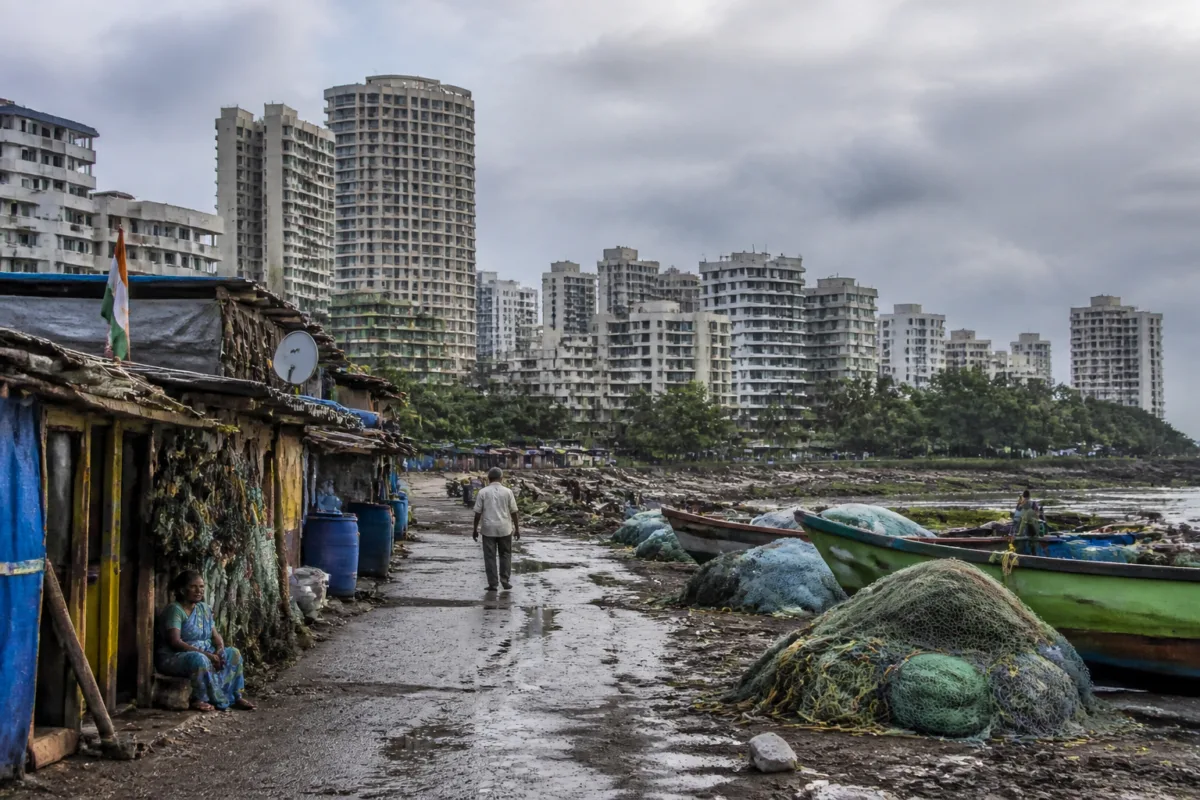
Juhu Moragaon Koliwada is not simply a settlement awaiting redevelopment. It is a coastal fishing village whose residents say repeated land claims, encroachments and redevelopment proposals have narrowed both their physical space and their livelihood options. The conflict reveals a larger problem in Mumbai: the city has yet to reconcile redevelopment with the rights, workspaces and environmental knowledge of communities that predate its modern real estate economy.
A report by Loksatta – Mumbai traces Moragaon’s history to the changing geography of Juhu. Until 1908, Juhu was separated from Parle village by marshland and salt-producing land known as khajan. Residents travelled through water at high tide and across exposed stretches at low tide. The settlement later emerged in the shifting sand belt between Juhu and Versova, where fishing families from coastal areas including Dahanu, Palghar, Vasai and Daman established themselves. Many belonged to the Mangela sub-community of Kolis.
That history matters because Moragaon’s land is not only residential. It includes fishing access, fish-drying areas, storage spaces and routes to the sea. The report places the settlement just 25 metres from the high-tide line. Its proximity to expensive seaside homes and newer apartments has made it part of one of Mumbai’s most valuable urban landscapes, while its residents continue to depend on facilities that the report says remain inadequate.
According to the report, Moragaon now has between 400 and 500 homes belonging to the original Koli community, alongside about 800 homes occupied by migrants. The figures are presented as local estimates. Residents cited in the report say the presence of migrant households was used to portray the area as a slum and to advance a forced Slum Rehabilitation Authority redevelopment proposal. The Koli community opposed the proposal and, according to the report, prevented it from being implemented.
The dispute is rooted in a longer history of land transformation. The report says mangrove areas, khajan land and fishing spaces once adjoining Moragaon were filled, including during the 1960s and 1970s development of the Juhu Vile Parle Development Scheme. Residents allege that land fill presented as necessary for the village benefited others rather than the Koli community. They also say that spaces used for drying fish were encroached upon.
The redevelopment conflict became more formal in the 1990s. The report says a developer sought to build multi-storey structures under an SRA proposal despite alleged violations of coastal regulation rules. A complaint was submitted to the Union environment ministry in May 1997, while the state government had already approved a letter of intent for the SRA scheme. The residents’ campaign was supported by the organisation Nivara Hakk and individuals including actor Shabana Azmi and architect P. K. Das, according to the report.
The most serious allegations concern consent and eligibility. Residents cited by Loksatta allege that documents showing 70 per cent consent were fabricated. The report refers to 98 people who allegedly did not live in Moragaon but appeared in records, 12 couples allegedly shown as separated to support claims over 24 homes, and 61 structures with names in the 1996 electoral roll that were allegedly excluded. These are allegations reported from local accounts and would require examination of official records and project documents before being treated as established findings.
The report further says 165 Koli homes were demolished after being classified as ineligible, of which about 100 were later rebuilt. It also alleges that three developers were shown as eligible slum dwellers and attempted to take positions in the society implementing the project. Although those arrangements were reportedly cancelled, the developer’s name allegedly remains on the property card. The residents’ demands include removing that entry and issuing separate property records for their residential and non-residential spaces.
This is where the case moves beyond a dispute over individual buildings. Conventional redevelopment treats a plot primarily as a housing asset. For a fishing community, however, the productive landscape extends beyond the home. A jetty, a road to the jetty, fish-drying grounds, net storage and work yards are part of the economic system. Rehousing families in taller buildings without securing those spaces can preserve an address while dismantling a livelihood.
The report says Moragaon residents want redevelopment but prefer self-redevelopment. They are asking the government to create separate rules for Koliwadas and gaothans rather than applying a generic slum-redevelopment framework. Their demand reflects an institutional gap: a community may be recognised as a group of residents under one policy while its occupational and cultural functions remain outside the project’s design.
Transport and major infrastructure have added another layer to the problem. Local fishers told the report that even as the Bandra-Versova Sea Link project was being built at a cost described as running into billions of rupees, a basic access road to the jetty had not been provided. The report also identifies shortages of jetties, fish-drying areas, net-storage facilities and other basic infrastructure. The contrast is stark: large regional connections can be planned and funded, while the small access systems that make a coastal livelihood possible remain unresolved.
The 2017 fire at a storage facility illustrates the vulnerability of that system. The report says fishing nets and equipment were destroyed, causing losses of lakhs of rupees, and that affected families told Loksatta they had not received compensation. The account is based on local statements; the report does not provide a compensation order or an official explanation for the alleged non-payment.
The environmental dimension is equally important. Architect and Urban Centre director Pankaj Joshi is reported to have submitted a comprehensive draft regulation for Koliwadas and gaothans. He described these settlements as living repositories of Mumbai’s maritime history, coastal culture and environmental knowledge, and argued that they are indicators of climate change. The report does not set out the draft regulation’s provisions, but the demand for a separate framework points to the need to treat coastal settlements as more than residual land awaiting construction.
Moragaon’s physical setting makes this question urgent without requiring a prediction about its future. A settlement close to the high-tide line must deal simultaneously with coastal regulation, drainage, access, safety, land records and livelihood continuity. Filling wetlands or narrowing common workspaces can change how water moves through the area, while dense construction can intensify pressure on roads and services. Yet the supplied report also shows that environmental arguments can be used selectively: coastal restrictions may constrain residents while high-value construction continues around them. The specific legality of individual projects remains a matter for official records and adjudication.
The governance chain is fragmented. Land and property records, municipal infrastructure, SRA approvals, coastal regulation, transport projects and compensation claims can fall under different authorities. That fragmentation makes it difficult for residents to secure a complete settlement plan. A home may be considered in one file, a fish-drying ground in another, an access road in a project plan and a coastal restriction in a separate regulatory process. Without coordination, redevelopment can resolve one category of entitlement while erasing the others.
The report says the Juhu Moragaon Fishermen’s Multipurpose Cooperative Society has submitted a memorandum seeking recognition of residents as project-affected persons because of the Bandra-Versova link project, protection of their workspaces and correction of property records. It also says that the community has approached the Bombay High Court over alleged encroachments on land used by Kolis. The supplied material does not state the present status or outcome of those proceedings.
The central lesson is not that Moragaon should remain unchanged. Residents themselves are reported to be seeking systematic redevelopment. The question is what counts as redevelopment and who defines the assets that must survive it. In Moragaon, the evidence presented by Loksatta points to a community caught between an outdated slum framework, high-value coastal land and infrastructure planning that has not fully accounted for traditional work.
What remains unresolved is the official status of the disputed records, the findings on alleged consent fraud and demolitions, compensation for the 2017 fire, the legal position of the proposed redevelopment and the implementation of any separate Koliwada regulation. Those documents and decisions will determine whether Moragaon’s future is designed as a liveable coastal neighbourhood or reduced to housing alone.

