


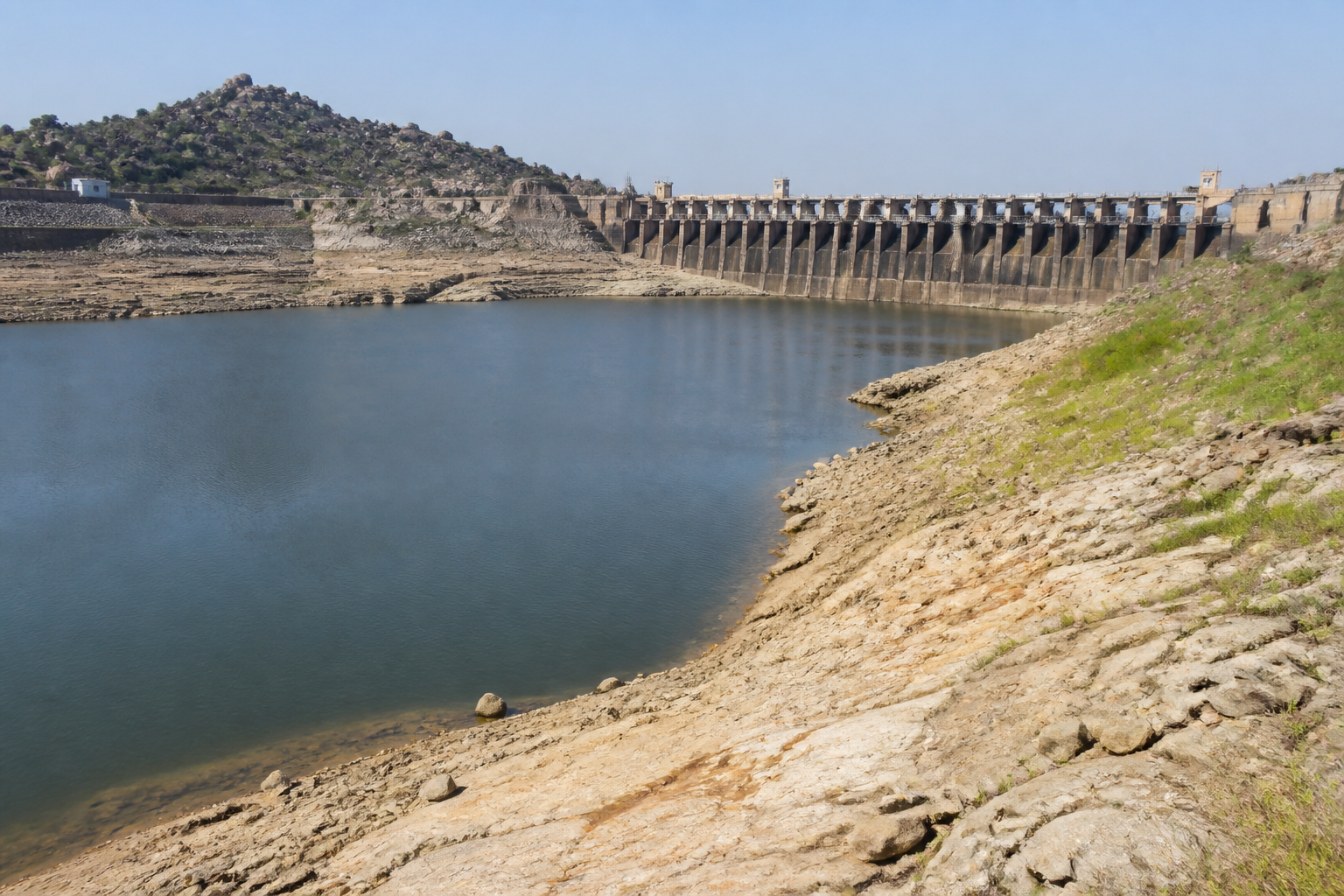
Karnataka has asked the Cauvery Water Management Authority to reduce the state’s daily water release to Tamil Nadu from 9,000 cusecs to 2,000 cusecs, citing falling inflows into its four reservoirs and the potential impact on drinking-water supplies. The appeal brings the inter-state water dispute back to a familiar question: how should a release order be assessed when the available storage, expected inflows and requirements of the two states point in different directions?
The request was submitted on Friday by Gaurav Gupta, Additional Chief Secretary of Karnataka’s Water Resources Department. According to the appeal, the state’s four Cauvery reservoirs currently hold 66.62 thousand million cubic feet, or TMC ft, of water. Karnataka argued that continuing with the existing order would create difficulties for drinking-water supply in the state.
The Cauvery Water Management Authority had ordered Karnataka on August 25 to release 9,000 cusecs daily to Tamil Nadu. Under that order, Karnataka is required to release a total of 11.66 TMC ft by September 8. The new appeal seeks an urgent revision of that direction, reducing the daily release to 2,000 cusecs.
The dispute is therefore not only about the volume of water moving downstream. It is also about which indicators should carry the greatest weight in a period described by Karnataka as a distress situation: current live storage, recent inflows, expected future inflows, releases already made and the water held in Tamil Nadu’s reservoirs.
Karnataka’s case rests first on the condition of its reservoirs. The state said the combined storage in four reservoirs had fallen to 66.62 TMC ft. It specifically cited live storage of 26.13 TMC ft in the Krishnaraja Sagar reservoir, commonly known as KRS, and 10.12 TMC ft in the Kabini reservoir. The appeal said these conditions were not adequately considered before the August 25 order was issued.
The state also presented a comparison of inflows between the previous year and the current year. From June through the end of August last year, Karnataka’s four reservoirs received 212 TMC ft of inflow. During the corresponding period this year, inflow was 106.98 TMC ft, according to the figures cited in the appeal. That is a difference of 105.02 TMC ft between the two periods.
Karnataka further argued that inflows would remain limited in the coming days. The appeal attributed the expected reduction to the effects of El Niño and stated that future inflows would not exceed 20 TMC ft. The supplied report does not provide an independent assessment of that forecast or indicate whether the authority has accepted it.
These figures form the basis of Karnataka’s argument that the release order must be reconsidered. The state’s position is that the combination of lower inflows, limited live storage and uncertain future availability makes it difficult to continue releasing water at 9,000 cusecs a day while protecting drinking-water supplies.
The other side of the comparison in Karnataka’s appeal concerns storage in Tamil Nadu. The state said three Tamil Nadu reservoirs held 61.22 TMC ft of water. By placing that figure alongside the storage in Karnataka’s reservoirs, the appeal is asking the authority to consider not only the water available upstream but also the quantity already held downstream.
That comparison highlights the institutional problem at the centre of the Cauvery dispute. A release order is implemented through a river basin shared by multiple states, but the consequences of a shortfall are experienced within separate administrative and political boundaries. A decision that appears necessary for one state’s supply security can be viewed by the other as a failure to receive its due share.
The release figures cited by Karnataka add another layer to the dispute. Between July 29 and September 4, the state said it released 327,647 cusecs of water to Tamil Nadu, equivalent to 28.30 TMC ft. According to the appeal, the authority’s order required 295,500 cusecs, or 25.53 TMC ft, during the same period. Karnataka therefore claimed that it had released an additional 32,147 cusecs, equivalent to 2.77 TMC ft.
The figures are being used by Karnataka to establish that it has already released more water than the amount specified for that period. However, the appeal does not by itself settle whether the cumulative releases comply with the larger seasonal or period-specific requirements under the authority’s directions. That distinction matters because water-sharing orders can involve both daily flows and cumulative obligations.
The authority’s next assessment will therefore have to reconcile several types of evidence. Current reservoir storage indicates how much water is physically available at the time of review. Historical inflow figures show how present conditions differ from the previous year. Forecast inflows point to the expected availability ahead, while measured releases indicate how much water has already moved downstream. The three Tamil Nadu reservoirs cited in the appeal provide a further reference point for evaluating the immediate distribution of water.
The information supplied in the report does not include a response from the Cauvery Water Management Authority or the Tamil Nadu government. It also does not identify the precise operational rules the authority will apply while considering Karnataka’s appeal. As a result, the available material establishes Karnataka’s request and the evidence it has submitted, but not the outcome of the request.
The drinking-water issue gives the appeal a significance beyond the immediate dispute over an administrative order. Karnataka has explicitly linked continued releases to future supply difficulties within the state. The report does not specify which cities, towns or communities would be affected, nor does it provide a breakdown of urban and irrigation demand. It does, however, show how reservoir management decisions can become directly connected to public water security when inflows decline.
The dispute also illustrates the limits of relying on a single measure of scarcity. A low inflow period may reduce the water entering reservoirs, but the practical severity of the situation depends on existing storage, projected rainfall or inflow, required releases and demand within the basin. Karnataka’s appeal presents all four elements as reasons for revising the order. Tamil Nadu’s position, which is not included in the supplied material, would be necessary to assess the downstream implications of the requested reduction.
The numbers cited by Karnataka point to a substantial year-on-year change in the basin’s immediate water position. Inflow into the four reservoirs between June and August fell from 212 TMC ft last year to 106.98 TMC ft this year. At the same time, the state has referred to live storage of 26.13 TMC ft in KRS and 10.12 TMC ft in Kabini, while saying that Tamil Nadu’s three reservoirs together held 61.22 TMC ft. These figures do not by themselves determine the legally or operationally required release, but they define the evidence presented in the appeal.
For urban residents, the most important unresolved question is how the authority will translate basin-level data into supply decisions. The appeal frames the matter as a choice between meeting an inter-state release direction and retaining sufficient water for drinking-water needs. The material available does not show how much of Karnataka’s stated storage is reserved for urban supply, irrigation or other uses, and it does not quantify the demand that would have to be met before the next review.
The institutional process is now as important as the figures themselves. Karnataka has asked for an urgent order reducing the release to 2,000 cusecs. The existing direction remains 9,000 cusecs a day, with a stated requirement of 11.66 TMC ft by September 8. The authority’s response will determine whether the order is revised, retained or otherwise modified in light of the new submission.
What the evidence confirms is that Karnataka is challenging the current release direction on the basis of lower inflows, limited reservoir storage, projected future availability, releases already made and storage reported in Tamil Nadu. What remains uncertain is how the authority will verify those claims, how Tamil Nadu will respond and whether the requested reduction will be accepted. The next formal decision by the Cauvery Water Management Authority, together with the reservoir and inflow data considered at that stage, will determine the immediate course of the dispute.
