


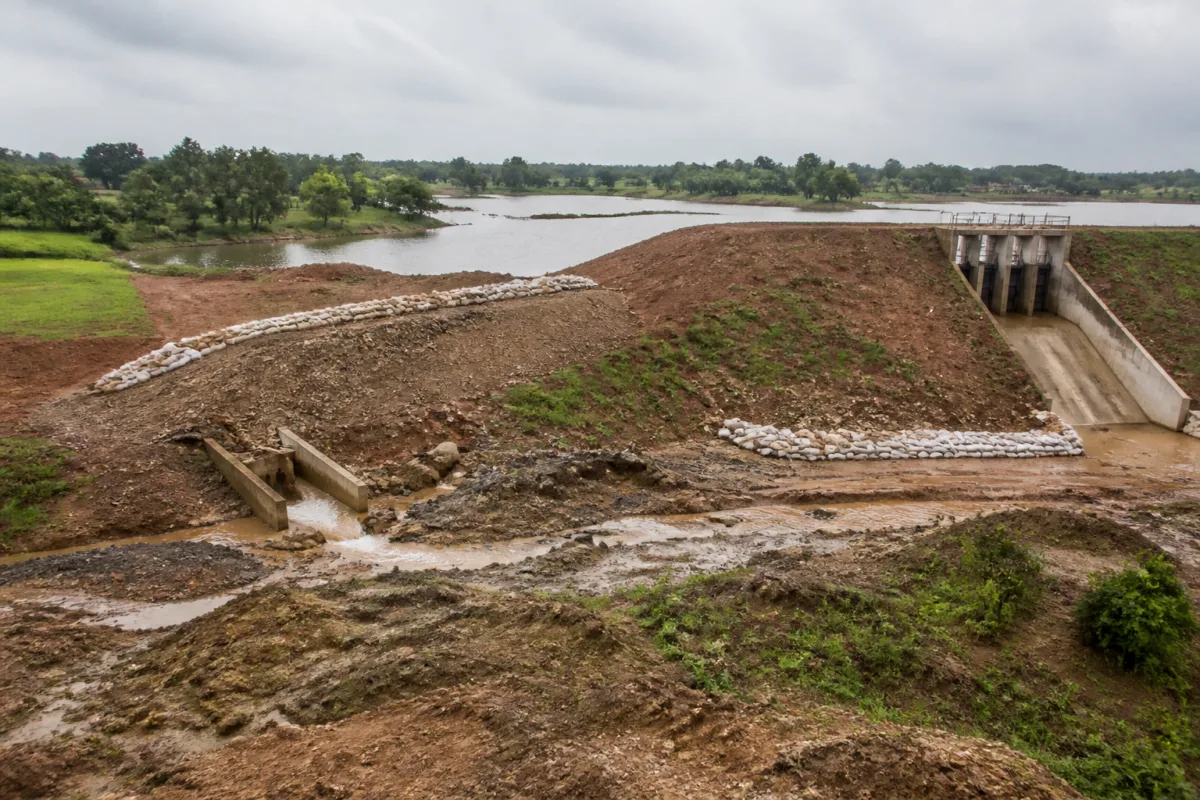
The Bodalkasa Dam breach in Gondia has been plugged after five days, but the reservoir is now left with only 50% of its storage and the damaged embankment and spillway still require reconstruction. The incident shows how an emergency response can stop an immediate flow of water without resolving the longer-term condition of an ageing irrigation system.
The State Irrigation Department said water discharge from the medium project in Tirora taluka was stopped on the evening of October 17. The breach had developed in the left bank canal wall on October 12, when the reservoir was reported to be about 95% full. Officials said they built up embankments to stop the flow and controlled the discharge without damage to downstream villages or standing crops.
The immediate outcome was therefore presented as containment rather than a completed repair. The department said the discharge was being observed after it was stopped to ensure that no further problems emerged. Kharif irrigation through the main outlet of the left canal was reported to be continuing smoothly, but the breached portion of the embankment and the spillway remain to be rebuilt.
That distinction matters for understanding the condition of the project. A stopped flow reduces the immediate threat, but it does not restore the infrastructure that failed. The department has said that design and other preparatory work will be completed before reconstruction begins. The supplied report does not provide a repair cost, a completion deadline or details of the design proposed for the damaged sections.
Bodalkasa Dam was built in 1917, during British rule. The project is therefore 109 years old. Its age alone does not establish that the breach resulted from inadequate maintenance, design limitations or structural deterioration. However, the failure places the operational challenge faced by irrigation authorities in clear view: an old water asset must continue serving farms while its vulnerable components are repaired without disrupting supplies or creating downstream risk.
The incident also illustrates the pressure created by high reservoir storage. When the left canal outlet breached, officials said the reservoir was approximately 95% full. A failure at that point leaves less room for managing inflows and increases the importance of quickly controlling the release. The response involved constructing embankments and stopping the flow rather than allowing the discharge to continue unchecked.
After the intervention, 7.852 million cubic metres of live storage remained in the reservoir, according to officials. The report describes this as 50% storage. The difference between the reported level before the breach and the remaining live storage indicates the scale of water released or otherwise lost during the five-day episode, although the supplied material does not provide a precise volume of discharge or a day-by-day account.
The public-interest question is not limited to whether the breach was plugged. It is also whether irrigation infrastructure can remain dependable when a repair has to be improvised under operating conditions. The department’s account shows a sequence of emergency action: officials inspected the site, directed urgent repairs, built up the embankment and monitored the site after the discharge stopped. Permanent reconstruction is a separate stage that has not yet been completed.
The institutional response involved several levels of the irrigation administration. Tirora MLA Vijay Rahangdale, Gondia collector Mandar Patki, Vidarbha Irrigation Development Corporation executive director JD Tale, chief engineer Sonali Chopde and superintending engineer Rajesh Patil inspected the site on the day of the breach and directed that the embankment be repaired urgently and the discharge stopped. Executive engineer Rajiv Kurekar, deputy executive engineer Sanjeev Sahare, sub-divisional engineer Chandrakant Dongre and junior engineer Abhishek Yadav worked with department staff until the flow was controlled, officials said.
This chain of response is significant because dam and canal incidents rarely belong to a single administrative unit. The reservoir, canal outlet, embankment, spillway, district administration and local agricultural users are connected operationally, even when responsibilities are distributed across different offices. At Bodalkasa, the response required site-level engineering work alongside district-level oversight and political attention.
The report says villages downstream and standing crops suffered no loss. That is an important reported outcome, but it should be read alongside the continuing uncertainty about the permanent repair. The absence of reported damage during this incident does not remove the need to establish what caused the breach, whether other sections were inspected and how the rebuilt structures will be assessed before the reservoir operates under similar storage conditions again. The supplied report does not state whether such an investigation has been ordered.
The continued operation of the main outlet for Kharif irrigation adds another layer to the repair challenge. Farmers depend on the canal for water, while engineers must work around an active irrigation system. Closing the outlet for a prolonged period could affect agricultural operations; keeping it in use while damaged sections are being repaired requires careful control. The authorities have said that irrigation through the main outlet is continuing smoothly, but no detailed operating protocol has been provided.
The event also exposes a recurring governance problem in public infrastructure: emergency performance can be visible and measurable, while preventive maintenance is less so. In this case, the five-day effort to stop the discharge produced a clear result. The less visible questions concern inspection schedules, asset-condition records, maintenance funding, design standards for reconstruction and the institutional process for deciding when an old structure needs major rehabilitation rather than local repair. The available report does not answer these questions, but the pending reconstruction makes them relevant.
The next phase will determine whether the incident remains a contained operational failure or becomes a wider lesson for the management of ageing irrigation assets. The department has said it will rebuild the breached embankment and spillway after completing the design and related work. That process should establish the technical basis for the repair, the timeline for execution and the arrangements for maintaining irrigation during construction.
For now, the evidence confirms three facts: the breach occurred in the left bank canal wall on October 12; the discharge was stopped five days later; and the reservoir was left with 7.852 million cubic metres of live storage, described by authorities as 50%. The immediate emergency has ended, but the infrastructure problem has not. The next significant milestone will be the start and completion of the permanent repair works.

