


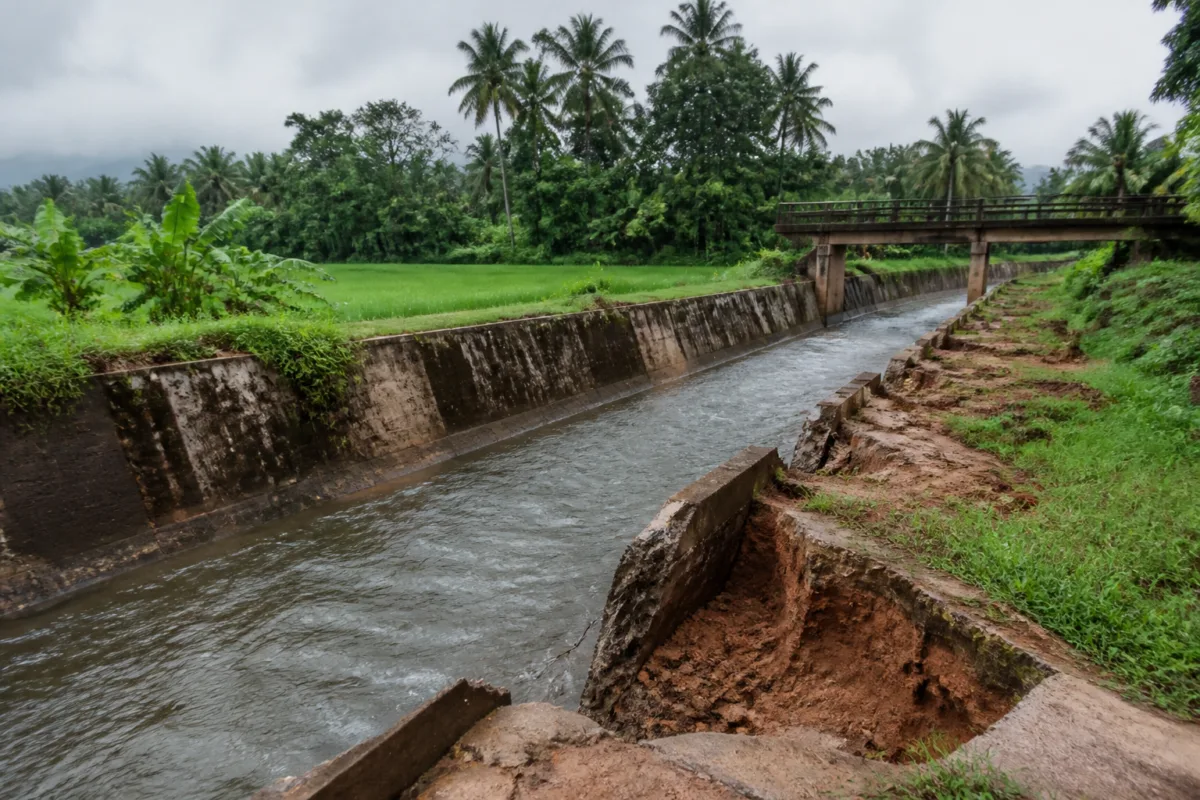
The deteriorating canals of the Chalakudy River Diversion Scheme are exposing a wider weakness in how long-lived water infrastructure is maintained. The scheme, commissioned in 1957, now has a 175-kilometre network of left-bank main and branch canals in which ageing structures, damaged canal walls, soil erosion and overflow are affecting water delivery, especially in tail-end areas.
The condition of the network was discussed at a meeting convened by water resources department officials at the Chalakudy Inspection Bungalow to consider water distribution for 2026-27. Representatives of three-tier local governments and farmer organisations asked the government to take steps for the complete renovation of the canals. The meeting was chaired by T.M. Varghese, vice-president of the Angamaly block panchayat and a member of the irrigation project advisory committee.
The report by Mathrubhumi – Kochi places the immediate problem in the physical deterioration of the system. Several canal sections have reportedly broken down because of age, causing the hydraulic design of the channels to be compromised. As a result, water often fails to reach the ends of the canal network. This is not simply a question of reduced flow in one stretch. A canal network depends on the functioning of its connected sections, and damage in the main canal, branch canals, control structures or embankments can affect distribution farther downstream.
The scheme’s age is therefore central to the current problem. A system commissioned nearly seven decades ago cannot be assessed only by whether water continues to enter the network. Its carrying capacity, structural stability and ability to regulate flows must also be preserved. The report does not provide the original design capacity, the present carrying capacity, or the investment made in maintenance over the years. It does, however, indicate that the designed hydraulic condition has been lost in several places.
That distinction matters for public administration. Routine repairs may address isolated breaches or visible damage, but the concerns raised at the meeting point to a network-level requirement. The demand is for complete renovation of the left-bank main canal and its associated branches, rather than a limited response to individual failures. The report also records a demand from farmers to raise canal walls and strengthen the inner surfaces with cement at vulnerable locations.
The physical risks are distributed across the network. Canal walls have weakened at various points, soil has eroded from their sides, and water has reportedly overflowed from the canals. A water-carrying overbridge in Thuravoor gram panchayat was described as being in a dangerous condition. These locations illustrate how irrigation infrastructure can become both a supply asset and a safety concern when structural maintenance is delayed. The supplied report does not identify the exact number of damaged locations or state whether any section has been formally closed because of safety risks.
The effect on farmers is most visible at the tail ends of the system. The report says that water frequently fails to reach these areas, while overall water availability is declining. This combination creates an unequal distribution problem: users closer to the source or better-served sections may continue to receive water while downstream areas face greater uncertainty. The report does not quantify the area under cultivation, the number of farmers affected or the economic value of the crops dependent on the scheme. Those missing figures would be necessary to measure the full agricultural impact.
The scheme also operates within an inter-state water framework. The report refers to the Parambikulam-Aliyar inter-state river agreement and says authorities must ensure that the water due to the Chalakudy River under the agreement is received every year. This introduces a second layer of responsibility. Canal rehabilitation can improve the delivery system, but it cannot by itself resolve a shortage at the source. Conversely, ensuring source availability will not guarantee equitable distribution if the downstream canal network remains damaged.
The institutional structure visible in the meeting reflects this shared responsibility. Water resources department officials, block and gram panchayat representatives, farmers’ organisations and project advisory committee members participated in the discussion. Executive Engineer A. Jisha and Assistant Executive Engineer V.G. Nirmal represented the department, while local representatives from Koratty, Thuravoor, Manjapra, Meloor, Mookkannur, Kalady, Kadukutty and Annamanada were listed among the participants. The involvement of several local bodies indicates that the network crosses administrative boundaries and cannot be managed by one panchayat alone.
That distributed geography can make infrastructure renewal more difficult. A main canal and its branches may pass through several local jurisdictions, while technical decisions, funding and execution remain with the responsible irrigation authority. Local governments and farmers can identify breaches and delivery failures, but the rehabilitation of hydraulic structures requires coordinated design, approvals and construction. The report records the demand for action but does not state whether a detailed project report, cost estimate, funding plan or execution schedule has been prepared.
The 2026-27 water-distribution meeting is therefore important less as an isolated administrative event than as a point at which the system’s accumulated maintenance burden has become difficult to ignore. The meeting connects annual water planning with the long-term condition of the infrastructure that must carry that water. If distribution decisions are made without resolving structural weaknesses, the network may continue to produce uneven results even when water is available.
The available evidence also shows the limits of treating water supply as a source-only issue. The inter-state agreement determines an important part of the water-availability question, but the final service experienced by farmers depends on the condition of canals, walls, crossings and hydraulic structures. In a 175-kilometre network, the reliability of delivery is shaped by the weakest or most vulnerable sections. The report does not establish whether the current shortfall is caused mainly by inadequate inflow, physical losses, operational decisions or a combination of these factors. A full assessment would need to separate those causes.
For the same reason, canal renovation should be understood as an infrastructure governance task rather than only a civil works demand. It involves asset mapping, condition assessment, prioritisation of dangerous sections, protection against soil erosion, restoration of hydraulic design and arrangements for future maintenance. None of these processes is described in detail in the supplied report, so it would be premature to claim that a renovation programme has been approved or funded.
The immediate public-interest question is whether the authorities will convert the concerns raised by local representatives and farmers into a time-bound technical and administrative response. The next steps would need to clarify the condition of the 175-kilometre network, identify priority structures, establish how water availability under the inter-state agreement will be monitored, and explain how the 2026-27 distribution plan will account for damaged sections. The report confirms that the demand for complete renovation has been placed before the government. It does not yet confirm a sanctioned project, a budget or an implementation timeline.

