


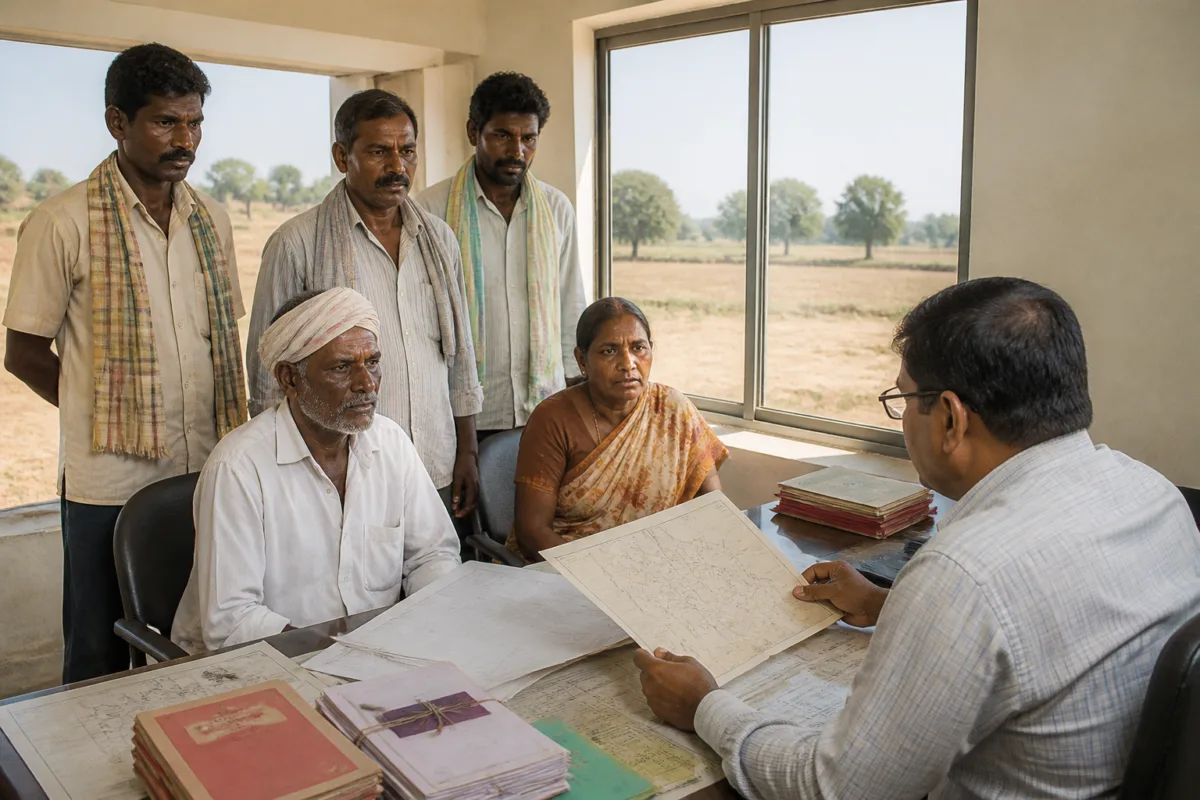
Telangana’s land rights drive has issued more than 12.40 lakh pattadar passbooks in 34 months, according to Revenue Minister Ponguleti Srinivas Reddy. The scale of the exercise, carried out alongside resurveys and the implementation of the Bhu Bharati Act, shows that the state is treating land records not merely as a revenue-administration issue but as the foundation for ownership, credit access and welfare delivery.
The minister said the government was undertaking a comprehensive overhaul of revenue administration to provide transparent services, secure legal land rights for farmers and address long-pending land disputes. He made the remarks at a review meeting with senior revenue officials at the secretariat, where he assessed the implementation of the Bhu Bharati Act, the distribution of pattadar passbooks, statewide resurveys and the handling of land-related grievances.
The central administrative challenge is clear from the programme’s stated objective: identifying people who have cultivated land for decades but do not have formal recognition in official records. Cultivation and recorded ownership do not always move together. When that gap persists, a farmer’s relationship with land may remain vulnerable even if the land has been worked over a long period. The government’s approach is to use resurveys to identify eligible cultivators and issue formal titles, the minister said.
The figures cited by the minister indicate two phases of implementation. More than 12.40 lakh pattadar passbooks have been issued during the past 34 months, including 5.68 lakh after the Bhu Bharati Act came into force on April 14, 2025. The government has described the legislation as an attempt to make Telangana free from land disputes. The supplied report does not establish how many disputes remain unresolved, how many applications are pending or how the performance of individual districts compares.
The passbook is significant because land records can determine whether a cultivator is able to approach formal institutions. According to the minister, legal recognition would help farmers access bank loans, Rythu Bharosa and other government welfare benefits. That makes the revenue department an important link between property administration and rural economic support. A correction or update in a land record can therefore influence access to services beyond the record itself.
The state’s examples also show how the exercise is being organised at the local level. In Narayanapuram revenue village in Kesamudram mandal of Mahabubabad district, 906 tribal and non-tribal farmers were granted land rights covering more than 1,600 acres. In 15 villages across Nutankal and Maddirala mandals of Suryapet district, resurveys resulted in land titles for 2,400 farmers covering 3,450 acres.
Together, these examples cover different administrative settings and beneficiary groups, but they do not by themselves establish the programme’s statewide impact. They do show the operational character of the initiative: land rights are being processed through village-level surveys, mandal administration and the formal issue of ownership documents. The success of the larger reform will depend on whether the same process can be applied consistently across regions and whether newly issued records remain accurate when land is transferred, inherited or disputed.
The review meeting covered progress in several other areas, including Mulkapalli mandal in Mulugu district; Palwancha, Aswaraopeta and Dammapeta mandals in Bhadradri Kothagudem district; and Sathupalli mandal in Khammam district. The minister directed officials to replicate the exercises in other regions and ensure that eligible beneficiaries receive their titles without further delay.
This places the field administration at the centre of the reform. A law can define rights and a department can set targets, but the final outcome depends on surveys, document verification, grievance handling and the delivery of records to individual farmers. The minister stressed that government decisions would benefit people only when they reached the grassroots efficiently. His instruction for faster, transparent and citizen-friendly services reflects the implementation burden that follows a statewide land-records programme.
The Bhu Bharati Act also changes the way the state frames land disputes. Rather than treating each dispute as an isolated case, the government is linking dispute resolution to the quality and completeness of land records. The available report does not provide details of the Act’s adjudication process, appeal mechanisms or institutional responsibilities. It does, however, show that the state is combining legislation with resurveys and passbook distribution instead of relying on a document-based process alone.
The numbers reveal both the reach of the initiative and the size of the administrative task. The 12.40 lakh passbooks issued over 34 months represent a large volume of individual land-record transactions. The 5.68 lakh issued after April 14, 2025 account for a substantial share of the total cited by the minister, although the supplied information does not specify how many of the earlier passbooks were issued through the same resurvey process or how many cases involved newly recognised ownership.
The district-level examples provide a more concrete measure of the work. In Narayanapuram, 906 farmers received rights over more than 1,600 acres, while the Suryapet exercise covered 2,400 farmers and 3,450 acres across 15 villages. On a simple average basis, the first exercise covered more than 1.7 acres per farmer and the second about 1.4 acres per farmer. These averages describe the reported cases but do not indicate the distribution of land among individual beneficiaries or establish a typical holding size across Telangana.
The larger urban and regional planning question is how secure land records affect the relationship between rural land administration and the wider built environment. Clear ownership records can influence the ability to borrow, invest in land and participate in government programmes. Unresolved or inaccurate records can create uncertainty for families, lenders and public agencies. The report does not quantify these downstream effects, but the government’s stated focus on loans and welfare access identifies them as central objectives.
The initiative also raises an institutional question about accountability. If a resurvey grants formal rights, the system must provide a reliable way to correct errors and resolve objections. If a passbook is issued but the underlying record remains contested, documentation alone may not end the dispute. The minister’s review of grievances indicates that complaint resolution is being treated as part of the reform, although no figures on grievance disposal or pending cases were provided.
What the evidence confirms is that Telangana is pursuing a large-scale land-records intervention built around the Bhu Bharati Act, resurveys and the issue of pattadar passbooks. It has reported more than 12.40 lakh passbooks in 34 months and cited specific outcomes in Mahabubabad and Suryapet districts. What remains unclear from the available material is the number of unresolved disputes, the consistency of implementation across districts and the safeguards available when records are challenged. The next significant measure of the programme will be whether the reviewed mandals and other regions receive the same combination of formal recognition, grievance resolution and field-level service delivery.

