


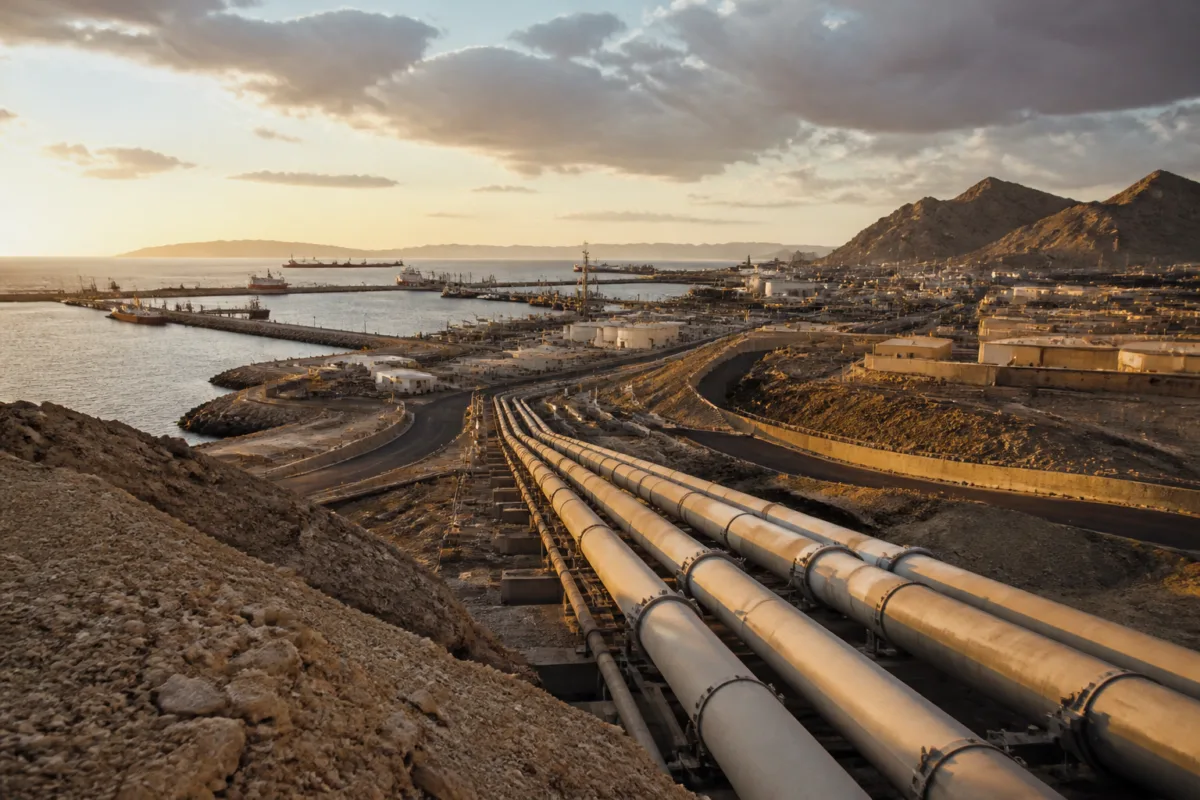
The Strait of Hormuz has long functioned as a critical gateway for Gulf energy exports, but the Middle East conflict is forcing governments and investors to reconsider how much of the region’s economic system depends on one maritime route. The emerging response is not simply a search for another shipping lane. It is a possible reconfiguration of pipelines, ports and logistics corridors designed to keep energy moving when the strait becomes vulnerable to disruption.
HSBC group chief executive Georges Elhedery said the Gulf could invest in alternative logistics corridors and energy pipelines over the next five years. Speaking at the HSBC Future Forum in Dubai, he said the region would be able to recover and continue growing, but would need substantial investment. He also said Hormuz could become “redundant” in five years, although the report does not establish that a complete replacement of the waterway is technically or economically assured.
The immediate significance of the proposal is institutional. Energy security is usually discussed in terms of production volumes, reserves and global prices. The Gulf’s current challenge is also about the physical network that links production centres to export markets. A pipeline connecting an inland or coastal production area to a port can reduce reliance on a particular maritime passage, but it does not eliminate the need for ports, storage, processing facilities, security systems and dependable international shipping connections.
That makes the proposed shift an infrastructure question as much as an energy question. The region’s response would require coordination between national governments, energy producers, pipeline operators, port authorities, construction companies, banks and international investors. It would also involve decisions about which routes are commercially viable, which projects receive public support and how much spare capacity is worth building to manage future disruptions.
### The infrastructure pipeline behind the shift
The scale of the region’s planned construction activity provides a potential financing base for that transition. An HSBC report published on Monday, citing data from Dubai-based construction industry market intelligence platform MEED, identified $872 billion in individual project packages across the Middle East, North Africa and Turkey. These projects form part of a wider $1.4 trillion pipeline of infrastructure projects that have been planned but not yet awarded.
The distinction between planned, packaged and awarded projects is important. A project pipeline is not the same as completed infrastructure or even a signed construction contract. The figures indicate the volume of potential work available to governments, developers, contractors and lenders, but they do not establish how much will ultimately be built, when construction will begin or whether every project is related to bypassing Hormuz.
The pipeline nevertheless shows why the Gulf’s energy-security response could extend beyond emergency measures. If governments direct a portion of planned investment towards pipelines, ports and alternative logistics corridors, the conflict could accelerate a reordering of infrastructure priorities. Projects that were previously justified as economic diversification or trade expansion could acquire a second role as strategic redundancy.
Redundancy is expensive because it requires capacity that may remain underused during normal conditions. A route built only for crisis periods may not generate sufficient commercial returns without public funding, long-term contracts or state-backed guarantees. The source material does not provide project-level costs, proposed routes or financing structures, so it is not possible to determine whether the infrastructure pipeline can deliver a full substitute for the strait. It does show, however, that the region already has a substantial pool of planned investment from which such priorities could be selected.
### Why a maritime chokepoint becomes a city and construction issue
The Strait of Hormuz is often presented as a geopolitical chokepoint, but its vulnerability has consequences across the built environment. Energy corridors terminate in physical places: ports, industrial zones, storage terminals, refineries and distribution networks. New or expanded routes can change where warehouses, processing facilities, worker housing, roads and utilities are required.
That means a decision taken at the level of energy policy can reshape urban growth around export gateways. Ports that receive greater investment may need additional road and rail connections, larger storage areas and more industrial land. Construction activity can move towards new corridors, while older logistics centres may face a different role if energy flows are redirected. The supplied report does not identify the locations or designs of these future projects, but the institutional chain is clear: energy diversification would require a corresponding expansion or adaptation of urban infrastructure.
The same logic applies to risk. A single maritime route concentrates exposure, while a network of pipelines and ports distributes it. But distributed infrastructure creates more points that must be maintained and protected. The system becomes less dependent on one waterway while becoming more dependent on the performance of several interconnected assets. For planners and public authorities, the question is therefore not whether one route can be replaced in isolation, but whether the full logistics system can operate reliably across multiple corridors.
This is where the Gulf’s investment model becomes significant. Large infrastructure programmes can be delivered quickly when public authorities, state-linked companies and financial institutions align around a strategic objective. Yet the report provides no evidence on how individual Gulf states would divide responsibilities, whether projects would be nationally controlled or regionally coordinated, or how cross-border connections would be governed. Those unanswered questions will determine whether the proposed escape routes function as a connected system or remain separate national assets.
### Investment remains available, but the regional outlook has weakened
The infrastructure opportunity exists alongside a more difficult economic environment. An HSBC survey of more than 1,600 business leaders and around 820 global institutional investors found that respondents continued to view the Gulf as an attractive investment destination despite the conflict. That suggests investor interest has not disappeared, even as the conflict has increased the importance of security and resilience.
At the same time, the report says the economic outlook for the wider Middle East, North Africa and Pakistan region has weakened. After growth of 3.3% in 2025, the region is expected to contract by 1.3% this year, according to a World Bank forecast issued the previous week. The forecast anticipates a strong but uneven recovery in 2027.
This combination creates a difficult infrastructure financing environment. Governments may want to accelerate strategic projects precisely when conflict is damaging growth and public finances. Investors may continue to find the Gulf attractive, but their willingness to fund major corridors will depend on the visibility of demand, the security of assets and the terms offered by governments and energy companies. The source does not provide details of those terms, so the balance between public expenditure and private capital remains unclear.
The postponement of Saudi Arabia’s flagship investment conference until 2027 adds another sign of how conflict is affecting the region’s investment calendar. The event was postponed following deadly strikes in Riyadh by Yemen’s Iran-backed Houthis. The delay does not by itself indicate that infrastructure investment will stop, but it illustrates how security conditions can disrupt the institutions and gatherings through which projects are promoted, financed and negotiated.
### The policy challenge is coordination, not only construction
A new pipeline or port cannot secure energy flows on its own. It must be integrated into production schedules, export contracts, storage capacity, customs systems and shipping operations. The route must also connect to markets that can receive the energy at competitive cost. That creates a policy challenge extending across energy, transport, industrial planning and national security.
The reported five-year horizon also raises questions about sequencing. Governments would need to identify which projects can be delivered rapidly, which require long construction periods and which depend on agreements across borders. They would also need to decide whether to prioritise oil, liquefied natural gas or broader logistics capacity. The source confirms that pipelines and alternative corridors are being considered, but does not specify the technologies, routes or commodities that would receive priority.
For construction and infrastructure markets, the difference between a strategic announcement and an awarded project is decisive. The $1.4 trillion pipeline creates a large opportunity set, but the report does not say how much of it will be redirected towards Hormuz resilience. Contractors and lenders will ultimately respond to tenders, contracts, guarantees and approvals rather than to the size of the unawarded pipeline alone.
The central urban question is therefore one of conversion: can a broad infrastructure pipeline be converted into a coordinated resilience network? If it can, the Gulf may reduce the consequences of a disruption at one maritime gateway while creating new growth nodes around ports, pipelines and logistics corridors. If it cannot, investment may produce isolated assets without delivering the system-wide redundancy that energy security requires.
The evidence currently confirms a change in strategic thinking rather than a completed infrastructure shift. The conflict has exposed the risks of dependence on Hormuz, HSBC has identified substantial investment needs, and regional investors continue to see the Gulf as attractive despite a weaker economic outlook. What remains uncertain is which projects will be awarded, how they will be financed and whether separate national initiatives can operate as an integrated alternative network. Those are the milestones that will show whether the Gulf is genuinely moving beyond the strait or simply preparing for a more resilient relationship with it.

