


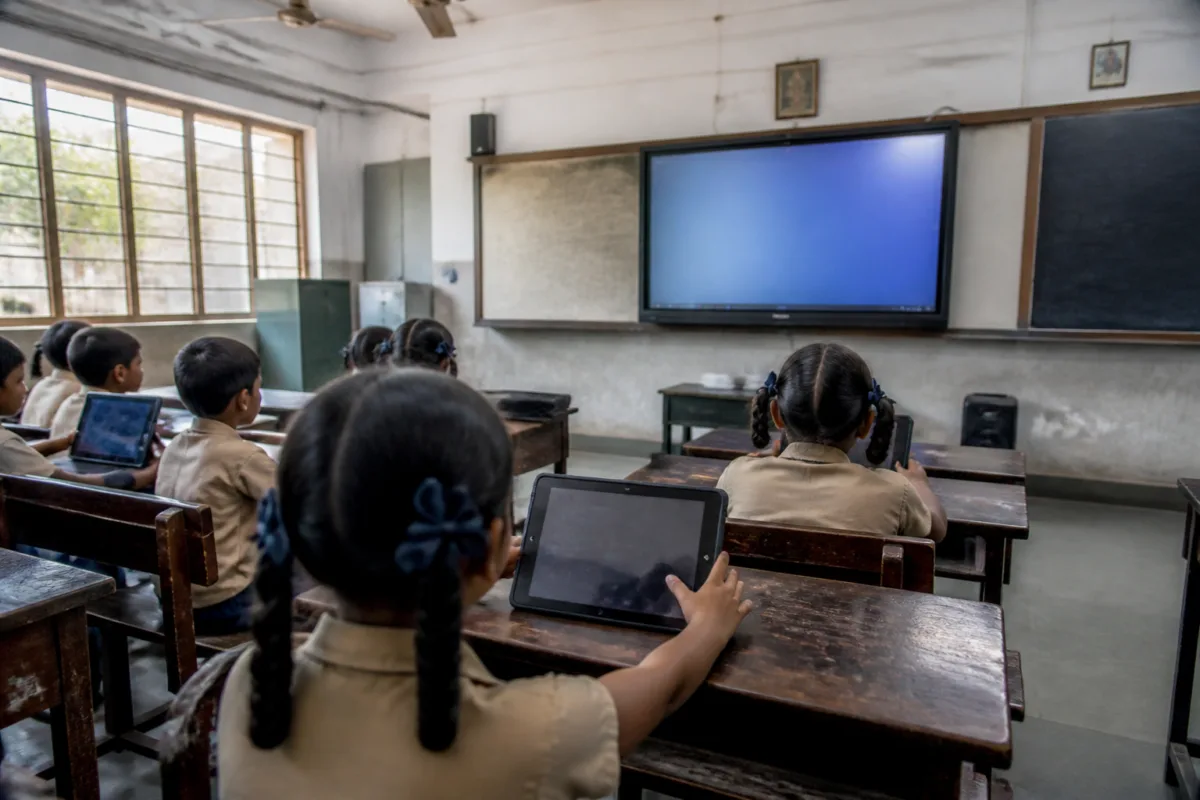
Allegations over the procurement of digital learning equipment for Mumbai’s civic schools have placed the Brihanmumbai Municipal Corporation’s education department under scrutiny, with Mumbai BJP president and MLA Ameet Satam seeking a review of the process. The claims remain unverified in the material available for this report, and the supplied account does not include a response from the BMC administration, the mayor, vendors or any procurement authority.
Satam has written to Mayor Ritu Tawde and municipal commissioner Ashwini Bhide, alleging that an internal nexus within the civic education department influenced the purchase of tablets and interactive learning panels for municipal schools. He said providing digital equipment to students was a welcome initiative, but claimed that some of the products supplied were from lesser-known companies and had generated complaints about quality.
The allegation raises a question that extends beyond the choice of brands: how the civic administration evaluates technology purchased for public schools, and whether the procurement system can demonstrate value, quality and accountability to the students and families who depend on municipal education. The supplied report, however, does not provide the tender documents, technical specifications, comparative price statements, inspection reports or complaint records needed to assess those questions independently.
### What has been alleged
According to the account published by Times of India – Mumbai, Satam alleged that certain companies supplying tablets and interactive panels appeared to be “dubious” and were part of a nexus supplying low-quality equipment to the BMC at high prices. The wording is an allegation by Satam and has not been established as fact in the supplied material.
Satam further claimed that a preliminary comparison of market prices suggested tablets from reputed brands were available at prices similar to the corporation’s expenditure on lesser-known products. The report does not identify the models compared, the quantities purchased, the procurement prices, the technical specifications or the methodology used for the comparison. Without those details, it is not possible to determine whether products with different warranties, software, maintenance arrangements, specifications or institutional features were being compared on an equivalent basis.
He also alleged that the equipment supplied by existing vendors appeared to be tailor-made for civic procurement. That claim could refer to customised technical requirements, procurement specifications or vendor-specific product features, but the supplied material does not clarify which tender conditions or technical clauses formed the basis of the allegation.
The report repeats an allegation that certain individuals exercised undue influence over the BMC’s education department. Satam also claimed that these individuals had played a role in drafting the policy for public-private partnerships involving school plots, a policy that has since been cancelled. The supplied material does not name those individuals, establish their role in procurement or policy drafting, or provide documents linking the cancelled policy to the equipment purchases.
### Why procurement design matters
Digital learning equipment is not a one-time purchase in the same way as a conventional classroom item. Tablets and interactive panels require functioning hardware, software compatibility, connectivity, training, repairs, replacement parts and technical support. For a large municipal school system, the value of a procurement contract therefore depends not only on the unit price but also on whether the equipment can remain operational after installation.
The allegation reported by Times of India – Mumbai focuses on reputed manufacturers, after-sales service and production in India. Satam has urged the civic administration to source equipment from globally reputed manufacturers that also manufacture their products in India, citing the Centre’s Make in India initiative. The report does not state whether the existing procurement specifications permitted only particular brands, whether brand-neutral criteria were used, or whether domestic manufacturing and service capacity were included as evaluation requirements.
These details are central to understanding whether the procurement process produced value for public money. A lower-priced device may not be comparable with a branded product if the two differ in screen size, processing capacity, durability, warranty period, software, security features, classroom integration or maintenance support. Conversely, a recognised brand name alone cannot establish that a product is suitable for municipal schools or that it was procured at a reasonable price. A defensible assessment requires the underlying records.
### The missing public record
The supplied report does not include the BMC tender notice, bid documents, technical evaluation, financial bids, purchase orders, inspection certificates or contract terms. It also does not provide the total number of tablets or panels procured, the total value of the contracts, the names of the selected vendors, the number of schools covered or the number of students intended to benefit.
Those figures would establish the scale of the issue. They would also help distinguish between a limited procurement dispute and a system-wide technology programme affecting a substantial portion of Mumbai’s civic schools. The absence of these details means the public significance of the alleged pricing and quality concerns cannot yet be quantified from the supplied evidence.
The report also does not state how many complaints were received, who made them, when the equipment was installed, how many devices were functioning, or whether the BMC conducted any technical or financial review. These are important distinctions. Complaints about product quality may concern isolated defects, widespread failure, inadequate maintenance or a mismatch between equipment and classroom needs. Each possibility would require different evidence and administrative action.
### Institutional accountability
The mayor and municipal commissioner have been identified as recipients of Satam’s letters. The supplied material does not record whether either office acknowledged the complaint, ordered an inquiry, paused procurement or directed the education department to review existing contracts. It also does not include a response from the BMC rejecting, accepting or examining the allegations.
That missing response is significant because the civic administration controls the relevant procurement and implementation records. It can establish which procurement method was used, what eligibility criteria vendors had to meet, how technical compliance was assessed and whether post-delivery inspections were conducted. It can also clarify whether the equipment was purchased centrally, supplied through multiple contracts or acquired as part of a broader digital education programme.
A review would need to examine more than the brand names of the devices. It would need to compare contracted specifications with delivered equipment, assess warranty and maintenance obligations, verify delivery and installation records, and determine whether payments were linked to acceptance tests or operational performance. None of those findings is available in the supplied material.
### The larger urban education question
Mumbai’s municipal schools serve as part of the city’s public education infrastructure. When digital equipment is procured for those schools, the immediate issue is not only whether devices are present in classrooms but whether they are usable, maintained and integrated into teaching. Technology that is unavailable, incompatible or unsupported can add equipment to a school without reliably improving learning access.
At the same time, the supplied material does not provide evidence on educational outcomes, student usage, teacher training or classroom performance. It would therefore be premature to conclude that the reported procurement concerns have affected learning outcomes. The available evidence supports reporting the allegation and the request for a review, not a finding that the equipment is defective or that public funds were misused.
The case also illustrates the importance of transparency in municipal technology procurement. Clear tenders, measurable technical standards, published contract information, vendor accountability and accessible complaint mechanisms allow citizens to evaluate whether public purchases meet their intended purpose. Without these records, public debate is forced to rely on competing assertions rather than verifiable evidence.
The immediate record confirms that Ameet Satam has alleged procurement irregularities and requested that the BMC review its process and consider reputed manufacturers with production in India. It does not confirm the alleged nexus, the pricing claims, the quality complaints or the involvement of unnamed individuals in procurement or policy drafting. The next material developments would be a formal BMC response, publication or examination of the relevant procurement documents, and any findings from an administrative, technical or financial review.

