


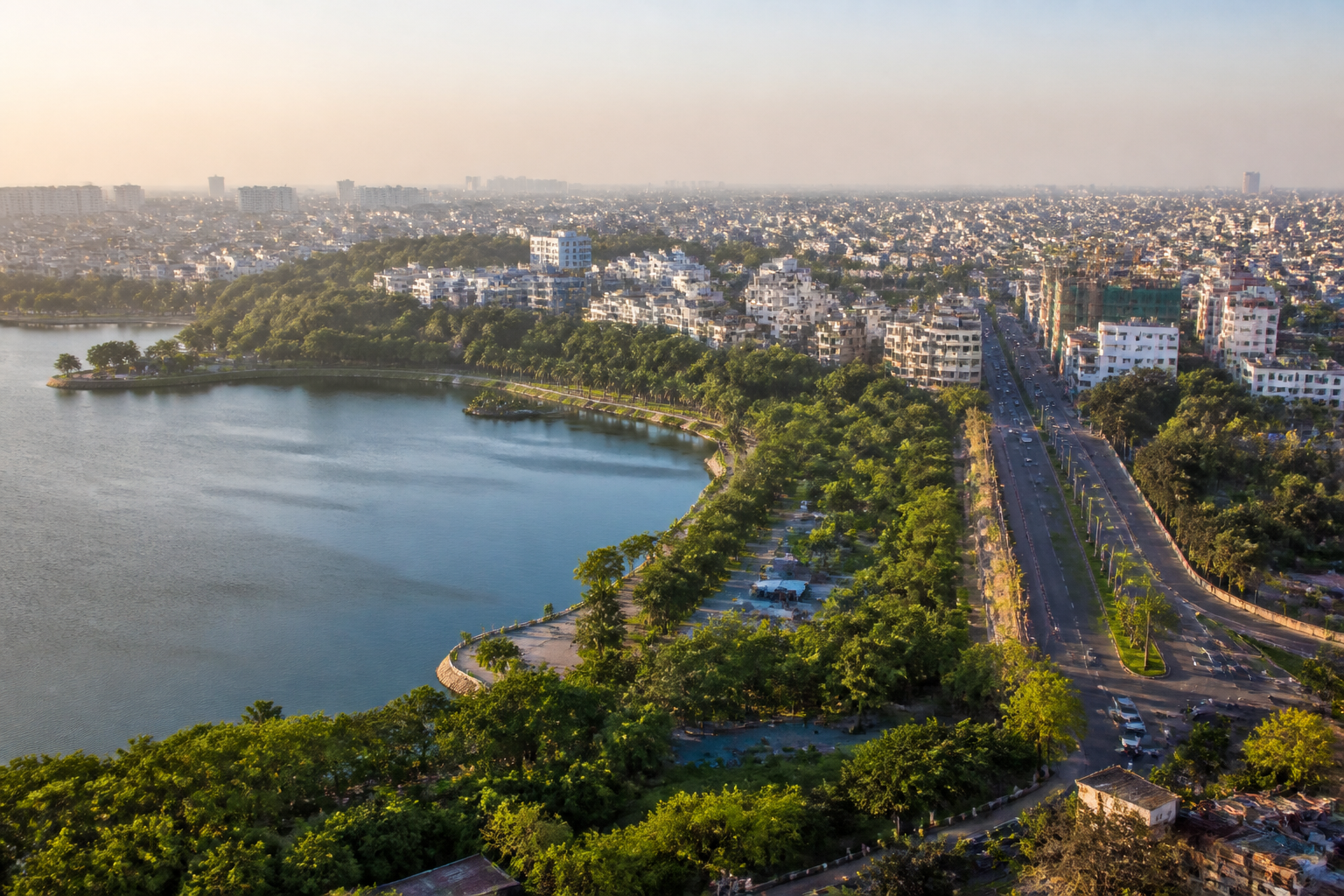
The release of the draft Bhopal Development Plan-2047 places the city’s most difficult urban question at the centre of its next phase of growth: how can Bhopal expand while protecting the lakes, forests and other natural assets that define it? The plan, announced by Chief Minister Mohan Yadav, proposes a framework built around conservation, improved mobility, mixed land use, green areas, connectivity and transit-oriented development. Its importance will ultimately depend on how these broad objectives are translated into land-use decisions and enforcement on the ground.
The draft arrives after a long interval and at a moment when Bhopal’s existing development rules are under renewed scrutiny. The Bhopal Municipal Corporation is acting against commercial activities allegedly operating from properties classified for residential use. At the same time, the Supreme Court has clarified that the legality of individual properties and constructions must be assessed under the existing master plan and applicable building bye-laws, pending further proceedings on the new plan. This creates a direct link between the plan’s release and the city’s immediate governance challenge: the transition to a new planning framework cannot erase the rules that apply today.
The announcement therefore represents more than the publication of a long-term blueprint. It begins a process in which the state government, planning authorities, the municipal corporation, property owners and developers will have to interpret the relationship between existing permissions and future land-use intentions. The supplied details do not establish the full legal status, approval schedule, zoning maps or implementation timetable of the draft. Those elements will be important in determining how much change the plan can deliver.
According to the chief minister’s announcement on X, the proposed plan seeks to balance urban expansion with the conservation of Bhopal’s natural heritage. Bhojtal, forest areas and tiger safari zones are specifically identified for protection. The emphasis matters because conservation in a growing city is not limited to creating isolated green spaces. It also involves controlling the development pressures around ecologically sensitive areas and ensuring that land-use decisions do not gradually undermine the assets the plan intends to protect.
Bhojtal gives this issue a particularly visible urban dimension. The lake is both a natural feature and part of Bhopal’s civic identity. The plan’s stated focus on protecting it indicates that the future growth of the city is being considered alongside the environmental systems within and around the urban area. However, the announcement does not provide the proposed boundaries, permitted activities, buffer provisions or enforcement mechanisms that would show how this protection is expected to work. Those details will determine whether conservation remains a stated objective or becomes an operational planning rule.
The same question applies to forest areas and tiger safari zones. Their inclusion signals an attempt to place ecological constraints within the city’s development framework rather than treating them as matters separate from urban planning. Yet a plan can protect an area on paper only if land-use classifications, building permissions, infrastructure alignments and monitoring responsibilities are clearly defined. The available source does not specify which authority will administer each measure or how conflicts between development proposals and conservation zones will be resolved.
One of the most notable proposals is Green Transferable Development Rights, or Green TDR. Under the mechanism described in the announcement, landowners whose properties fall within designated green zones could receive development rights as compensation. These rights could then be transferred to developers for additional development, subject to applicable regulations. In principle, this approach attempts to address a recurring planning problem: conserving land can impose a financial cost on owners when development is restricted, while cities still need a way to protect environmentally important areas.
Green TDR could provide a compensation route without requiring every protected parcel to be acquired outright. It could also shift development potential from areas where construction is restricted to locations where additional development is permitted. But the success of such a mechanism would depend on details that have not been provided in the announcement. These include the method for calculating development rights, the zones where receiving additional rights would be allowed, the authority responsible for issuing and tracking them, and the safeguards needed to prevent pressure from accumulating in already congested areas.
The proposal also raises a question about who benefits and who bears the cost of conservation. Landowners in designated green zones may receive an economic asset in the form of transferable rights, while developers may gain additional development capacity elsewhere. The city, in return, may retain ecologically significant land. Whether that exchange is fair and workable will depend on transparent valuation, clear zoning and enforceable limits. The draft’s detailed provisions, which are not included in the supplied material, will be central to assessing that balance.
Mixed land use is another important component of the proposed plan. Bhopal Municipal Corporation’s current action against commercial activity in residential spaces shows why land-use classification has become a live public issue. Mixed-use planning can allow homes, shops and services to operate in closer proximity when streets, parking, access, fire safety and civic infrastructure are designed to support that combination. But it also requires precision. A broad mixed-use designation without clear conditions can create uncertainty for residents, businesses and enforcement agencies.
The contrast between the proposed mixed-land-use approach and current enforcement activity is not necessarily a contradiction. It may indicate that the city is moving towards a more deliberate framework for deciding where commercial activity is appropriate, rather than allowing land-use changes to occur informally. Until the draft’s maps and regulations are available, however, it is not possible to determine which areas may be opened to mixed use or how existing properties will be treated.
Mobility and transit-oriented development are also included in the plan’s stated objectives. This suggests that Bhopal’s future growth is being linked to transport connectivity and the location of new development. Transit-oriented planning generally seeks to concentrate suitable activities and higher development intensity around public transport corridors, reducing the need for long trips and improving access to services. The source does not identify specific corridors, modes, station areas, density standards or investment commitments under the draft plan.
That absence is significant because mobility objectives cannot be separated from land-use decisions. New roads, transit links and civic facilities can influence land values and development patterns, while unplanned expansion can make public transport more difficult and expensive to provide. A development plan must therefore connect its proposed land-use structure to the infrastructure capacity required to support it. The announcement establishes the direction but does not yet provide the evidence needed to evaluate whether the proposed network and development pattern are aligned.
The plan’s reference to better civic facilities and economic opportunities places municipal capacity alongside physical growth. Urban expansion requires more than allocating land for construction. It also requires water, roads, waste management, public transport, drainage and other services to reach new and existing neighbourhoods. No service-capacity figures, projected population estimates, infrastructure budgets or phasing details are included in the supplied report. Without those figures, the practical scale of the plan’s ambitions remains unclear.
The institutional setting will be equally important. The chief minister announced the draft, while Bhopal Municipal Corporation is responsible for municipal enforcement in the current land-use dispute. The Supreme Court’s observation adds a judicial dimension by keeping attention on the existing master plan and building bye-laws while proceedings on the new plan continue. This means the plan will operate within a layered governance system involving state-level planning decisions, municipal administration, development permissions and judicial scrutiny.
That layering can create accountability, but it can also produce uncertainty if responsibilities are not clearly assigned. Residents and property owners need to know which rules apply to their land, while planning and enforcement agencies need a consistent basis for approvals and action. Developers also require certainty about development rights, land-use changes and infrastructure obligations. The transition from the existing framework to Development Plan-2047 will therefore be judged not only by its vision but by the clarity of its procedures.
The announcement confirms several directions: Bhopal intends to protect Bhojtal, forest areas and tiger safari zones; it is considering Green TDR as a conservation-linked compensation mechanism; it wants to incorporate mixed land use, green areas, connectivity and transit-oriented development; and it presents the plan as a framework for balancing expansion with natural heritage. It does not yet establish the plan’s final provisions, legal effect, implementation schedule, financing arrangements or measurable targets.
Those unresolved details are the real test ahead. Bhopal’s planning challenge is not simply to accommodate more development, but to decide where development can occur, what infrastructure must precede it, how ecological restrictions will be enforced and how existing land-use conflicts will be handled. The next stage will require scrutiny of the draft’s maps, regulations, public consultation process and approval pathway. Until those materials are available, the release should be understood as the opening of a planning process rather than the completion of Bhopal’s urban blueprint.
