


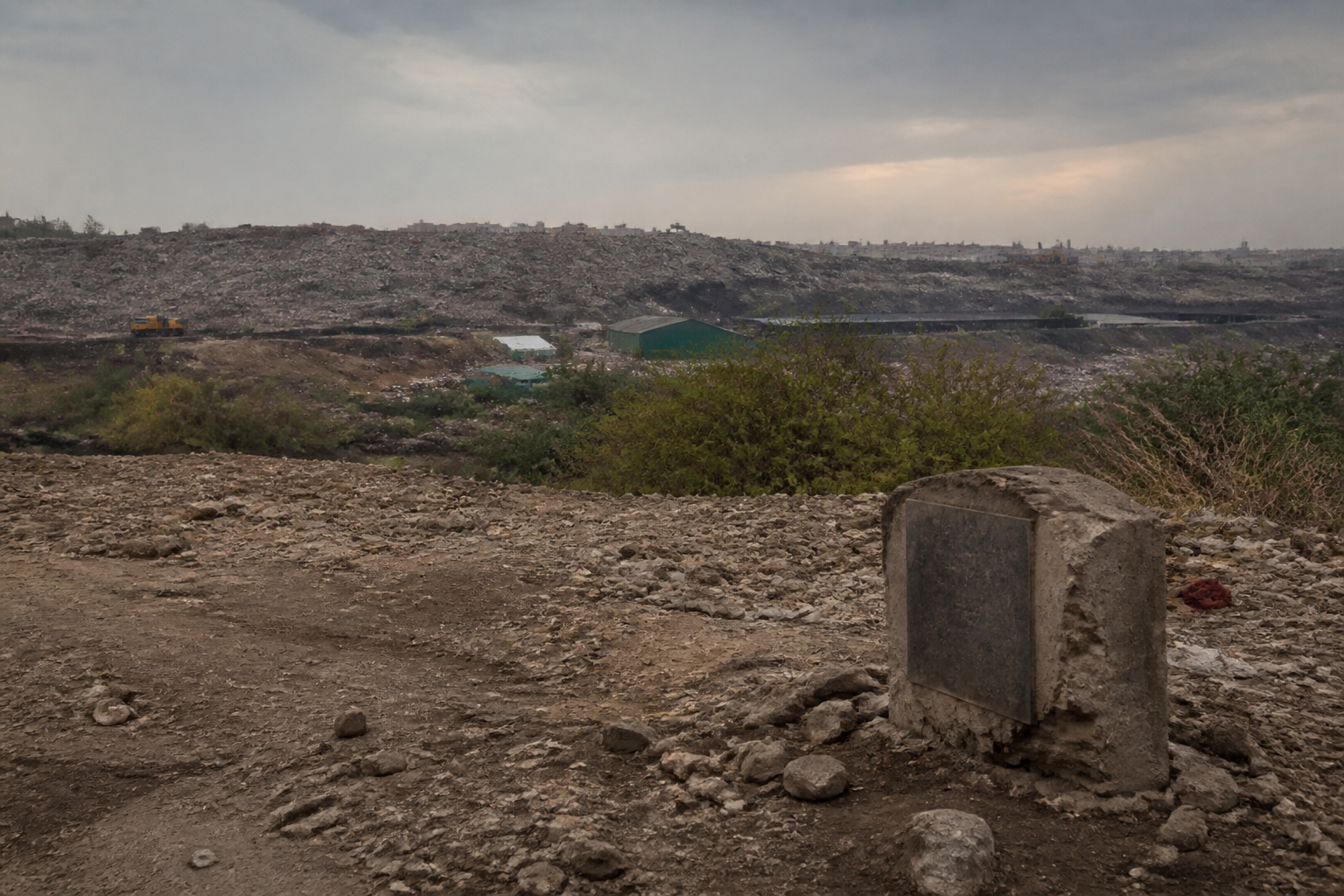
The disappearance of Delhi’s Bhalswa bamboo park is more than the reversal of a plantation drive. It exposes the difficult gap between announcing a green use for reclaimed landfill land and making that land ecologically and operationally suitable for one. The Municipal Corporation of Delhi has repurposed the five-acre site for inert-waste dumping and processing after more than 4,000 bamboo saplings failed to survive, according to officials cited by the Times of India.
The site was created on land flattened after waste was removed from part of the Bhalswa landfill. In March 2025, the MCD planted over 4,000 bamboo saplings there, with a broader plan to plant around 54,000 saplings across the initiative. The plantation was launched in the presence of Delhi chief minister Rekha Gupta and then lieutenant governor VK Saxena, who presented it as a step towards a cleaner, greener and more liveable city.
The site’s current condition shows how quickly a high-visibility urban greening project can lose its intended use when the underlying land remains unstable or unsuitable. The Times of India found the area largely barren, with wild bushes around the inauguration stone, while other portions were vacant or covered with heaps of inert waste. The physical landscape now reflects two competing municipal priorities: reclaiming former landfill space for environmental improvement and retaining that space for the continuing management of Delhi’s waste.
MCD officials said the plantation was maintained for more than a year after the March 2025 drive. The saplings were watered and monitored, and a replantation exercise was attempted after many plants failed. That effort also did not succeed. Officials attributed the failure to leachate, the contaminated liquid present at the base of the flattened landfill, which prevented the bamboo from growing.
The explanation is important because it shifts the issue away from the simple question of whether enough saplings were planted or watered. A reclaimed landfill is not automatically equivalent to ordinary urban land. Its soil, drainage, residual waste and contamination conditions can determine whether a public-space or ecological restoration project is viable. In Bhalswa, the plantation was placed on a surface that officials later acknowledged could not support it, while the site continued to hold operational value for legacy-waste processing.
That sequence raises a basic planning question: was the land treated as reclaimed because the visible garbage had been removed, or was it assessed as environmentally ready for a new use? The material supplied in the report does not establish what soil testing, leachate-control work or post-reclamation monitoring was carried out before the bamboo was planted. It does establish that the plantation failed twice and that the corporation eventually chose a waste-management use instead.
The MCD’s decision was described by an official as an operational necessity linked to processing legacy waste. The official said the corporation had tried to revive and maintain the plantation before deciding to repurpose the site. The same official said a site near the landfill entrance had been flattened and would soon be used for a fresh plantation. The report does not provide details of the new site’s area, soil treatment, species mix, survival targets or monitoring arrangements.
This matters because landfill reclamation involves more than converting a waste mound into visually open land. The Bhalswa experience, as reported, shows that land clearance and land rehabilitation are being treated as separate but overlapping processes. A cleared parcel may still contain leachate and may still be needed for waste operations. Until those conditions are addressed, a plantation can remain vulnerable to failure and the reclaimed land can be drawn back into the waste system.
The project’s changing footprint also illustrates the administrative difficulty of measuring progress through plantation numbers alone. The original plan involved around 54,000 bamboo saplings, while the Bhalswa site received more than 4,000. When those saplings failed, a fresh plantation was attempted rather than the land being permanently secured for the announced public or ecological purpose. The report therefore leaves unanswered whether the success of the initiative was being measured by the number of saplings planted, their survival after one or more seasons, or the long-term conversion of landfill land into a functioning green area.
A similar problem appears in the report’s account of the Okhla landfill. In June 2025, the MCD planted 8,000 bamboo saplings on two acres of reclaimed land there, but the plantation was also unsuccessful. Grass was later planted at the site. The two cases do not prove that bamboo is unsuitable for all reclaimed landfill land, but they show that the chosen plantation model has faced difficulties at more than one Delhi landfill site.
The repeated failures also expose a tension in the public language surrounding landfill reclamation. Removing or flattening waste is an important operational step, but the next use of the land depends on factors that are less visible to the public: the stability of the underlying material, the movement of contaminated liquid, the quality of the soil layer and the continuing need for access to waste-processing areas. If these are not resolved, a green installation may function more as a demonstration of intent than as a durable urban asset.
The institutional responsibility is similarly divided. The MCD manages the landfill sites and decides how reclaimed parcels are used for waste processing, dumping and plantation. Senior political and administrative leaders publicly associated themselves with the bamboo initiative. The Union housing and urban affairs minister also visited the Bhalswa site after adopting it, according to the report. Yet the supplied material does not identify a publicly stated responsibility framework for the plantation’s survival, the cost of the failed drives, or the decision to return the land to inert-waste use.
That missing information is central to evaluating the project. A plantation on difficult land requires clear accountability for site assessment, species selection, soil preparation, irrigation, contamination control and replacement planting. It also requires a defined point at which continued plantation efforts should stop and the land should be assigned another use. Without those details, the public can see the announcement and the failure but not the decision process between them.
The political dispute around the site further complicates the administrative picture. Praveen Kumar, a former AAP MLA and the party’s co-in-charge in the MCD, alleged that garbage was again being dumped on 25 acres of land cleared during the AAP’s tenure, including land where bamboo saplings had been planted. AAP raised questions about who ordered the dumping and accused the BJP of misleading Delhi on the issue of garbage mountains. These are political allegations, and the supplied report does not independently establish the claimed 25-acre extent or identify the order behind the dumping. The MCD’s stated position, however, is that the site was repurposed because of the operational requirement to process legacy waste.
The distinction between the verified operational explanation and the political allegation is important. The available evidence supports the fact that the Bhalswa plantation failed, that the land is now being used for inert waste, and that officials cited leachate and legacy-waste processing as the reasons. It does not establish whether the return to waste use represented a preventable administrative failure, an unavoidable consequence of landfill conditions, or a combination of both.
What the evidence does establish is a pattern of incomplete reclamation. At Bhalswa, a plantation was announced, maintained, replanted and then abandoned. At Okhla, another bamboo plantation failed and was replaced by grass. In both cases, the sites remained part of a broader waste-management system rather than becoming clearly secured green spaces. The change from bamboo to grass at Okhla and the planned fresh plantation near Bhalswa also suggest that the corporation is adapting its approach, although the report does not explain the technical basis for those choices.
For Delhi’s landfill policy, the practical test is therefore not the launch of a plantation but the survival and permanence of the reclaimed land’s new use. The city’s waste sites occupy land that is urgently needed for processing and disposal while also carrying the promise of future environmental restoration. When those objectives collide, operational requirements can displace public-facing greening commitments unless the land has been properly prepared and protected.
The Bhalswa case leaves several questions for the next stage of scrutiny: what contamination and soil assessments were conducted before planting; how much public money was spent on the two plantation attempts; what proportion of the saplings survived at each monitoring stage; and whether the new plantation site has been assessed differently. The report also does not specify how long the inert-waste use will continue or whether the five-acre parcel remains part of a future greening plan.
The immediate fact is clear: the Bhalswa bamboo park no longer functions as the green site announced in 2025. The MCD has returned the land to waste-related operations after repeated plantation failure, while promising a fresh plantation at another flattened site. The larger lesson is that landfill reclamation cannot be judged by the removal of visible waste or the planting of saplings alone; its success depends on whether the land can sustain the new urban use and whether that use survives administrative and operational pressures.
