


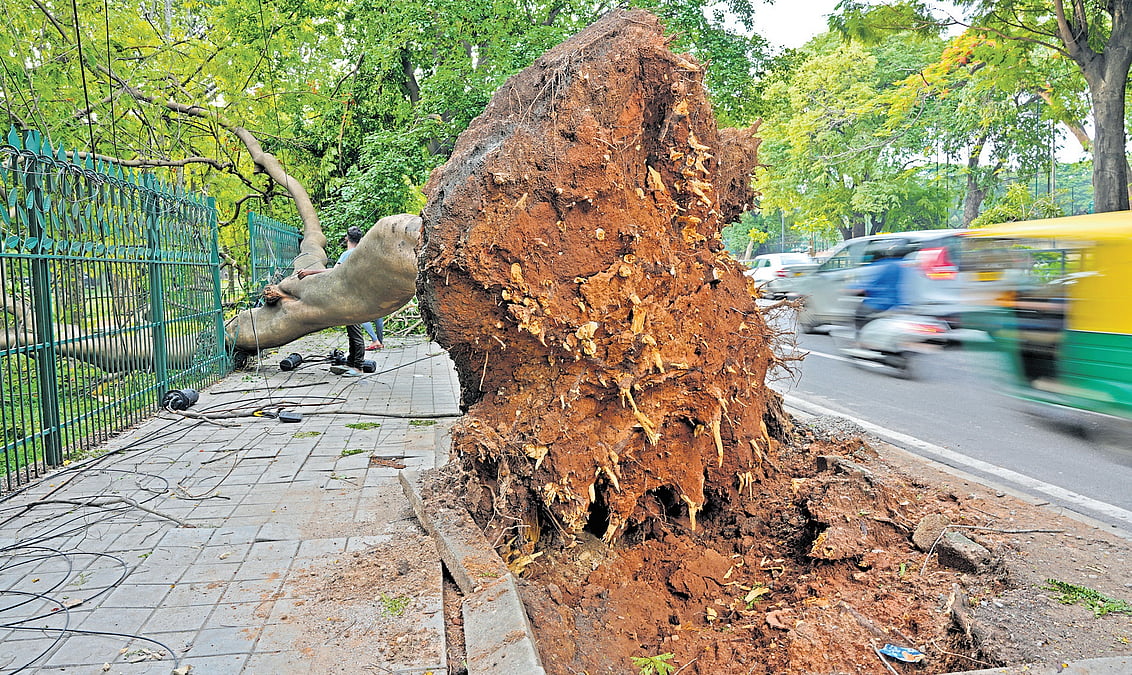
A damaged tree branch along a prominent residential stretch in Jayanagar has triggered fresh debate over the fragile balance between civic events and Bengaluru’s shrinking urban green cover, after local authorities initiated an inquiry into the incident linked to a public procession.Forest and civic officials confirmed that an investigation has been initiated after a large branch from a roadside tree was reportedly cut to facilitate the movement of a ceremonial structure through a narrow section of the neighbourhood.
The incident has drawn criticism from residents, environmental groups, and urban planners who argue that repeated damage to mature trees is steadily weakening the city’s ecological resilience.Bengaluru, once widely recognised for its tree-lined avenues and interconnected green corridors, has witnessed growing pressure on its urban canopy from road widening, infrastructure expansion, extreme weather events, and unregulated pruning practices.Environmental experts say even partial damage to older trees can reduce their stability, increase disease vulnerability, and diminish long-term carbon absorption capacity.Residents in Jayanagar raised concerns over the lack of coordination between event organisers and civic authorities, pointing out that mature roadside trees are increasingly treated as obstacles rather than critical public infrastructure. Urban ecologists note that trees in dense neighbourhoods provide essential environmental services including heat reduction, stormwater absorption, air filtration, and pedestrian comfort — functions that are becoming more important as Bengaluru experiences rising temperatures and intensified rainfall patterns.
The latest incident has also renewed questions around enforcement mechanisms governing tree protection in Indian cities.While permissions are typically required for trimming or removing branches from protected urban trees, activists argue that monitoring remains inconsistent and penalties are often insufficient to deter violations.Urban governance specialists say Bengaluru’s rapid urbanisation has exposed gaps in how cities integrate cultural activities with environmental safeguards. Large public gatherings and processions remain central to civic life, but planners increasingly stress the need for route assessments that minimise ecological damage and reduce pressure on public infrastructure.The issue carries broader implications for climate resilience in fast-growing metropolitan regions. Studies across Indian cities have shown that declining tree cover contributes to urban heat island effects, worsened flooding risks, and deteriorating air quality. In Bengaluru, where lakes and green corridors have steadily contracted over decades of expansion, protecting mature trees is viewed by sustainability experts as both an environmental and public health priority.
Officials are expected to review the circumstances surrounding the incident and determine whether violations of tree protection norms occurred. For many residents, however, the episode reflects a larger challenge confronting Indian cities — how to accommodate growth, mobility, and public activity without eroding the ecological systems that make urban life liveable.
Also Read:Bengaluru Flights Expand Noida Airport Connectivity
