


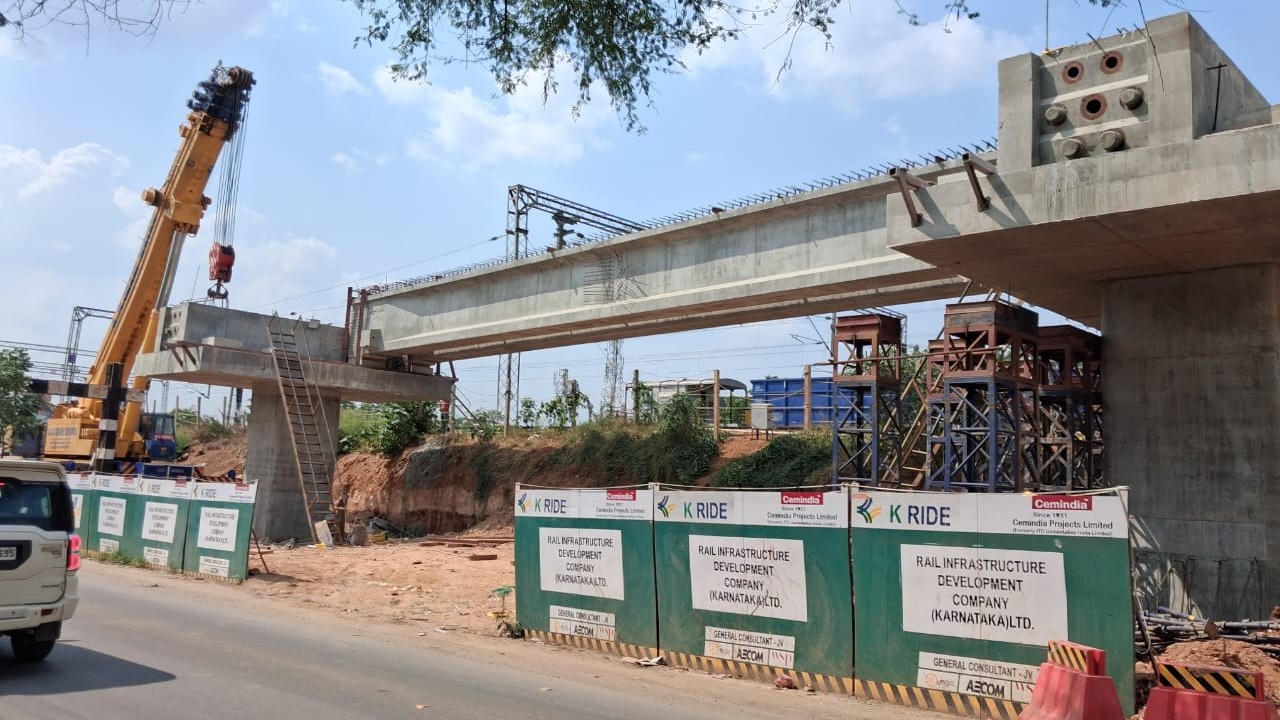
Bengaluru’s long-delayed suburban rail programme has reached another construction milestone with the installation of a major steel girder segment along one of its priority corridors, signalling gradual momentum in a project expected to reshape regional mobility across the metropolitan area.The newly erected 25-metre I-girder span forms part of the elevated infrastructure being developed for the suburban rail network, which is designed to connect rapidly growing residential and employment clusters across Bengaluru.
Infrastructure officials described the development as a critical engineering step in advancing viaduct construction and accelerating corridor execution timelines.The suburban rail initiative is increasingly viewed as essential to Bengaluru’s future urban mobility strategy as worsening traffic congestion, rising commute times and expanding peripheral development continue to strain existing road infrastructure. Urban planners say the rail system could significantly alter travel patterns by creating a high-capacity public transport alternative for daily commuters travelling between outer districts and central economic zones.The use of large-span steel girders is intended to support elevated rail sections passing through dense urban environments where land acquisition and traffic disruption remain major challenges. Engineering specialists note that such construction methods can reduce on-ground disturbance while enabling faster assembly in constrained city corridors.For Bengaluru, where private vehicle dependency remains among the highest in India’s major metropolitan regions, the suburban rail network is expected to complement the metro system rather than compete with it.
Mobility experts argue that integrated multimodal transport systems are becoming increasingly necessary for cities seeking sustainable growth while limiting emissions and fuel-intensive commuting patterns.The Bengaluru suburban rail project also carries significant economic implications. Improved regional connectivity could influence real estate development patterns, expand labour market accessibility and reduce productivity losses associated with long travel durations. Peripheral neighbourhoods connected through efficient rail infrastructure may witness more balanced urban growth, potentially easing development pressure on the city core.However, transport analysts caution that infrastructure delivery alone will not guarantee long-term success. Effective integration with metro stations, bus routes, pedestrian infrastructure and affordable fare systems will be essential in ensuring widespread adoption among commuters. Without seamless connectivity, large-scale rail investments risk underutilisation despite substantial capital expenditure.The pace of execution remains closely watched by residents and businesses alike, particularly as Bengaluru continues grappling with infrastructure deficits linked to rapid urbanisation. Delays in mobility projects have historically intensified congestion costs and reduced commuter confidence in public transport systems.
Urban policy observers say continued progress on the Bengaluru suburban rail network could eventually support broader climate and sustainability goals by encouraging modal shifts away from private vehicles. As construction advances across multiple corridors, the project is increasingly being seen not merely as a transport intervention but as a long-term urban restructuring exercise for one of India’s fastest-growing metropolitan economies.
Also Read:Bengaluru Railway Terminal Faces Passenger Experience Challenges
