


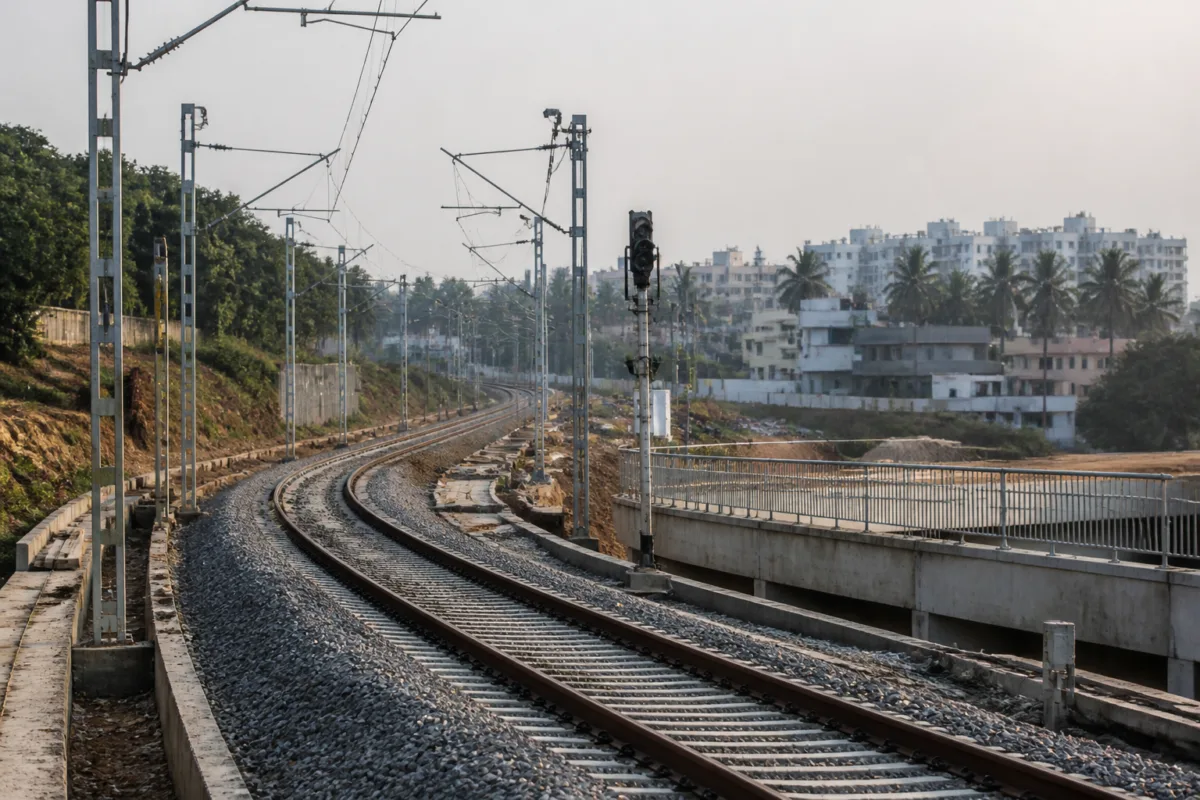
Bengaluru’s suburban rail project could face a further delay, with commercial services on the first operational corridor now potentially pushed to June 2030 because the trains required for the network have not yet entered the design and production process, according to a report by Vijay Karnataka.
The 25-kilometre Mallige corridor between Benniganahalli and Chikkabanavara was targeted for commercial operations by December 2028. However, a K-RIDE official cited in the report said that if train design work begins only by April 2027, services may not start before June 2030.
The delay is linked to the Integral Coach Factory (ICF) in Chennai, which has not yet finalised a design consultant for the Bengaluru Suburban Rail Project trains, the report said. ICF has so far invited expressions of interest from design firms and is yet to invite bids for selecting the consultant.
K-RIDE awarded ICF a contract worth Rs 1,513.75 crore in May 2026 to manufacture 153 air-conditioned coaches. The two organisations signed a memorandum of understanding for the work in September, according to the report.
The design process is required to finalise the trains’ technical specifications and select suppliers for the propulsion system through a separate bidding process. A K-RIDE official said design could take at least one year, followed by about two years for manufacturing, testing and starting operations. Testing on the main railway line alone could require at least six months.
K-RIDE had earlier indicated that coach deliveries would begin within 18 months of awarding the contract, or by November 2027. The trains were expected to support services on the Chikkabanavara-Yeshwanthpur section as well.
The 148-kilometre suburban rail project was approved in 2020 and was initially expected to be completed by 2026. Its overall deadline has since been extended to March 2030. The Kanaka corridor between Heelalige and Rajanukunte is scheduled for June 2029, while the Sampige corridor between KSR Bengaluru and Devanahalli and the Parijata corridor between Kengeri and Whitefield are scheduled for March 2030.
The planned trains will use corrosion-resistant steel coaches. Each six-coach train is designed to carry 1,052 passengers, with a maximum speed of 95 kilometres per hour and an operating speed of 85 kilometres per hour.
The report also said that ICF’s production capacity and the priority given to the project could prevent a supply delay. Two firms, Medha-ECI MG and Italy-based Blue Engineering, have reportedly submitted expressions of interest for the design work, although the terms of the design contract were still under discussion.

