


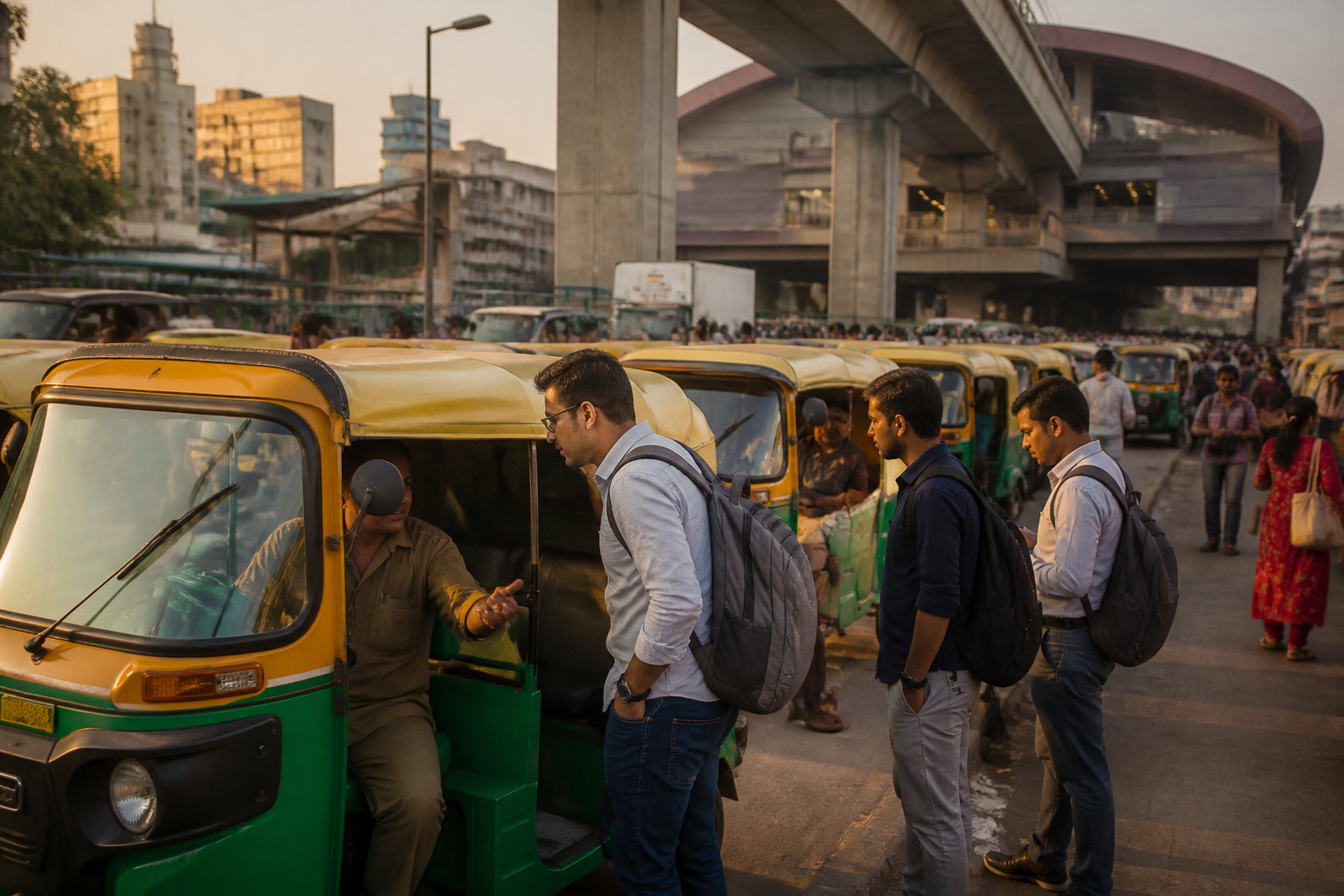
Bengaluru auto fares are increasingly being determined by negotiation, app pricing and location rather than the traditional meter. The shift has made short-distance travel less predictable for commuters and exposed a deeper problem in the city’s urban mobility system: regulation exists, but its everyday enforcement and economic logic are contested.
The physical meters installed in many autorickshaws have not disappeared, but their role has weakened. Commuters quoted in the report said that drivers frequently refuse to use them, demand a higher fare or direct passengers towards app-based bookings. For many residents, the change became especially visible after the pandemic, when app-based travel became a more routine part of urban commuting.
One commuter, Rishab Vinay Malde, said he had not taken a meter auto since before the pandemic. Earlier, he would hail autorickshaws for three- to four-kilometre trips around Basaveshwaranagar and pay between Rs 25 and Rs 30. That fare point, he said, is now difficult to find. Another commuter, Neha Nagpal, recalled asking for a meter ride between Koramangala and Richmond Circle. Although the driver agreed on that occasion, she said drivers usually refuse or demand more when she makes the same request.
These experiences show that the meter has become less a standard operating mechanism than a matter of chance, timing and bargaining power. A commuter who has used meter autos for a decade said drivers near Indiranagar metro station sometimes agree to take passengers to Domlur by the meter, particularly early in the morning. The commuter also believed that knowing Kannada helped in negotiating such rides. That account suggests that access to a regulated fare is not uniform across the city; it may depend on location, language, time of day and the relationship between driver and passenger.
The gap between the regulated fare and the fare demanded on the street can be significant. Saahiba, whose name was changed in the report, said a driver asked for Rs 100 for a 1.7-kilometre trip. When she asked for the meter, the driver refused. She approached a traffic officer nearby, but the auto left before the officer could return. Without the vehicle’s registration number, she found it difficult to file a complaint.
That incident points to an important feature of transport regulation: a rule is only as effective as the system through which a passenger can report a violation and the authority’s ability to identify the vehicle. In the absence of a registration number, location and time may not be enough for a commuter to pursue a complaint. The practical burden therefore falls on the passenger, who must document a refusal or overcharge while already trying to complete a journey.
## The economics behind the meter
Auto drivers interviewed in the report described a different set of pressures. Shantha Gowda, an autorickshaw driver from Sarjapur, said drivers who pick up passengers on the road are increasingly expected to charge fares shown on aggregator applications. He argued that apps can underpay drivers during non-peak hours while charging customers more during peak periods, creating a situation that is disadvantageous to both sides.
This is a central tension in app-based urban transport. Aggregators make prices visible and bookings convenient, but the price displayed to the passenger does not necessarily represent the driver’s earnings. A percentage-based commission can alter the economics of a short trip, particularly when the driver has spent time travelling to the passenger or waiting between bookings. The report does not establish the full cost structure for drivers, but the accounts indicate that the traditional meter is being assessed against a changing platform-based market.
Some drivers also said that they face pressure when they try to use meters at auto stands where fares are informally controlled. Gowda alleged that drivers had struck deals with police officials and local politicians. That allegation is not independently established in the supplied report, but it identifies the kind of institutional question that sits beneath fare disputes: who controls access to passengers at high-demand locations, and how are informal stand-level practices monitored?
At Brigade Road, drivers who depend on app bookings reportedly refused to use the meter, saying they did not need to do so. Outside the M G Road metro station, drivers were reported to charge a minimum fare of Rs 100 and say it matched the prepaid booking booth. When asked why they quoted fares directly even when a ride was not routed through the booth, they said they knew the fares themselves.
These locations are significant because they connect two parts of Bengaluru’s transport network: high-footfall commercial areas and metro stations. Autorickshaws are often the last-mile link between a rapid-transit station and a neighbourhood that is not directly served by public transport. When fares at such points are not transparent, the cost of using the metro can become less predictable after the passenger leaves the station. The issue is therefore not confined to auto travel; it affects the reliability of the wider public transport chain.
## A regulated fare with weak everyday authority
The report states that Bengaluru’s mandated minimum fare is Rs 36, followed by Rs 18 for every kilometre after the first two kilometres. The existence of a notified fare provides a clear benchmark, but commuters’ experiences suggest that the benchmark is not consistently translated into street-level transactions.
The problem is not simply that passengers and drivers disagree about price. It is that the system has multiple overlapping pricing mechanisms: the official meter, aggregator fares, prepaid booths and informal rates at stands or busy locations. Each mechanism may be familiar to a different participant, but the passenger often has to decide which one is legitimate at the moment of travel.
Niranjanaradhya N, chief executive of the Nagara Meter Auto and Taxi app, said many drivers had initially shown interest in returning to a meter-based model. However, complaints about rigged meters undermined trust. His organisation developed an in-app live meter that calculates fares based on distance and charges a platform fee of Rs 3 per ride rather than taking a percentage-based commission.
The proposed digital meter model attempts to address two failures at once. It seeks to reduce passenger uncertainty by calculating the fare from distance, while also offering drivers a platform with a different revenue structure. Its existence also shows that the debate is no longer about choosing between a mechanical meter and an app. The more relevant question is whether technology can reproduce the transparency of a meter without reproducing the trust problems associated with either physical devices or opaque platforms.
Driver representatives, however, say the official fare itself needs review. Rudramurthy, general secretary of the Auto Rickshaw Drivers Union, argued that the minimum charge and per-kilometre rate should be discussed with drivers and revised to reflect rising living costs. He said cities including Mangaluru, Udupi and Shivamogga charge a minimum fare of Rs 40 and Rs 20 for every subsequent kilometre.
This comparison does not by itself prove that Bengaluru’s fare is inadequate, because the cost of operating an autorickshaw and the structure of demand can differ between cities. It does show that fare regulation is not a one-time administrative decision. Rates have to be reviewed, explained and enforced if drivers are expected to accept them and passengers are expected to trust them.
## The enforcement question
Rudramurthy also acknowledged instances in which drivers near Cubbon Park allegedly charge Rs 100 per person for a short ride shared by three passengers. His position was that strict implementation, combined with a fair minimum price, could make the meter system work again.
That formulation captures the institutional trade-off at the heart of the issue. Enforcement without a fare that drivers consider viable may push more transactions outside the regulated system. A higher fare without enforcement may simply formalise a price that passengers still cannot reliably access. The system requires both a credible rate and a visible mechanism for ensuring that it is used.
For commuters, the current complaint process requires the vehicle’s registration number, the place, and the time and date of the incident. Bengaluru Traffic Police helplines listed in the report are 080 2558 8444 and 080 2558 8555. The requirement for basic evidence is understandable, but the incident near a traffic post illustrates why enforcement can fail in practice: by the time a passenger seeks help, the vehicle may have left and the identifying details may be unavailable.
The larger urban question is whether Bengaluru can preserve autorickshaws as a dependable part of public transport while the market around them changes. App bookings have made it easier to request a ride, but they have not removed the need for clear fares, accountable operators and effective last-mile connections. At the same time, a meter cannot regain legitimacy if passengers believe it may be tampered with or if drivers believe the notified rate no longer covers their costs.
The evidence in the report establishes a city caught between an older regulated model and a newer platform-led model. It does not establish that every driver refuses meters, that every app fare is unfair, or that alleged arrangements between drivers and officials occur across the system. What it does show is a recurring mismatch between the official fare framework and the way many journeys are negotiated on the ground.
Any revival of the meter will therefore depend on more than fitting vehicles with functioning devices. It will require a fare structure that drivers accept, a calculation method passengers can verify, and a complaint system capable of identifying and responding to violations. For now, Bengaluru’s auto fare system remains officially regulated but operationally fragmented, leaving the city’s short-distance commuters to navigate the gap.
