


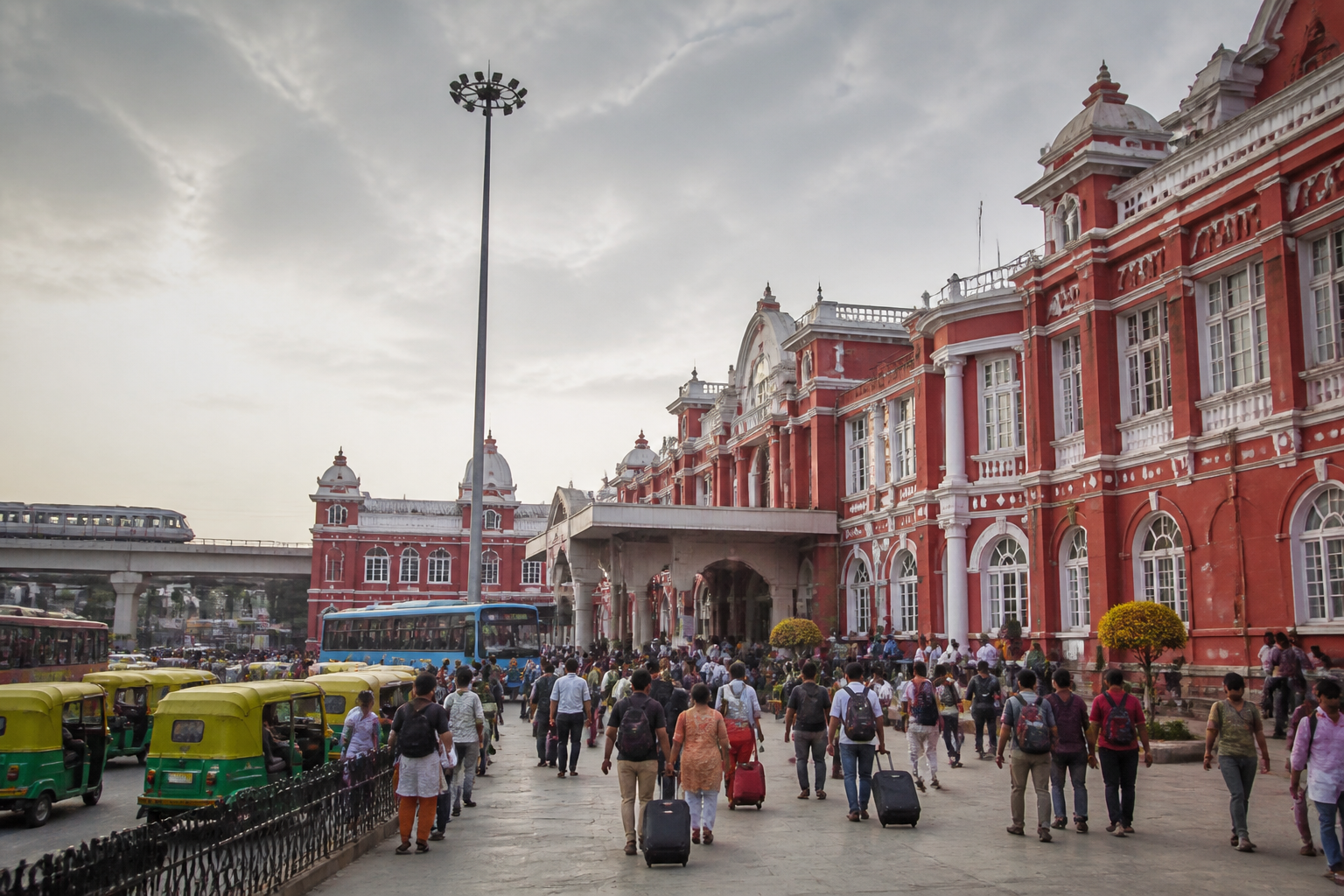
Bengaluru railway station is more than a place where trains arrive and depart. At Majestic, the station forms one part of a dense transport interchange where Indian Railways, BMTC buses, the Metro and auto-rickshaws meet, making it one of the clearest physical expressions of how the city moves. Its history also reflects Bengaluru’s transition from a slower-growing urban centre into a city whose daily journeys depend on tightly connected transport systems.
The station opened in 1968 as Bangalore City station, when railway traffic had outgrown the city’s earlier arrangements. That decision was not simply about adding platforms or accommodating more trains. It marked the expansion of a city whose movement patterns were changing and whose transport infrastructure needed to absorb a larger volume of passengers and services.
Nearly six decades later, the station remains embedded in the city’s everyday vocabulary. Some residents still call it Bangalore City, while many refer to it as Majestic. In 2016, it was renamed Krantivira Sangolli Rayanna Bengaluru railway station, after the 19th-century freedom fighter from Karnataka. The different names attached to the station reveal how infrastructure can carry several histories at once: an official identity, a neighbourhood identity and the informal language of daily travel.
Its importance is also visible in the way people approach it. “Majestic-ge bartira?” is a familiar question for Bengaluru auto drivers, according to the account, and the response carries an understanding of the station’s role in the wider transport economy. A driver who accepts the destination may already be calculating the likelihood of finding a passenger for the return journey. The station is therefore not only a destination for rail users. It is also a point around which short-distance mobility and livelihoods are organised.
The physical arrangement of Majestic makes this role unusually clear. Trains, BMTC buses and the Metro converge in the same broad transport district, allowing passengers to change between different modes for journeys across Bengaluru and beyond. The railway station’s significance cannot be separated from this surrounding network. Its value lies partly in the services inside the building, but also in the connections that begin immediately outside it.
The figures cited in the account show the scale of that role. The station’s 10 platforms handle more than 180 passenger and express trains a day. Another 4,500 people visit daily without intending to travel themselves. They come to see someone off or welcome someone home. That number expands the meaning of station capacity. A railway station serves not only passengers who board trains, but also families, friends, drivers and other visitors whose journeys are connected to someone else’s movement.
These non-travelling visitors are part of the station’s social infrastructure. The rituals associated with Bangalore City station include steel trunks, packed suitcases, hurried goodbyes and instructions to call after reaching the destination. Such details may appear personal, but they are also evidence of how transport infrastructure is experienced. A station is a building designed for circulation, yet it becomes meaningful through waiting, meeting, accompanying and returning.
This distinction matters in understanding major urban transport facilities. Passenger numbers and train counts describe operational intensity, but they do not fully capture the public role of a station. The daily presence of thousands of people who are not travelling suggests that the station functions as a civic meeting point as well as a transport facility. The boundary between mobility infrastructure and public space becomes less clear at a place where departures and reunions happen every day.
The station’s architecture reinforces its landmark status. Its red-and-white facade, tall windows and signboards in Kannada, Hindi and English make it recognisable within the city. These elements do not merely help passengers identify the building. They give the station a visual presence and connect it to Bengaluru’s linguistic and cultural setting. The building becomes part of the city’s image, not just a container for railway operations.
The station’s evolution also shows how urban infrastructure accumulates layers rather than replacing them entirely. The 1968 opening responded to railway traffic that had outgrown older arrangements. The 2016 renaming added a new official identity. The continued use of “Majestic” preserves the station’s relationship with the surrounding transport district. The result is an infrastructure site in which institutional decisions, local usage and personal memory remain visible at the same time.
That layering is particularly important in a city where transport facilities are often understood through their connections. A railway station may be managed as a specific asset, a bus terminal as another and a Metro station as a third. But commuters experience them as parts of one journey. At Majestic, the combined presence of these modes creates a transport knot whose significance extends beyond any one agency or service. The station’s history therefore belongs to Bengaluru’s wider mobility history.
The source account does not provide a detailed breakdown of passenger volumes, train categories, interchange numbers or the institutional responsibilities of the different transport operators. It also does not establish how the station’s current capacity compares with demand over time. Those limits matter. The available figures—more than 180 trains a day and 4,500 daily visitors who are not travelling—are enough to demonstrate the station’s intensity, but not to measure its full performance or the pressures faced by passengers and operators.
What the account does establish is the station’s continuity. It has remained part of Bengaluru’s travel story for nearly six decades despite changes in name, transport technology and the city around it. The presence of the Metro and BMTC alongside the railway station indicates that the area has developed as a multimodal hub rather than as a single-purpose rail facility. Its identity has been shaped by the movement of people between modes as much as by the trains using its platforms.
The station also offers a way to read the city through memory. The monthly “Once Upon A Frame” column places archival photographs alongside images from the same locations today, inviting readers to revisit vanished facades, surviving street corners and personal recollections. Applied to the railway station, that approach shifts attention from infrastructure as a finished object to infrastructure as an evolving record of urban life.
Old photographs and personal memories cannot replace operational data, but they can reveal what formal records often leave out: how people used a place, what they called it and which rituals became associated with it. In Bengaluru railway station’s case, memories of luggage, farewells and reunions help explain why the building remains a landmark even as the city’s transport system grows more complex.
The larger urban question is how cities preserve the civic meaning of infrastructure while expanding its operational role. A station must move people efficiently, but it also becomes part of the public memory of the city it serves. At Majestic, the railway station’s identity has been produced by official investment, multimodal connections, everyday livelihoods and repeated personal encounters.
Bengaluru railway station’s story therefore cannot be reduced to its platforms or train schedules. It is a record of a city learning to move at greater scale and of a transport facility becoming part of the city’s emotional and physical geography. The evidence supplied here confirms its centrality as a multimodal landmark and a place of arrival and departure. A fuller assessment of its present-day pressures would require additional operational and passenger data, but its six-decade role in Bengaluru’s travel story is already clear.
