


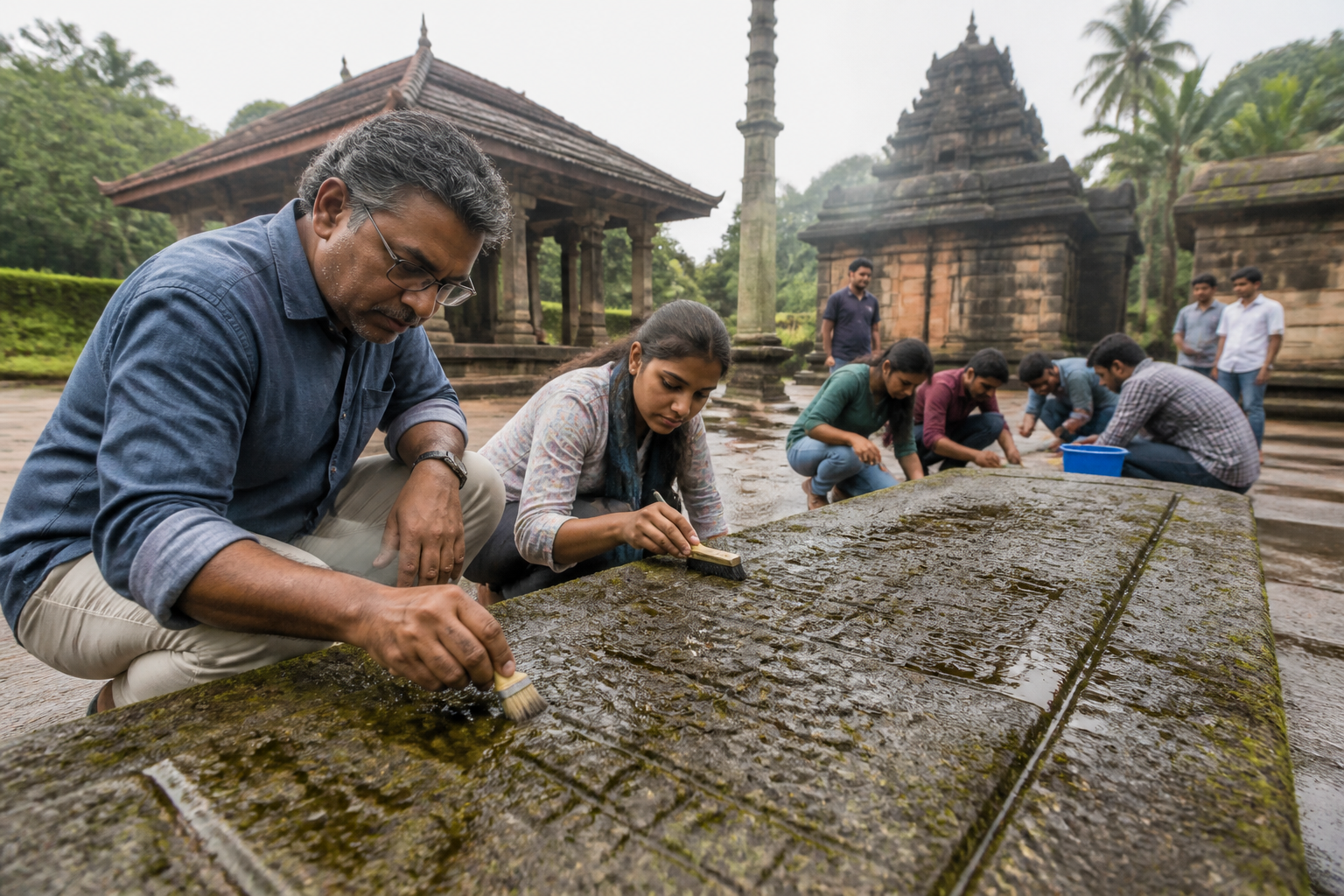
A campaign to clean centuries-old inscriptions in Barkur, near Udupi, is doing more than removing moss and dust from stone. It is restoring public access to records that document how temples were administered, how donations were made and how power operated across one of coastal Karnataka’s historic centres. The campaign also exposes a recurring problem in heritage conservation: a monument can survive physically while becoming unreadable, inaccessible and effectively invisible to the people who live around it.
The initiative was launched at Kallu Chappara in Barkur by Hampi Kannada University Vice-Chancellor Dr DV Paramashivamurthy. The Veera Rani Chikkaayi Thayi Charitable Trust-Gulladi, Adima Kala Trust-Udupi and Gajani Foundation-Mulki have joined the effort, with archaeologist and historian Prof T Murugeshi leading the work with volunteers. On the first day, around eight inscriptions at Sri Someshwara Temple were cleaned using water and soft brushes.
That method is deliberately modest. The campaign is not presented as a large restoration project involving structural reconstruction or chemical treatment. Its immediate objective is to make the writing visible again without damaging the carved surfaces. This distinction matters because inscriptions are not decorative surfaces alone. They are historical documents whose meaning depends on the legibility of scripts, dates, names, institutional references and administrative instructions.
In Barkur, those records have become difficult to read as algae, moss, dust and other deposits accumulated over time. To a visitor, a darkened stone slab may look like an undifferentiated remnant of an old temple. Once its letters disappear beneath organic growth and dirt, the stone loses much of its interpretive value in the public realm. The campaign therefore treats cleaning as the first stage in making heritage understandable, rather than as an end in itself.
Barkur’s historical importance gives the exercise a significance beyond the individual temples where the work is taking place. The town is located about 20 kilometres north of Udupi and served as a capital of the Alupa dynasty from the 11th century. Historical records identify it as Barakuru and Barahakanyapura. It was the third Alupa capital after Mangalapura, present-day Mangaluru, and Udayapura, present-day Udyavara. The Alupas continued to hold Barkur as their capital until the royal line ended in the 14th century.
The town later served as an administrative headquarters for the Hoysalas under Rani Chikkayi Tayi and became a coastal headquarters under the Vijayanagara Empire. The source report also places Barkur within a later administrative division of the coastal region, when it functioned as the northern headquarters and Mangaluru as the southern one. These successive political roles help explain why the town’s inscriptions cover several periods and why the records are relevant to more than dynastic history.
The inscriptions found in Barkur range from the 11th century, including the reign of Kulashekhara Alupendra I of the Alupa kingdom, to the 17th century, including the period of Aliya Ramaraya of the Vijayanagara Empire. They represent a long administrative memory embedded in temple spaces. Local oral tradition describes the region as having had as many as 365 temples in the past, while the inscriptions themselves provide a more concrete route into the institutions that once organised religious and civic life.
Many of the records concern donations, temple administration and the operation of religious institutions. That content is important because it complicates the common perception of inscriptions as isolated royal proclamations. A temple inscription could record who gave resources, what duties were assigned and what consequences followed if those duties were not performed. At Chaulikeri Ganapathi Temple, Prof Murugeshi identified a 12th-century inscription of Kulashekhara Alupendra I that records a donation and describes the responsibilities of people associated with the temple, including a fine for failing to perform assigned duties.
Such details make the stones relevant to the history of governance. They show that temples were not only ritual sites but also places where responsibilities, resources and institutional rules were recorded. Because people gathered at temples regularly, these locations offered a durable and visible setting for public records. The continuing deterioration of the inscriptions therefore represents a loss of information about the social and administrative systems that shaped the town.
The campaign’s proposed scale is significant even though its tools are simple. Organisers estimate that more than 150 inscriptions are located in temples within a radius of about two kilometres of Barkur. If around 10 inscriptions can be cleaned in a day, and the work continues every Sunday, the exercise could take at least 15 Sundays. The campaign is currently limited to inscriptions located in temples in Barkur village.
Those numbers reveal the practical challenge of local heritage stewardship. The problem is not one stone or one neglected temple. It is a dispersed network of records requiring repeated visits, careful handling and people able to recognise the difference between removing surface growth and damaging the inscription beneath it. Even before questions of documentation, interpretation or long-term maintenance arise, the basic task of reaching and treating each inscription demands coordination.
The participation of students is consequently central to the initiative rather than incidental to it. The organisers have invited college students to register for the Sunday campaign, and Prof Murugeshi said 175 students had registered on the first day. For students of history and archaeology, the work creates direct contact with original material that cannot be replicated fully in a classroom. They can observe the physical condition of inscriptions, learn how surface deposits are removed and, where they know the script, attempt to read the records in their original setting.
This also changes the relationship between heritage sites and their surrounding communities. When inscriptions remain covered, their interpretation is largely confined to specialists who know where they are and what they contain. When the surfaces are cleaned and the records become visible, residents and visitors have a greater chance of encountering the history embedded in ordinary temple spaces. The campaign can therefore be understood as a public-access effort as much as a conservation activity.
At the same time, cleaning cannot by itself resolve every problem associated with heritage preservation. The supplied account establishes that the campaign is intended to bring the writing back into view, but it does not provide a conservation assessment, a complete inventory, a documentation protocol or details of how the inscriptions will be monitored after cleaning. It also does not establish whether all 150-plus inscriptions have been formally recorded, translated or signposted for visitors. Those gaps do not diminish the value of the current work; they define the further institutional questions that follow once visibility is restored.
The campaign’s structure offers one response to those questions: regularity. By committing to work every Sunday, the organisers are creating a recurring conservation practice rather than a one-day cleaning drive. The involvement of three organisations and the planned participation of students may help distribute the work across a large number of sites. However, the source material does not establish the long-term governance arrangement for the inscriptions, the role of temple authorities or the responsibility of government heritage agencies.
That institutional dimension is important because historic landscapes rarely fit neatly within one administrative boundary. An inscription may stand inside an active temple, on property used by a religious institution and within a settlement that is also an archaeological and tourism destination. Conservation, access, religious use and visitor management can therefore overlap. The Barkur campaign brings volunteers and historians into the foreground, but its future durability will depend on how these responsibilities are recorded and coordinated.
The evidence currently available confirms a clear sequence: the inscriptions are difficult to see because of moss, algae, dust and other deposits; a coalition of heritage organisations has begun cleaning them; eight were treated on the first day; 175 students registered; and more than 150 inscriptions may remain across temples within roughly two kilometres. The campaign is expected to continue for at least 15 Sundays at an estimated pace of 10 inscriptions a day. What remains less clear is how the cleaned records will be documented, interpreted and protected from renewed deterioration.
Barkur’s inscriptions show that heritage is not preserved simply because stone survives. Preservation also requires visibility, skilled attention, institutional continuity and a public able to understand what it is seeing. The Sunday campaign has begun with brushes, water and volunteers, but its larger importance lies in reconnecting a historic town’s physical remains with the administrative, social and cultural record carved into them. The next milestones are the continuation of the weekly work, the cleaning of the remaining temple inscriptions and the development of a durable system for recording and presenting what the stones reveal.
