


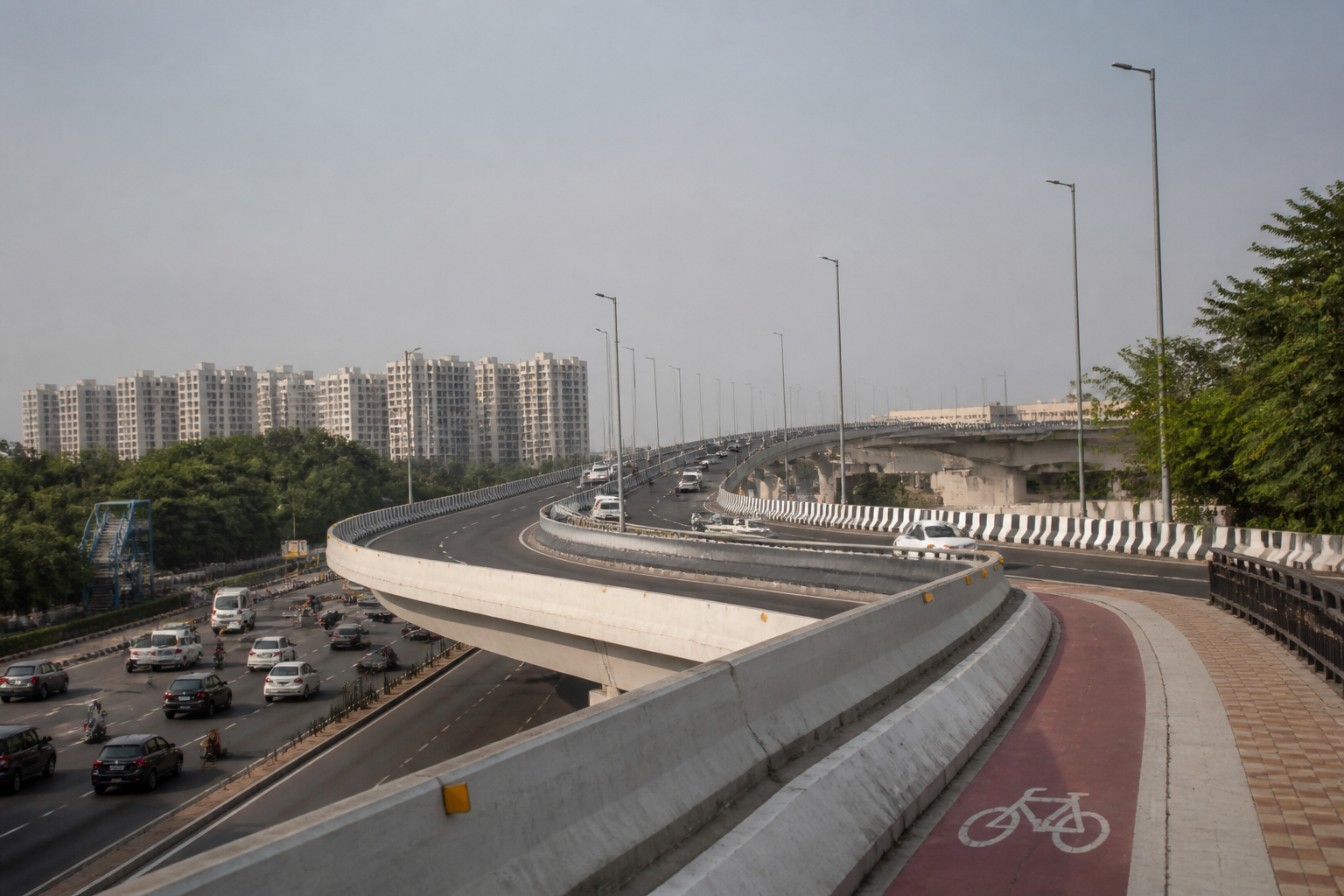
The Barapullah Phase III corridor in Delhi will open to traffic on September 29, giving eastern and southern Delhi a new signal-free road connection after a construction delay of several years. The 3.5-kilometre, four-lane elevated corridor has been built at a reported cost of Rs 1,635 crore and includes nine loops, a dedicated cycle track and footpaths.
The corridor is designed to provide a direct connection between key parts of eastern and southern Delhi while allowing vehicles to avoid several signal-controlled routes and congestion points. Its opening is expected to give commuters an additional route across the Yamuna, although the effect on daily travel times and traffic volumes will become clear only after operations begin.
A key feature of Barapullah Phase III is its network of nine loops. These connections are intended to allow vehicles approaching from different directions to enter and exit the corridor without concentrating all traffic at one or two junctions. The elevated alignment has been planned as a signal-free link, with the objective of improving the movement of vehicles between the two sides of the city.
The project also includes facilities for people travelling without cars. A dedicated cycle track and footpaths have been provided along the corridor, creating separate space for cyclists and pedestrians. The arrangement is intended to improve movement around the elevated road and reduce the need for non-motorised users to share space with general traffic.
The project was approved in 2014 and was originally scheduled for completion by 2017. According to the report, land acquisition, environmental clearances and construction-related challenges contributed to the delay. The extended timeline also resulted in a rise in the project’s estimated cost.
The initial estimate was Rs 1,261 crore, while the reported final cost increased to Rs 1,635 crore. The difference is approximately Rs 375 crore, reflecting the financial impact of the project’s prolonged implementation. The available report does not provide a separate breakdown of how much each factor contributed to the increase.
Once opened, Barapullah Phase III will become one of Delhi’s important road links across the Yamuna. Its significance will depend on how effectively the nine loops distribute traffic, how the adjoining roads absorb additional vehicle movement and whether the cycle and pedestrian facilities remain usable alongside the elevated carriageway.
Traffic will begin on the corridor on September 29, according to the report. The opening will provide the first opportunity to assess its operational performance, the changes in congestion on alternative routes and the extent to which it improves connectivity between eastern and southern Delhi.
