


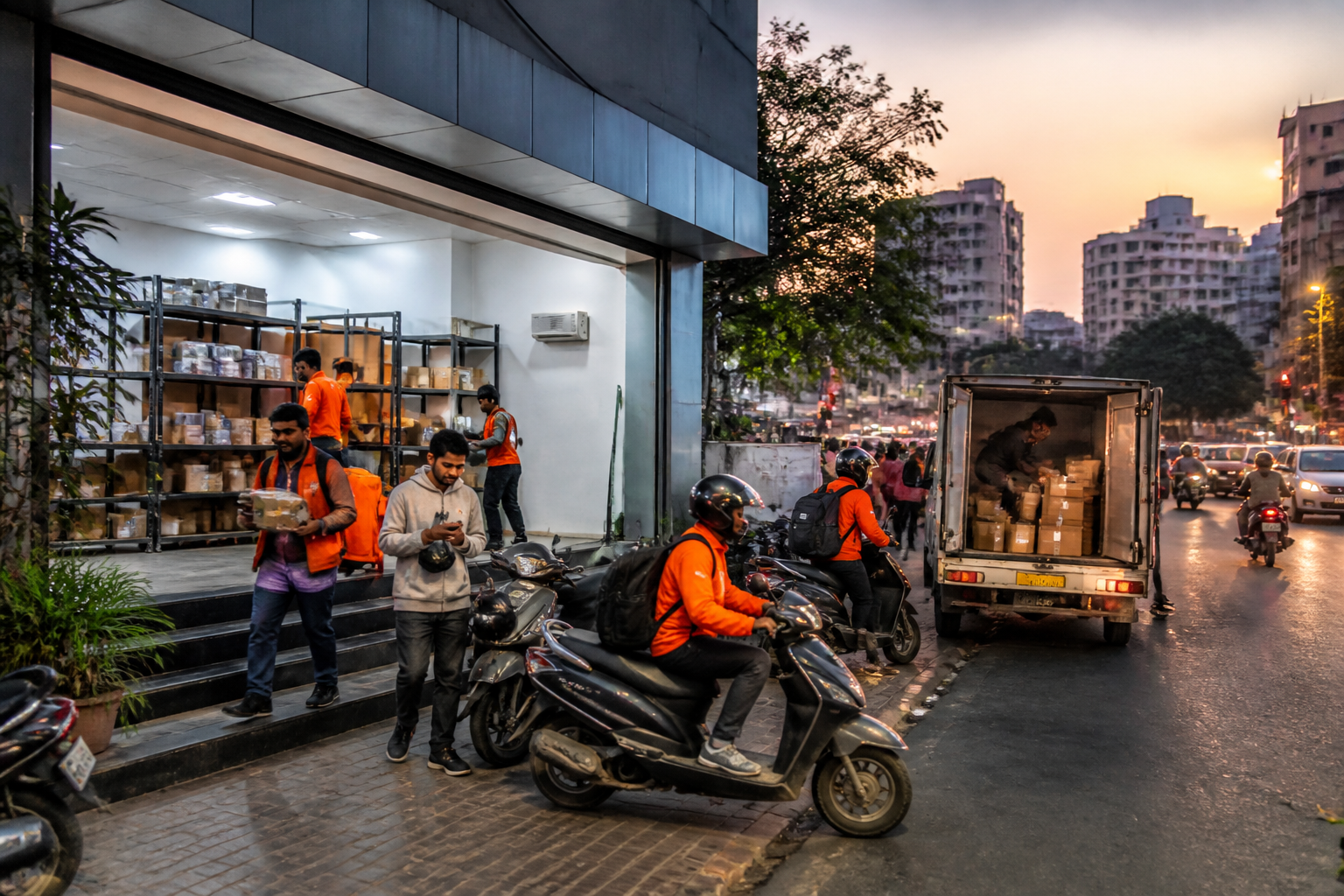
Amazon’s quick-commerce expansion is no longer only a retail story. With Amazon Now crossing a company-reported $1 billion annualised gross sales run rate in India and expanding to more than 60 cities, the platform is accelerating a shift in how urban retail is physically organised: inventory is moving closer to neighbourhoods, delivery networks are becoming denser and commercial activity is increasingly being supported by small, distributed fulfilment facilities.
The scale of the expansion is visible in the company’s infrastructure plans. Amazon says it is opening 20 fulfilment centres, six sort centres and 150 delivery stations across 118 cities for the festive season. Its Amazon Now network includes more than 750 micro-fulfilment and urban fulfilment centres. The company says the quick-commerce service is on track to reach 100 cities by Diwali, although the material supplied does not specify how these facilities are distributed between metropolitan areas, smaller cities and different types of urban locations.
That distinction matters. A conventional e-commerce network is organised around larger warehouses, sorting infrastructure and delivery routes that can serve a broad geography. Quick commerce requires a different physical logic. Products must be positioned close enough to customers for delivery within minutes or a few hours. The result is a more dispersed urban network, with commercial storage and dispatch activity embedded closer to residential demand.
Amazon’s announcement therefore points to a change in the relationship between retail and the built environment. The city is not simply the destination for deliveries; it becomes part of the operating system. Roads, local access lanes, small warehouses, delivery stations and neighbourhood-level demand all become operational components of the retail model. Amazon has described Now as an extension of its broader e-commerce proposition rather than a standalone quick-commerce business, suggesting that the company is trying to connect these different layers rather than operate them as isolated services.
The company’s reported growth also illustrates why this model is being pursued. Amazon says orders on Now have doubled every quarter since its launch, making it the fastest-growing e-commerce business unit in Amazon India’s history. It also says the service expanded to more than 60 cities, four times the number covered less than 10 weeks earlier. These figures are company claims and are not accompanied in the supplied material by an independent breakdown of order volumes, profitability, delivery distances or facility-level performance.
Even so, the reported network numbers indicate the physical demands of the model. More than 750 micro-fulfilment and urban fulfilment centres represent a large distributed footprint, although the company has not disclosed the size, tenure or exact urban location of these facilities. A micro-fulfilment centre may occupy substantially less space than a conventional warehouse, but the network depends on many such points working together. It requires reliable replenishment, local inventory decisions, sorting capacity and a steady flow of delivery workers and vehicles.
Amazon’s broader investment commitment adds another layer to the infrastructure question. Samir Kumar, Country Manager, Amazon India, said the company is investing across e-commerce, logistics, quick commerce and artificial intelligence as part of a $48 billion commitment in India. Of that overall commitment, $21 billion has been committed to cloud and AI data centres, while the company is also expanding its physical fulfilment network.
The split is significant because the future retail network is both physical and digital. Data centres and artificial intelligence can influence product discovery, inventory planning and personalisation, but the final service still depends on physical assets operating within cities. The company says more than 2,00,000 sellers in India have adopted its AI tools and that shopping will become more personalised through AI-powered assistants and agents. Those tools may alter how consumers interact with the marketplace, but they do not remove the need for storage, sorting and last-mile movement.
Amazon’s stated product proposition makes that integration more demanding. It plans to offer tens of thousands of products within minutes or a few hours, more than one million products through same-day delivery and over four million products the next day. The company says selection will be central to its differentiation, including the ambition to provide the largest assortment of products for minutes delivery.
This creates a direct operational tension. A larger assortment requires more inventory and more sophisticated allocation across facilities. Faster delivery requires inventory to be closer to consumers. Together, those objectives can increase the number of locations needed to keep products available without creating excessive duplication between facilities. The supplied material does not establish how Amazon is resolving that tension, but its investment in both fulfilment centres and urban fulfilment centres suggests that the company is building a tiered network rather than relying on one type of facility.
The same network is also being extended beyond the largest cities. Amazon says it is deepening its presence in value commerce through Amazon Bazaar as smaller cities bring new consumers and sellers onto the platform. Kumar said value-conscious customers are not limited to non-metro markets. The company has added 3,00,000 sellers this year, taking its seller base to two million.
For urban India, this broadening of the marketplace could make the geography of digital commerce more complex. The company’s stated plans combine rapid delivery in selected urban areas with next-day and value-commerce services across a wider market. That means different cities may receive different forms of infrastructure: dense local fulfilment for high-frequency demand in some locations, larger distribution and delivery capacity in others, and marketplace access without the same quick-commerce footprint elsewhere.
The expansion also raises questions about how cities accommodate logistics uses that are neither traditional shops nor conventional industrial warehouses. The source material does not provide details on zoning permissions, facility sizes, traffic generation, delivery-worker conditions, parking arrangements or municipal responses. Those are important gaps because the performance of a distributed fulfilment network depends on its interaction with neighbourhood streets and local land-use patterns.
The company’s plans for the festive season offer a near-term view of this interaction. Twenty fulfilment centres, six sort centres and 150 delivery stations are being opened across 118 cities, according to Amazon. These facilities are intended to support a period of increased demand, but the company has not stated whether they are temporary, permanent or part of a longer-term expansion plan. Nor has it disclosed how many additional delivery trips the network is expected to generate.
The institutional issue is therefore larger than the headline sales milestone. A platform can announce a rapid city expansion, but that expansion ultimately depends on permissions, land and building availability, road access, electricity, digital connectivity and the ability to recruit and coordinate workers. These responsibilities are distributed across private companies and public agencies. Municipal bodies influence land use and local access, while transport networks determine how efficiently goods can move between facilities and households.
Amazon’s model also illustrates how the boundaries between technology infrastructure and urban infrastructure are becoming less distinct. Artificial intelligence, cloud systems and personalised shopping tools are part of the digital layer. Fulfilment centres, sort centres, delivery stations and micro-fulfilment centres form the physical layer. Quick commerce works only when both layers are synchronised closely enough to support the promised delivery times.
What the available evidence confirms is the scale and speed of Amazon’s stated expansion. Amazon Now has crossed a $1 billion annualised gross sales run rate, operates in more than 60 cities, has access to more than 750 micro-fulfilment and urban fulfilment centres and is targeting 100 cities by Diwali, according to the company. What remains unclear is the financial performance of the business, the geographic distribution of its facilities, the effect on local traffic and land use, and the terms under which the new infrastructure is being developed.
Those unanswered questions will determine whether quick commerce becomes merely a faster retail channel or a lasting reconfiguration of urban logistics. For now, Amazon’s investment signals that India’s next phase of e-commerce growth is being built not only through apps and algorithms, but through a denser and more distributed physical presence inside cities.
