


A year after nine-year-old Amaira died after falling from the fourth floor of Neerja Modi School in Jaipur during school hours, the unresolved question is no longer limited to what happened on one day. It is whether India’s private-school regulatory system can convert identified safety failures into timely accountability, enforceable corrective action and safer conditions for children.
According to a Times of India report, Amaira’s parents and the Sanyukta Abhibhavak Sangh continue to question the delay in action despite a police chargesheet and investigations by the Central Board of Secondary Education (CBSE) and Rajasthan’s education department. The report says these processes identified deficiencies at the school, while the family has continued to seek action against those it believes should be held responsible.
The case brings together several institutional layers that govern school safety: the school’s management, its teaching staff, the police, the state education department, the CBSE and the courts. Each institution has a distinct role. The police investigate possible criminal responsibility. Education authorities regulate recognition. The CBSE controls affiliation within its framework. Courts examine challenges to administrative or criminal proceedings. For families, however, these processes are experienced as one system. When decisions remain pending or are altered through interim legal relief, accountability can appear fragmented even when individual agencies have acted.
The reported sequence also shows why school safety cannot be reduced to the presence of physical barriers or compliance certificates. The family said Amaira had approached her class teacher, Punita Sharma, several times on the day of the incident, complaining of harassment by classmates. The teacher allegedly scolded and threatened her instead of helping her. The report says CCTV footage showed Amaira leaving the classroom in distress. These claims are part of the case record as described by the family and the report; the final legal determination remains with the competent authorities.
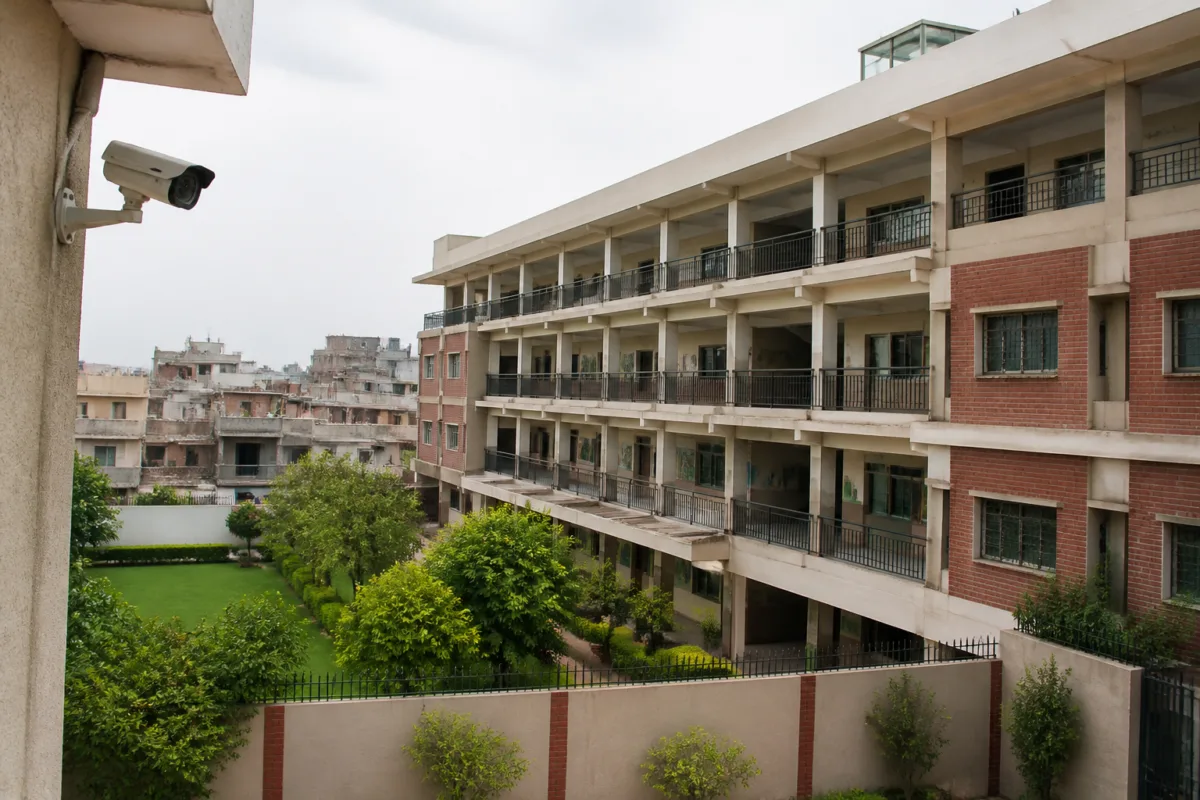
That account points to two connected but distinct dimensions of safety. The first is the physical environment: floors, railings, access points, surveillance and emergency arrangements. The second is the institutional environment: how complaints are received, how staff respond to distress, whether counselling is available and whether a school has systems to identify and protect vulnerable children. A school can address one dimension while failing in the other. The regulatory response described in the report suggests that both physical and institutional safeguards are under scrutiny in this case.
The police chargesheet is one of the clearest developments cited in the report. Police filed it on July 1, 2026, naming the teacher, principal Indu Dubey, chairperson Saurabh Modi and another person as accused. The chargesheet does not itself establish guilt; that is for the court to determine. Its significance is that the criminal investigation moved beyond an initial incident report to identify people whom investigators considered relevant to the alleged failures.
The legal process has not, however, produced a final resolution. A court rejected the family’s plea seeking the addition of more serious charges in September, according to the report. That decision narrowed, at least at that stage, the charges sought by the family. It did not resolve the wider administrative questions around school recognition, regulatory compliance or the continuation of officials in positions of responsibility.
The CBSE’s actions further illustrate the tension between regulatory sanction and institutional continuity. The board withdrew the school’s affiliation on December 30, 2025, citing safety deficiencies, the report says. It later restored affiliation up to Class X while barring Classes XI and XII for two years. The school subsequently obtained interim relief from the Rajasthan High Court.
This sequence matters because affiliation is not merely an academic label. It is part of the framework through which a school is permitted to operate under a particular board’s standards. When affiliation is withdrawn, restored in a limited form or modified through court intervention, parents are left to understand what has changed on the ground. A regulatory order may specify classes, conditions or timelines, but the practical question is whether students and families can verify that the identified safety gaps have been addressed.
The report says later CBSE inspections also flagged gaps in student safety, counselling facilities and teachers’ qualifications. These findings widen the issue beyond the incident involving Amaira. If confirmed through the relevant inspection records, they would indicate that safety concerns were not confined to one physical location or one day. They would instead raise questions about whether schools maintain a functioning safeguarding system, whether staff are adequately prepared and whether counselling is treated as an operational necessity rather than an optional service.
The distinction between inspection and enforcement is important. An inspection can record a deficiency. A notice can require correction. An affiliation decision can impose a sanction. But accountability depends on what follows: whether the corrective measures are specific, whether responsibility is assigned, whether compliance is independently checked and whether parents receive meaningful information. The report does not establish that this complete chain has been completed in the Amaira case. That gap is central to the concerns raised by the family and the parents’ association.
Recognition creates another layer of administrative uncertainty. The association has questioned the pending decision on recognition for Classes I to VIII and the continued appointment of Dubey as principal. The report does not state the final outcome of that recognition process. This distinction between recognition and affiliation is significant for families because different authorities may control different parts of a school’s legal and academic operation. Without clarity, parents may struggle to determine which authority is responsible for a particular deficiency and what remedy is available.
The case therefore exposes a structural problem in urban governance: responsibility is distributed, but information and accountability are not always integrated. A school in a city is regulated through multiple systems that may operate on separate timelines. Police proceedings follow criminal-law procedures. Board affiliation follows educational regulations. State recognition follows departmental processes. Court orders can temporarily alter the effect of administrative decisions. Each process may be lawful in isolation while producing prolonged uncertainty for affected families when viewed together.
For parents, the practical consequences are immediate. They must decide whether a school is safe, whether complaints will be taken seriously and whether regulatory action has changed everyday conditions. Those decisions are difficult when the available information consists of conflicting orders, pending recognitions, inspection findings and legal proceedings. The burden of interpreting institutional action often falls on families, even though they do not control the records or enforcement mechanisms.
The reported demand for a review of safety arrangements in private schools across Rajasthan reflects this wider concern. The request is not only for action against the school management and officials concerned, but also for an examination of whether similar weaknesses exist elsewhere. The supplied report does not provide statewide inspection numbers or comparative data, so it cannot establish how widespread such deficiencies are. It does, however, show why one case can trigger questions about the adequacy of the broader regulatory system.
The absence of such data is itself relevant to the accountability question. A review of private-school safety would need to clarify what is being assessed, which authority is conducting it, how schools are selected, what standards are applied and what happens when deficiencies are found. The report records the association’s demand for such a review, but does not report that a statewide exercise has been completed or announce its scope.
Amaira’s parents have said their fight is not only for their daughter but also to protect other children. Their statement gives the case a public dimension, but the institutional test remains factual and administrative: whether the identified concerns are documented, whether the responsible authorities act within defined timelines and whether compliance is independently verified. Sympathy cannot substitute for procedure, and procedure cannot substitute for a demonstrably safer school environment.
The case also underlines the importance of preserving a clear distinction between allegation, investigation and adjudication. The teacher, principal, chairperson and another person were named as accused in the chargesheet, but being charged is not the same as being convicted. The allegations concerning the teacher’s response to Amaira must similarly be tested through the legal process. At the same time, administrative authorities do not necessarily have to wait for a criminal conviction before taking proportionate steps to protect students, review recognition or impose compliance conditions, subject to law and due process.
What the available account confirms is a chain of unresolved institutional questions: a child died on school premises; the family reported prior distress and alleged an inadequate response; police filed a chargesheet; the CBSE identified safety deficiencies and altered the school’s affiliation status; subsequent inspections reportedly raised further concerns; and questions remain over recognition and school leadership. What it does not confirm is the final criminal responsibility of the accused, the ultimate status of all regulatory proceedings or whether every reported deficiency has been corrected.
The next meaningful developments will therefore be administrative and legal: the decision on recognition for Classes I to VIII, the status of the school’s affiliation and court proceedings, any final determination in the criminal case, and evidence of corrective action on safety, counselling and staff qualifications. Until those processes produce clear outcomes, the Amaira school safety case will continue to represent more than a single institutional failure. It will remain a test of whether urban India’s schools are governed as safe public environments or merely assessed through fragmented compliance procedures.

