


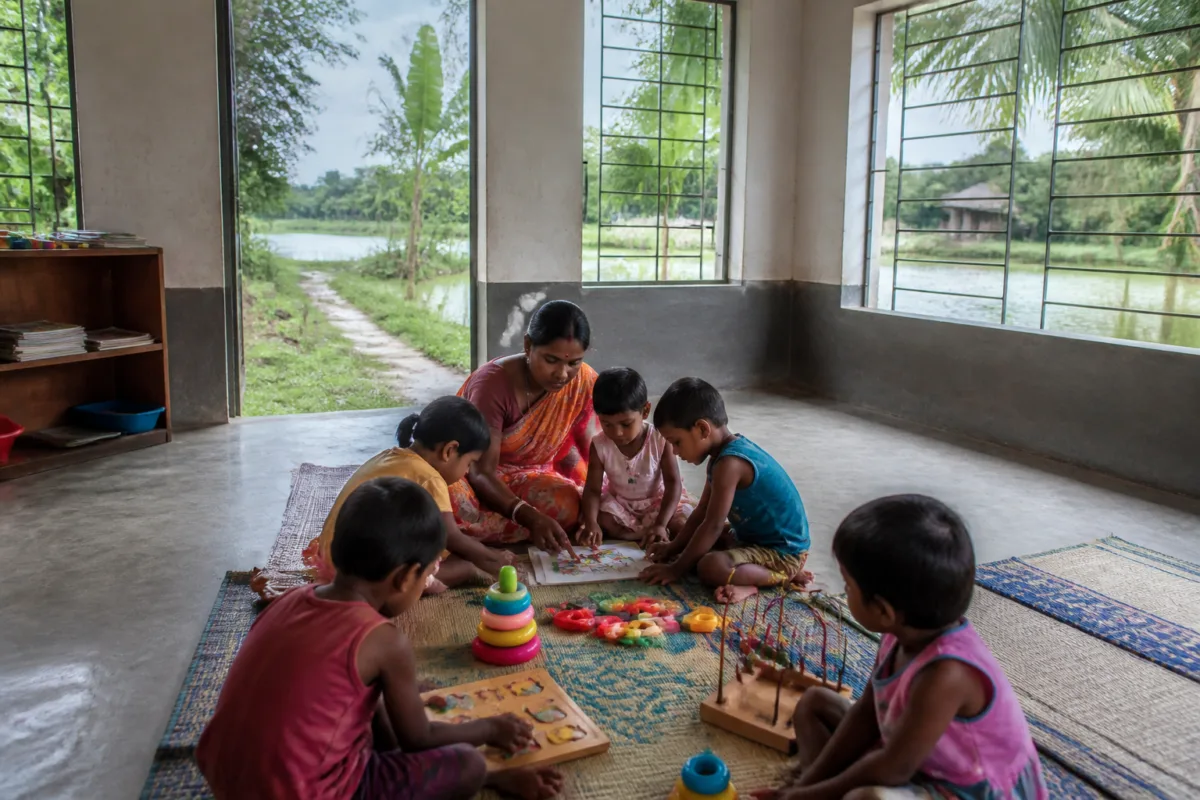
The recognition of Manju Pradhan and Sonamoni Halder, childcare workers serving remote communities in the Sundarbans, places an overlooked form of infrastructure at the centre of the conversation about child safety and household livelihoods. Their work through the Child in Need Institute’s KAVACH initiative is not limited to supervision inside a crèche. It connects daily care, early learning, family engagement and protection from a specific environmental hazard: the ponds and other open water bodies that are part of life in the Sundarbans.
Pradhan and Halder, who work in Kultali in South 24 Parganas, were among 14 care workers honoured at the India Childcare Champion Awards. The ceremony was organised by the Forum for Creches and Childcare Services with the Global Alliance for Care and Support and UN Women India to mark the International Day of Care and Support. Their recognition provides a useful lens for examining what childcare delivery requires in settlements where geography, safety and access to services are closely connected.
The award itself is a public acknowledgement. The larger issue is institutional: whether childcare is treated as an occasional welfare activity or as essential social infrastructure. A crèche enables children to remain in a supervised setting while families work. In a location where open water creates a stated drowning risk for young children, supervision also becomes a safety intervention. The KAVACH model described in the report combines childcare and early learning with measures intended to reduce children’s exposure to those hazards.
That combination matters because the risks facing young children do not exist separately from the way settlements function. A childcare space is located within a household economy, a community network and a physical environment. When caregivers engage families in keeping children safe, the service extends beyond the hours children spend at the centre. It attempts to make risk reduction part of everyday behaviour without removing childcare from its developmental purpose.
The available account does not establish how many children use KAVACH spaces, how many centres operate, or whether the initiative has recorded a measurable reduction in injuries. Those details are important for assessing scale and outcomes, but they are not provided in the report. What is established is the model’s operational logic: supervised care, early learning, caregiver involvement and attention to local hazards are being delivered together in Kultali.
## Care work as local infrastructure
Urban policy discussions often reserve the word infrastructure for roads, transport systems, drainage, water supply and public buildings. Childcare is less visible in that framework, even though it affects whether adults can work and whether children can remain safe while they do so. The KAVACH experience described by CINI presents care as a service that supports both households and the wider local economy.
The report quotes Sujoy Roy, CINI’s lead for Injury Prevention and National Advocacy, as saying that care protects lives, nurtures children and enables families to earn a living. His statement identifies three connected functions. First, care reduces the amount of time young children are left without supervision. Second, it supports early childhood development. Third, it allows family members to pursue work with greater assurance that children are being looked after.
This does not mean that a crèche can resolve the broader economic or environmental pressures facing Sundarbans communities. The supplied material does not make that claim. It does show, however, that the usefulness of a childcare service depends on how closely it is designed around local conditions. A standard facility without attention to open water hazards would not address the same risk profile as a community-based space that actively involves families in child safety.
The role of the caregiver is therefore wider than attendance management. Pradhan and Halder provide daily care and engage families. That makes them part of a local safety network as well as a childcare workforce. Their knowledge of the community can help connect formal service delivery with household routines, although the report does not provide detailed evidence on the training methods or the frequency of family engagement.
## Sundarbans childcare and the public-service gap
The story also highlights a recurring challenge in delivering public services to geographically difficult areas: access cannot be measured only by whether a scheme exists on paper. A service must reach households, function consistently and respond to local risks. In remote Sundarbans settlements, the report places community-based workers at the point where policy becomes a daily service.
KAVACH is implemented by CINI with funding from the Indian Council of Medical Research. That institutional arrangement is significant because it links a community organisation’s field presence with research-linked funding. The supplied material does not describe the funding period, budget, monitoring system or formal evaluation. It does indicate that the initiative has developed experience in community mobilisation, caregiver training, child safety and early childhood development.
CINI has said it is ready to use that experience to support the West Bengal government in implementing Palna, the Union Ministry of Women and Child Development’s quality crèche services scheme. This creates a possible bridge between a locally developed model and a government programme. Whether that bridge becomes operational will depend on decisions not detailed in the report, including the government’s requirements, financing, staffing arrangements, monitoring standards and geographical coverage.
The institutional question is not simply whether a community organisation can run a successful initiative. It is whether the lessons from such an initiative can be translated into a public system without losing the local knowledge that made it relevant. A scaled programme would need to retain the elements identified in the report—caregiver training, child safety, early learning and community mobilisation—while establishing clear standards for quality and accountability.
The awards gathering in Delhi brought together officials and representatives from organisations working on care. Those included Rashmi Singh, secretary of the Department of Women and Child Development, Government of the National Capital Territory of Delhi; retired Justice Gita Mittal; and Shoko Ishikawa, country representative of UN Women India. Discussions reportedly focused on strengthening childcare services and training, alongside fair remuneration, social protection and career opportunities for care workers.
These concerns point to the workforce conditions behind any childcare system. Recognition can raise the visibility of care work, but awards do not substitute for stable employment, adequate pay or professional development. The report does not state how Pradhan and Halder are compensated or what employment protections they receive. It does, however, identify fair remuneration and social protection as central issues discussed at the national event.
## What the available evidence shows
The evidence in the report is specific but limited. Two workers from Kultali were selected through an independent jury process as part of a group of 14 awardees. Their work is associated with a named initiative, a named implementing organisation and funding from ICMR. The service operates in an environment where ponds and other open water bodies pose a drowning risk to young children. The model combines supervised childcare and early learning with family engagement on safety.
Those facts support a clear conclusion: community childcare workers can perform a public-safety function when services are designed around the physical environment in which children live. They also support a broader conclusion about service design. The same facility can contribute to care, learning, injury prevention and household livelihood support when these objectives are planned together.
The evidence does not support larger claims about the prevalence of drowning, the number of children protected, the comparative performance of KAVACH, or the effectiveness of Palna in West Bengal. No such figures are included in the supplied report. Any assessment of impact would require data on enrolment, attendance, staffing, training, incidents, family participation and continuity of service.
That absence of data is itself relevant to the policy conversation. Recognition can draw attention to frontline work, but long-term public investment requires more than individual stories. It requires systems that can document who is being served, what risks are being addressed and whether the service remains available across seasons and changing local conditions. The source material does not say whether such a monitoring framework exists for KAVACH.
## The policy choice ahead
Palna is identified in the report as the Union Ministry of Women and Child Development’s quality crèche services scheme. CINI’s stated willingness to support West Bengal’s implementation places KAVACH within a policy transition from an individual initiative to a broader state-supported service framework. The next stage, according to the available material, is not a confirmed expansion but an expression of readiness to contribute experience.
That distinction matters. A proposal to support implementation is not the same as an approved partnership, a funded rollout or a government notification. The report does not provide a timeline, number of proposed centres or administrative decision. The immediate institutional question is therefore whether the state government will formally use the experience offered by CINI and, if so, how it will adapt that experience to programme standards.
For policymakers, the Sundarbans case raises practical questions about the design of childcare services in hazard-prone communities. Where should centres be located? What safety measures should be mandatory? What training should caregivers receive? How should families participate? How can workers be paid and supported? The report identifies several of these themes but does not provide the answers.
For families, the value of a crèche is experienced at street and household level rather than through programme terminology. It is measured in whether a child has a safe place to spend the day, whether early learning is available, and whether adults can work without leaving young children exposed to preventable risks. For the administration, the challenge is to ensure that these everyday outcomes are not dependent only on exceptional individuals or short-term projects.
The recognition of Pradhan and Halder therefore matters less as a ceremonial story than as evidence of where care infrastructure is actually being built: within communities, through trained workers and around local hazards. The report confirms the contribution of the two caregivers and the policy interest in strengthening childcare. It leaves open the questions of scale, funding, measurable outcomes and formal adoption. Those are the developments that will determine whether the lessons from KAVACH remain a recognised local practice or become part of a stronger childcare system in West Bengal.

