


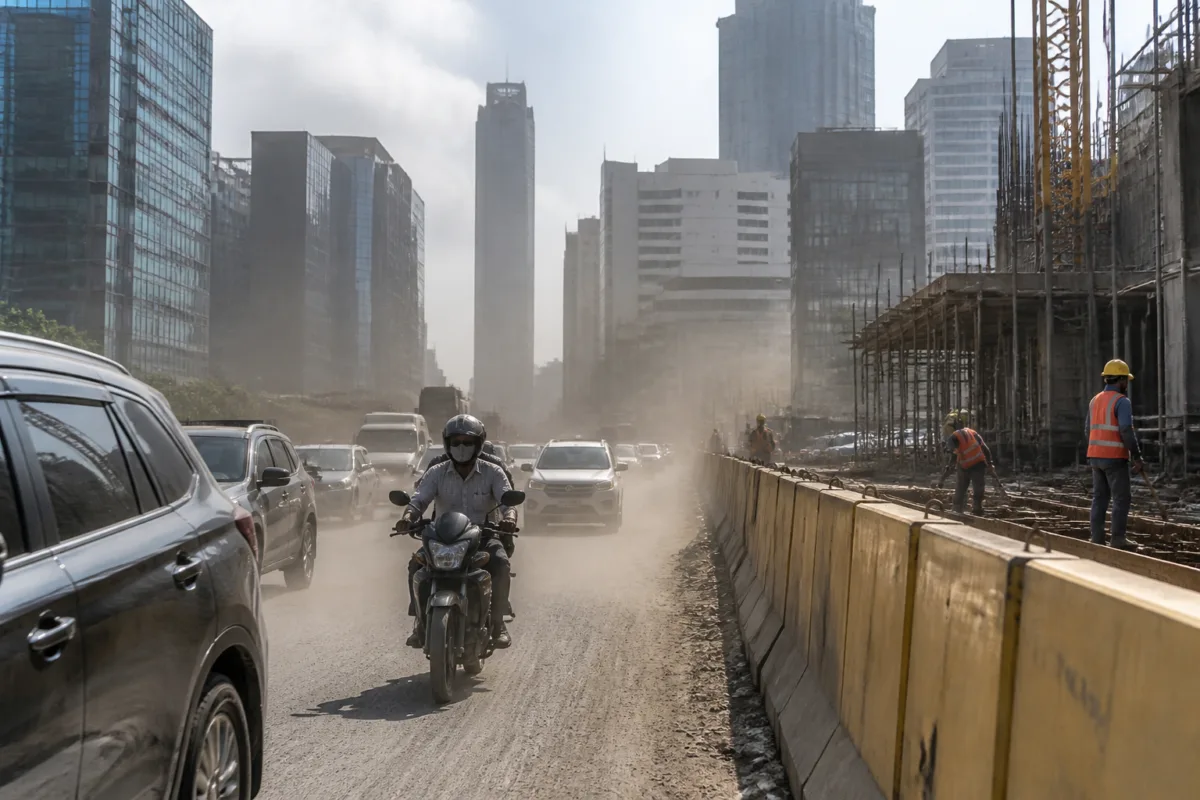
Mumbai’s annual PM10 pollution levels exceeded India’s national limit at 13 of the city’s 14 air-quality monitoring stations in 2025-26, with Chembur and the Bandra-Kurla Complex recording concentrations more than twice the prescribed standard, according to the BMC’s Environment Status Report 2025-26.
Both Chembur and BKC recorded annual average PM10 concentrations of 125 micrograms per cubic metre, against the Central Pollution Control Board’s national limit of 60 micrograms per cubic metre. Kandivali was the only monitoring location to meet the standard, recording 59 micrograms per cubic metre.
PM10 consists of particulate matter measuring 10 micrometres or less in diameter and can be inhaled. The sources identified in the report and accompanying observations include road dust, construction activity, vehicle emissions and dust resuspended from roads and open spaces. The data combine readings from nine SAFAR-Mumbai stations and five continuous ambient air-quality monitoring stations operated by the BMC.
Among the BMC-run stations, Shivaji Nagar in Govandi recorded the highest annual PM10 concentration at 93 micrograms per cubic metre, 55% above the national limit. Ghatkopar recorded 84 micrograms per cubic metre, followed by Sewri at 75, Byculla at 69 and Kandivali at 59.
Avinash Kate, BMC deputy municipal commissioner for environment and climate change, attributed part of Shivaji Nagar’s elevated reading to roadwork dust and a bakery that used wood instead of cleaner fuel. He said the bakery had since been shut. Kate also said construction dust accounts for nearly 9% of PM10 in past studies and that Mumbai has around 3,000 construction projects underway, meaning their contribution to particulate levels cannot be ruled out.
Kate described construction dust as largely a post-monsoon concern and said air quality remains more controlled during the rest of the year. He added that washing the wheels of vehicles involved in construction work is mandatory. The BMC has issued 28 guidelines for construction sites.
Bhagwan Kesbhat, founder of the Waatavaran Foundation, questioned how consistently those guidelines are being followed. He said construction sites sometimes install green cloth only around the active work area rather than covering the entire site. BKC’s high readings, he added, could be linked partly to infrastructure projects, including the bullet train project and Metro 2B between DN Nagar and Mankhurd.
BKC also recorded an annual average PM2.5 concentration of 48 micrograms per cubic metre, above India’s national limit of 40 micrograms per cubic metre. India’s annual PM10 standard is four times the World Health Organization’s recommended annual guideline of 15 micrograms per cubic metre, although the WHO guideline is health-based while India’s limit is a national regulatory standard. The BMC’s report provides the latest monitoring data; enforcement of construction controls and the next cycle of air-quality readings will determine whether the recorded breaches persist.

