


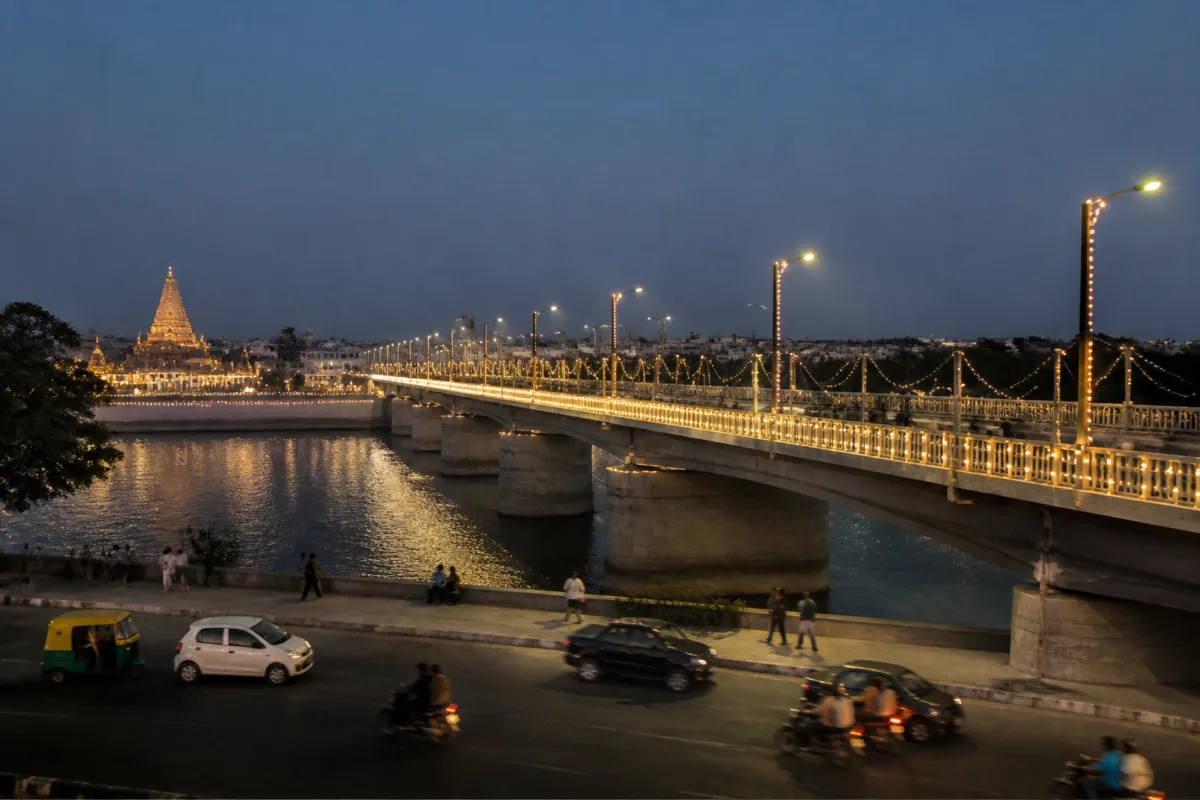
The Ahmedabad Municipal Corporation (AMC) has decided to restrict its official Diwali illumination to seven prominent locations and operate the decorative lighting for a limited period, citing the power crisis reported across Gujarat. The move will reduce the civic body’s usual festive lighting across bridges, public buildings, underpasses and traffic circles.
According to Nav Gujarat Samay, standing committee chairman Kamleshbhai Patel said the AMC would limit the illumination to Bhadrakali Temple and six bridges over the Sabarmati river. The report did not identify the six bridges or specify the revised operating hours.
The corporation has traditionally illuminated several prominent public assets during Diwali, including Sabarmati river bridges, Town Hall, Tagore Hall, underpasses and traffic circles. Patel said conserving electricity was appropriate while the state was facing a power shortage. He also pointed to the decorative lighting already installed in city markets as a reason to avoid extending municipal illumination across numerous additional locations.
The decision places the AMC’s festive lighting programme within a wider question of how civic bodies manage electricity use during periods of supply stress. Unlike private market and residential lighting, municipal illumination is funded and operated through public systems, making the scale, duration and location of such displays an administrative decision.
The report also records a separate instruction concerning water use in Ahmedabad. The engineering department has been asked to check the legality of water connections at vehicle service centres, guest houses, religious lodging facilities and paying guest accommodations that are suspected of using excessive quantities of water. Illegal connections are to be disconnected after verification, according to the report.
The direction comes as the civic administration considers water conservation alongside electricity savings. However, the supplied report does not provide details of the number of properties to be inspected, the criteria for identifying excessive use, or a timetable for the checks.
Questions were also raised in the standing committee about possible irregularities involving water tankers used by the gardens department. Much of the department’s work is reportedly carried out through private agencies. A BJP standing committee member sought details on the number and capacity of tankers used to water plants in the central verge, as well as the frequency of watering. The requested information is to be presented at a subsequent standing committee meeting.
The lighting restriction and the proposed water-connection checks are separate administrative measures, but both involve the municipal management of essential resources. The immediate next steps are the implementation of the seven-location lighting plan and the presentation of tanker-use details before the standing committee.

