


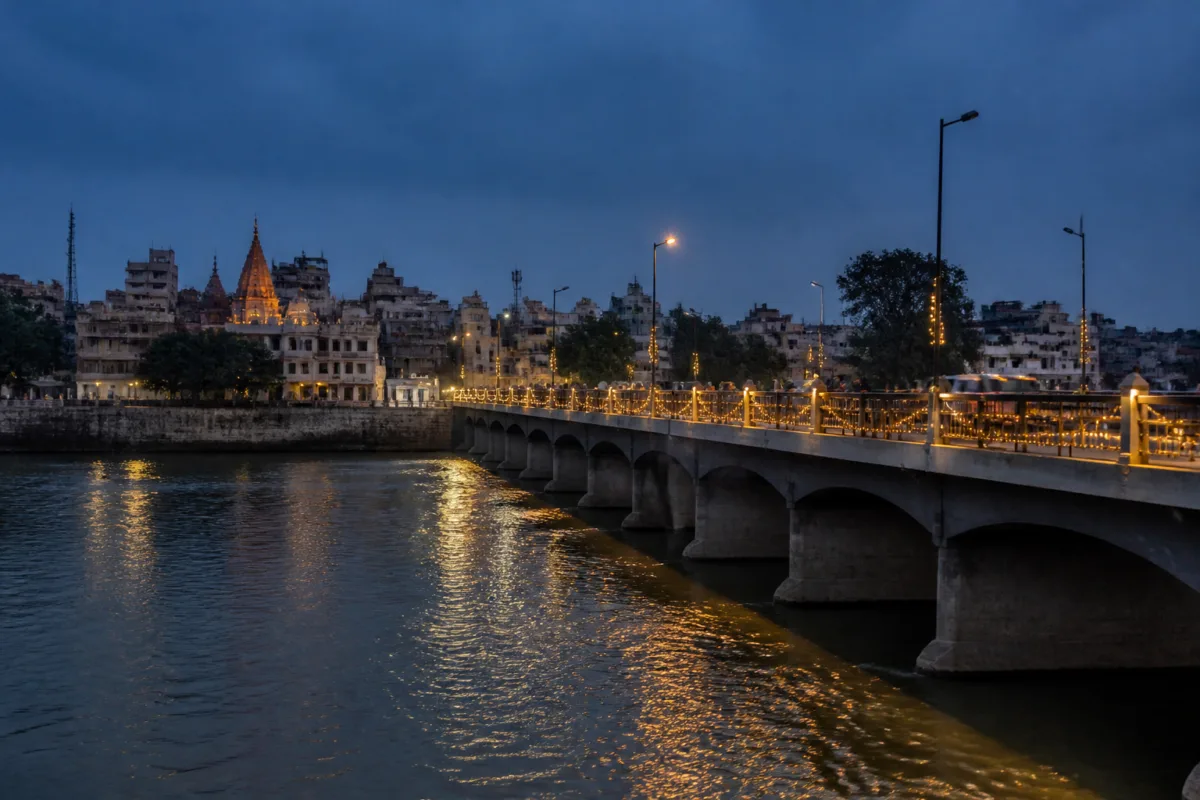
Ahmedabad Municipal Corporation’s Standing Committee has decided to sharply limit public Diwali lighting this year, reducing decorations to the Bhadra Kali Temple and six bridges over the Sabarmati River in an effort to save electricity and curb expenditure. The move is expected to bring the civic body’s festival lighting cost to less than 10% of the Rs 92 lakh spent last year.
The limited lighting will operate from Dhanteras to Labh Pancham, between 7 pm and 1 am, according to Standing Committee chairman Kamlesh Patel, as reported by Gujarat Samachar. Patel said the decision was taken to reduce electricity consumption and avoid what the committee considers unnecessary spending on public decorations.
Last year, Ahmedabad’s municipal authorities decorated around 118 public locations during Diwali. These included seven bridges over the Sabarmati, 45 road overbridges, seven underpasses, 46 traffic circles and 11 heritage gates. The committee’s decision means that most of these locations will not receive civic-funded lighting during this year’s festival period.
The Bhadra Kali Temple and six Sabarmati bridges will remain illuminated for six hours each evening during the selected period. The source report does not identify which six bridges will be included or provide the final estimated cost of the reduced programme. It also does not specify whether existing lighting contracts will be cancelled, amended or replaced for the limited installation.
The decision places festival decoration within a wider municipal question: how civic bodies allocate discretionary spending for public spaces while managing electricity use and essential services. In this case, the committee has linked the reduction directly to energy saving and expenditure control. The reported comparison with last year’s Rs 92 lakh bill provides the main financial basis for the change.
The Standing Committee also directed the municipal food department to require rapid testing kits at shops selling mawa, sweets and farsan with annual turnover above Rs 5 lakh. The requirement is intended to allow consumers to check for adulteration and potentially harmful substances, including colour and starch levels, according to the report.
The committee has instructed the food department to enforce the requirement strictly during the festival season. The report does not provide details of the approved testing-kit standards, the testing procedure, the agencies responsible for checking compliance or the penalties for shops that do not keep the kits. It also does not state whether the requirement applies only during Diwali or will continue throughout the year.
In a separate matter discussed by the committee, officials’ roles and responsibilities are to be examined after two people died and two others were injured in an incident at the Solanki sewage treatment plant, where workers reportedly fell inside after being affected by gas. The committee has directed that the responsibilities of both the contractor and municipal officials be investigated.
The lighting decision and the food-safety direction will now depend on implementation by the relevant municipal departments. The reported festival lighting schedule runs from Dhanteras to Labh Pancham, while the food department has been asked to enforce the rapid-testing requirement at eligible shops.

