


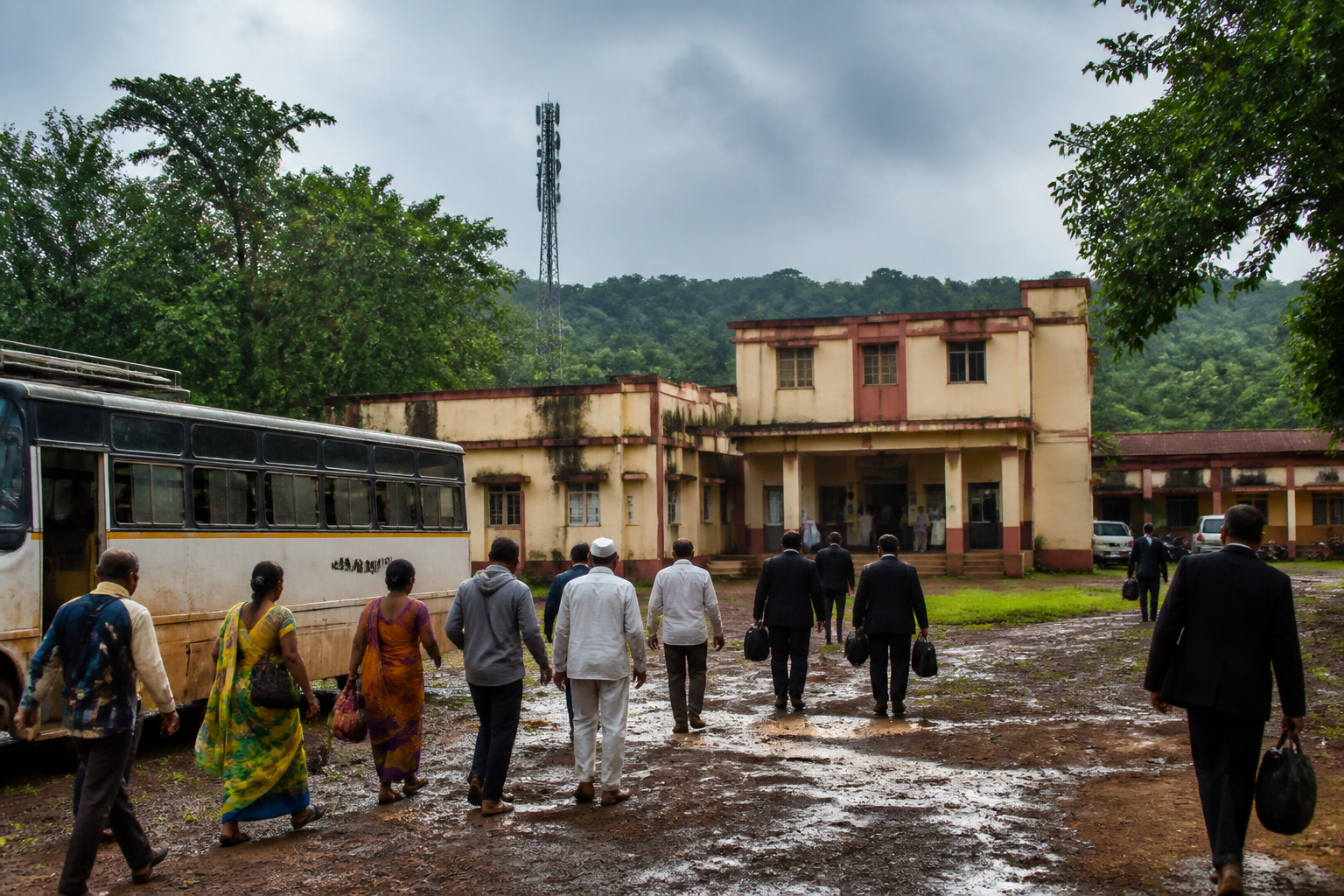
The Aheri court was created to bring trials closer to remote villages in Maharashtra’s Maoist-affected Gadchiroli district. Three years later, its 31 pending cases under the Unlawful Activities (Prevention) Act show that geographic proximity has not resolved the deeper problem: a court can be closer to citizens and still struggle to deliver timely justice when judges, prosecutors, witnesses, transport and video links are all constrained.
The additional sessions court, opened in 2023, was the result of a long-standing demand from local lawyers. They had sought a sessions court in Aheri since 2008, arguing that cases arising in the region should be heard closer to the communities and locations connected to them. The court has jurisdiction over more than 700 villages, including Etapalli, Bhamragad and Mulchera, across heavily forested areas. It is located more than 120 km from the Gadchiroli district headquarters.
The institutional purpose was straightforward: reduce the distance between the justice system and people living in a remote, difficult-to-reach region, while speeding up the disposal of serious criminal cases. But the numbers now point to a capacity problem. Court records cited in the report show that 31 UAPA cases were pending before Aheri as of July 31. Gadchiroli accounted for 33 of the 72 UAPA cases pending across Maharashtra, with the remaining cases spread across Mumbai, Pune, Thane, Nagpur, Nashik, Gondia and Aurangabad. A further 16 cases were before a Mumbai special court dealing with matters investigated by the National Investigation Agency.
The Aheri docket is particularly significant because most of the 31 cases have been pending for five years or more. Five cases had not yet reached the stage of framing of charges, while three were nearing conclusion. The cases largely involve alleged seizures of material or arms linked to Naxal groups, or allegations of violence and arson. The report does not establish that all pending cases will end in acquittal or conviction. It does, however, show that the time taken to reach a trial outcome has become a central feature of the justice process in the region.
That delay has a distinct consequence in UAPA cases. The law imposes stringent restrictions on bail. When proceedings extend for years, the gap between the presumption of innocence and the practical experience of incarceration becomes especially consequential for accused people who remain undertrials. The issue is not simply that a case is pending on a court register. It is that the pending case can determine whether a person remains in prison while the evidence is tested.
The recent outcomes at Aheri underline the importance of timely adjudication without establishing a general conclusion about every case. Three UAPA cases have been disposed of there since January, and all three ended in acquittals. In one case dating to 2016, a 38-year-old Etapalli resident accused of being part of a group that allegedly fired at police was acquitted in March after the court found there was no witness identification. He had been arrested four years earlier. He was acquitted again in July in another case involving violence in Etapalli in 2022.
In a third case, decided on September 1, a 45-year-old Bhamragad resident was acquitted after being accused of possessing a banner allegedly linked to Naxals. The court found no evidence that the banner had been recovered from him, or that he was a member of an unlawful association or involved in unlawful activity. He had remained in custody since his arrest in 2021.
These outcomes do not by themselves demonstrate a failure of prosecution in the entire docket. They do reveal the human and administrative stakes of a system in which cases can remain unresolved for years and evidence must still be assembled under difficult conditions. In the reported cases, the courts’ findings concerned basic evidentiary questions, including identification, recovery and proof of association. Such questions can be tested only through a functioning trial process.
The physical geography of the court is central to how that process works. Witnesses from interior villages often travel for hours by public transport through forested areas. They must reach the court, give evidence and leave in time to catch the last bus, usually around 4 pm or 5 pm. A government official cited in the report described ensuring that witnesses were present on time and completed their depositions before the last bus as a primary logistical challenge.
This turns public transport into an informal part of the court’s operating timetable. A hearing cannot be treated as a purely legal event when a witness’s ability to attend depends on the availability of a single return journey. If a deposition is delayed, or if a witness is not produced, the cost is measured not only in a rescheduled date. It can mean another journey of several hours, additional expense for the witness and another adjournment in a case that may already have been pending for years.
Presiding officers have asked police to ensure that witnesses are produced regularly and have scheduled depositions around local transport constraints. Police and medical witnesses who have been transferred to other districts also require coordination. These arrangements show that the court’s performance depends on agencies beyond the judiciary. The court may schedule a hearing, but police departments, prisons, transport systems and administrative officers determine whether the participants can actually reach it.
The court’s staffing history adds another layer to the problem. The Indian Express had reported that the Aheri court was without a judge for three months in 2025 and again in January. At the same time, around 200 undertrials were lodged in jails. A court established to reduce delay cannot meet that objective if its judicial capacity is interrupted or if the number of matters exceeds what its available officers can handle.
Two additional courts were added in April to the single functioning court in Aheri. Two of the three courts are designated to hear UAPA cases. The expansion is an important institutional response to the backlog, but its effectiveness will depend on whether the courts remain staffed, whether prosecutors and defence lawyers are available, and whether witnesses and accused people can be brought before them consistently.
The use of videoconferencing illustrates both the potential and the limits of a technology-based solution. Accused people held in jails more than six hours away, including Nagpur jail, are frequently produced through video links. This can reduce the need for long-distance prisoner transport and lower the administrative burden on prisons and police. It can also make routine production more practical when physical travel is difficult.
But courts have previously flagged patchy connectivity at the facility, describing the infrastructure as far from ideal. In a trial involving serious allegations and stringent bail conditions, a video link is not merely a convenience. It is part of the mechanism through which an accused person participates in proceedings. If the connection fails, the hearing may be deferred. If the link is technically available but unreliable, the expected efficiency of digital production is weakened.
The Aheri experience therefore points to a wider distinction between access and proximity. Establishing a court nearer to remote communities addresses one barrier: the distance to the courthouse. It does not automatically address the other barriers that determine whether a case can proceed, including vacancies, prosecution capacity, witness transport, prisoner production, police coordination and communications infrastructure.
That distinction is relevant to public administration well beyond Gadchiroli. Justice infrastructure is often measured through buildings, sanctioned posts or the creation of new jurisdictions. For residents, however, access is experienced through whether a witness can reach the court, whether a hearing takes place on the scheduled date, whether an accused person is produced, and whether the court has the staff and connectivity to complete the proceeding.
The distribution of pending UAPA cases also shows why a district-level response matters. While Mumbai had 19 pending cases, and other districts had cases in single digits, Gadchiroli’s concentration of 33 pending cases across the district placed a particularly heavy burden on the courts serving a large and difficult geography. The Aheri court’s 31 cases form the bulk of that district workload. A standardised approach that treats every court as facing the same logistical conditions may therefore miss the specific needs of remote, forested jurisdictions.
The policy question is not whether courts should be located closer to villages. The reported evidence supports that goal: the Aheri Bar Association said residents of nearby villages no longer had to travel to the Gadchiroli court for these cases. The harder question is what institutional support must accompany decentralisation so that a new court does not become a closer location for a backlog.
The answer, based on the difficulties described in the report, involves coordination across the justice system rather than a single intervention. Judicial appointments, designated UAPA benches, regular witness production, transport-aware scheduling, coordination for transferred police and medical witnesses, and dependable videoconferencing all affect disposal. The April addition of two courts is a measurable step, but the court’s ability to reduce the backlog will be visible only through sustained hearings and completed cases.
The Aheri court has already produced three acquittals since January, while 31 UAPA cases remained pending as of July 31. Those figures capture both movement and limitation: cases are being decided, but the overall docket remains large and most matters are old. The reported record does not provide a projected disposal date for the remaining cases, nor does it establish how the additional courts will change the pace of hearings.
What it does establish is that rural justice access is an infrastructure issue as much as a legal one. The court was created to shorten distance, but the functioning of justice still depends on roads and buses, prison logistics, telecommunications, judicial staffing and administrative coordination. The next measure of the Aheri experiment will not be the existence of the additional courts alone. It will be whether those courts can keep witnesses, accused people and officials present often enough to move long-pending cases towards a final determination.
