


Adani Airports’ expansion plan is linking airport infrastructure more closely to airport-city development, passenger capacity and commercial real estate. The company is raising Rs 9,825 crore in primary equity from a consortium that includes Alpha Wave Global, Premji Invest, Temasek and BlackRock-managed funds, while separately considering selected opportunities outside India, according to the Financial Times as reported by Moneycontrol.
The transaction values Adani Airport Holdings Limited, or AAHL, at a pre-money equity valuation of about $18 billion. The investors will subscribe to new shares in three tranches, with the final tranche expected to be completed by July 2027. Once all three tranches are completed, they are expected to collectively hold approximately 5.54% of AAHL.
The immediate significance of the deal is financial, but its stated uses point to a broader infrastructure strategy. AAHL says the proceeds will support the expansion and modernisation of its airport portfolio, the development of integrated Adani Airport City ecosystems and the scaling of passenger-facing and other non-aeronautical businesses, including ground handling. The company has identified approximately 22 million square feet of mixed-use development for the first phase of its airport-city plans.
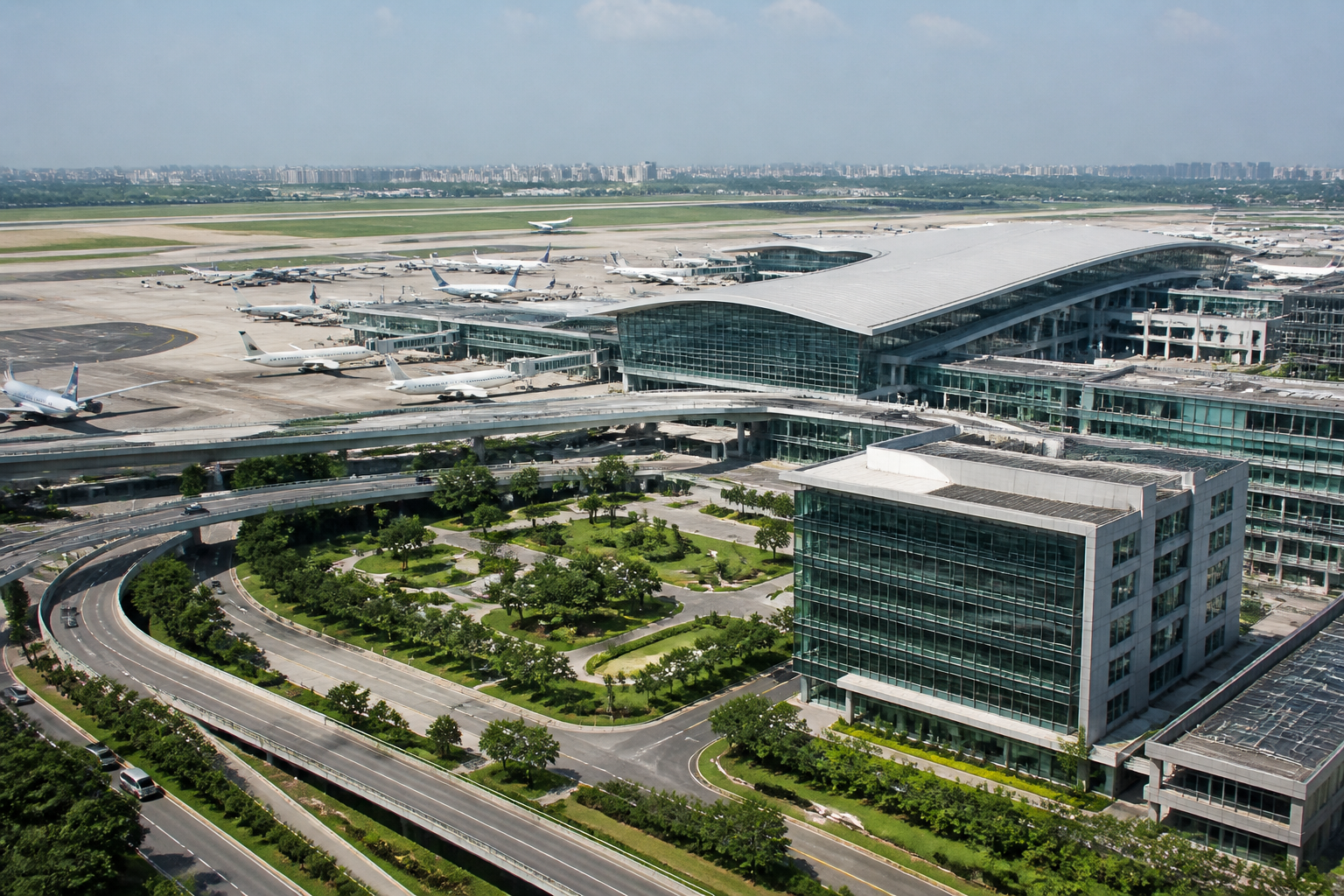
That combination matters because airports are no longer being developed only as aviation facilities. In the model described by AAHL, the airport becomes the anchor for a wider urban ecosystem containing commercial, hospitality, retail and other mixed-use activity. The airport’s passenger flows provide the initial demand base, while the surrounding development is intended to create additional revenue and economic activity on the city side of the terminal.
The company expects these investments to increase the annual capacity of its airport portfolio to about 200 million passengers. The supplied material says AAHL currently operates eight airports with total annual capacity of approximately 120 million passengers, and that the targeted expansion is to be achieved over the next five years. The company has not provided, in the material available here, a detailed airport-by-airport capacity schedule or a complete timeline for each construction package.
Jeet Adani, a non-executive director of AAHL, told the Financial Times that the company would pursue overseas opportunities “very selectively” and focus on opportunities “of size and relevance”. The remarks followed the company’s bid earlier this year to operate Sicily’s main airport. The report also linked the group’s international ambitions to its exploration of a possible bid for Associated British Ports in the United Kingdom. The supplied material does not establish that either overseas opportunity has been secured.
The distinction between an operating airport, a bid and an exploratory opportunity is important. AAHL currently operates only in India, according to the Financial Times report cited by Moneycontrol. Its international strategy therefore remains at the stage of selective pursuit rather than an established overseas operating platform. The capital raised through the current transaction is primarily intended to expand the company’s footprint and capacity in India, even as the group assesses opportunities abroad.
The structure of the fund-raising also indicates that the company is positioning airports as a long-duration infrastructure and urban-development asset. The investment is not described only as a means of financing runways, terminals or other aviation equipment. It is also intended to support city-side development and businesses that operate around the passenger journey. Ground handling, commercial activity and mixed-use development can give an airport revenue sources beyond aeronautical charges and airline-related operations.
This approach reflects the changing physical role of major airports in Indian cities. As passenger volumes rise, airports require more than terminal expansion. They need road and transit connections, parking and access systems, freight and service infrastructure, utilities, hotels, offices, retail areas and land-use coordination. Where airport-city development proceeds at scale, the airport can become a major node in the surrounding metropolitan economy rather than a facility separated from the rest of the urban system.
However, the supplied information does not establish how AAHL’s planned 22 million square feet will be distributed across locations, what land parcels are involved, or how the developments will connect to public transport and municipal infrastructure. It also does not provide projected employment numbers, investment by airport, construction schedules or details of the planning approvals required. Those gaps will matter for assessing how the airport-city concept translates into built projects and public infrastructure demand.
The proposed passenger-capacity increase is similarly a statement of corporate intent rather than a completed outcome. Moving from about 120 million to 200 million passengers annually would require substantial expansion across the eight-airport portfolio. The available material confirms the target and the funding priorities, but it does not specify the terminal, airside, access or utility works that would be needed at each airport. Nor does it state how passenger demand will be distributed among the airports.
AAHL’s stated strategy places commercial monetisation alongside capacity expansion. Jeet Adani described the investment as supporting infrastructure, city-side developments and non-aeronautical businesses. Arun Bansal, the company’s chief executive, described city-side developments as economic catalysts in major urban centres and connected the company’s ambition to rising consumer spending and growth in India’s aviation sector. These are company statements and should be read as the rationale offered by the airport operator for the investment.
The institutional context is also significant. AAHL is a subsidiary of Adani Enterprises Limited and is described in the supplied material as one of India’s largest private airport operators. The equity transaction follows a Rs 15,000 crore qualified institutional placement by AEL in July 2026, which the company described as the largest QIP by a non-financial corporate in India. Taken together, the two transactions indicate that the group is seeking long-term domestic and global institutional capital for infrastructure-related expansion.
For cities, the central issue is how private airport investment interacts with public planning responsibilities. Airport terminals and associated commercial districts may be developed by an operator, but their performance depends on roads, transit, water supply, power, waste management, drainage and land-use regulation involving public authorities. The supplied material does not specify the institutional arrangements for AAHL’s proposed airport-city projects, making it too early to assess how responsibilities, costs and approvals will be divided.
The same uncertainty applies to the relationship between airport capacity and metropolitan access. A larger terminal does not by itself resolve congestion on approach roads or improve connectivity for passengers and workers. The available information identifies capacity and mixed-use development targets but does not disclose the transport investments that will accompany them. Future project documents and approvals will therefore be necessary to understand the wider urban consequences of the plan.
The numbers provide the clearest outline of the strategy: Rs 9,825 crore of primary equity, an approximately $18 billion pre-money valuation, a potential 5.54% combined investor holding, about 22 million square feet of first-phase mixed-use development and a targeted increase from 120 million to 200 million passengers in annual capacity. Each figure describes a planned or contractual stage, not a completed infrastructure outcome. The final investment tranche is expected by July 2027, while the passenger-capacity target is framed over the next five years.
What the evidence confirms is that AAHL is pursuing an integrated airport-platform model in India, supported by institutional capital and supplemented by selective interest in overseas opportunities. What remains uncertain is how the airport-city developments will be planned, where the additional capacity will be created, how public infrastructure will support it and whether the international bids will progress beyond their current reported stages.
The next milestones are the completion of the three investment tranches, the release of more detailed airport expansion plans and the development of the proposed city-side projects. Those steps will show whether the strategy remains primarily a capital-raising exercise or becomes a larger transformation of the urban areas around AAHL’s airports.
