


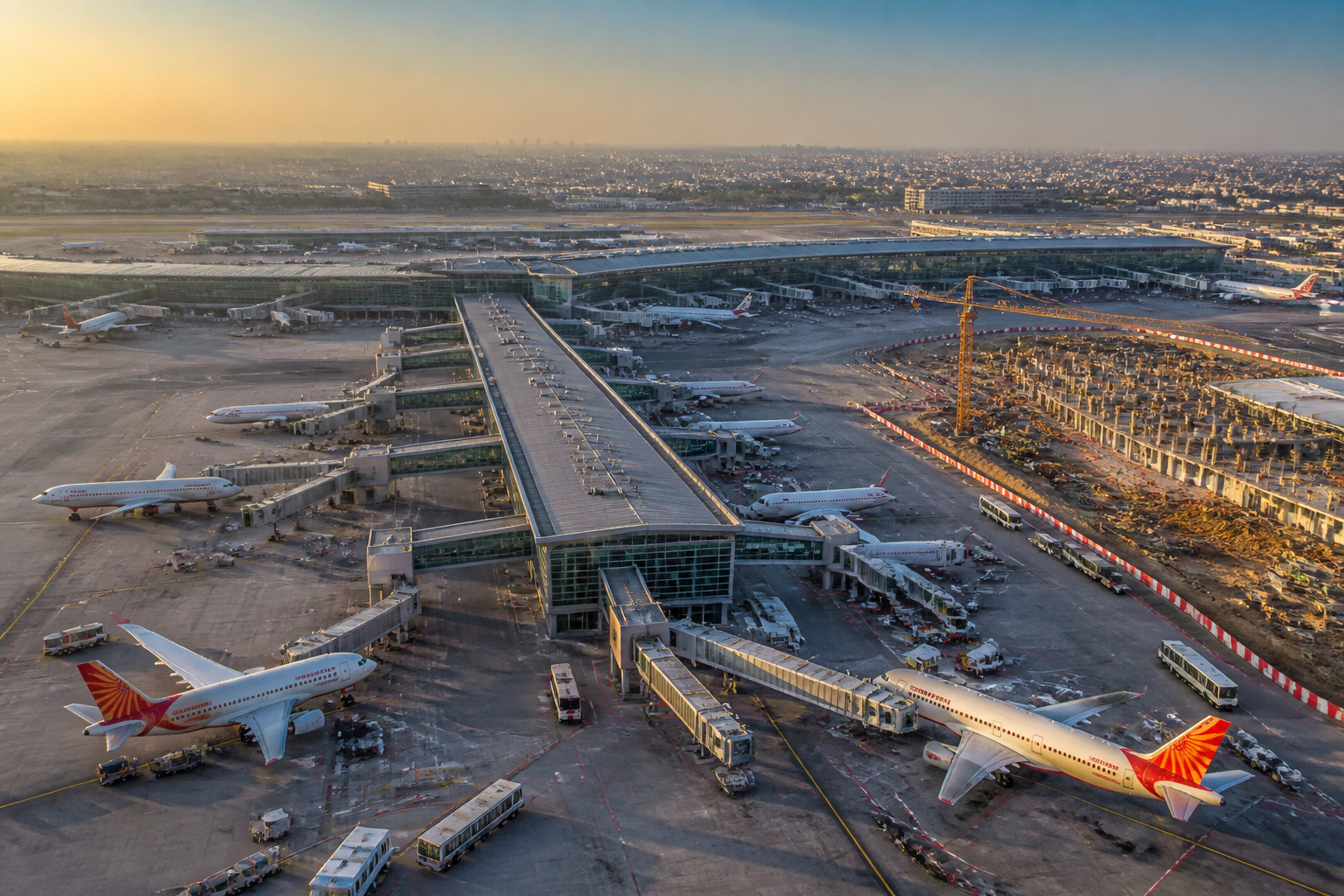
Delhi’s Indira Gandhi International Airport is preparing for a major increase in international passenger capacity, but the plan also exposes the difficult balancing act facing the National Capital Region’s airport system. The proposed expansion would add a new international pier at Terminal 3, make limited changes at Terminal 1 and defer a larger Terminal 4 decision until the next decade, while Greater Noida’s secondary airport remains in the shadow of the established Delhi hub.
The plan, shared by Delhi International Airport Ltd (DIAL) during a stakeholder consultation on August 16, aims to raise IGIA’s overall annual capacity from 10.4 crore passengers to more than 12.5 crore by early 2030. The plan is being finalised before submission to the aviation ministry, which will examine it as part of the approval process.
At the centre of the proposal is a new international pier, identified as Pier E, at Terminal 3. The pier is planned to add capacity of 1.6 crore passengers annually. With this addition, Terminal 3’s capacity would rise from 5 crore passengers per year to 6.6 crore. The international component would increase from 3 crore passengers to 4.6 crore, while domestic capacity would remain at 2 crore.
That split is important. The proposed expansion is not a broad increase across all terminals. It is primarily an international-capacity intervention, supported by a smaller domestic enhancement at Terminal 1. The figures indicate that DIAL is prioritising the part of the airport network where the master plan expects the strongest requirement by 2030.
Terminal 1 would receive additional check-in and security counters, taking its planned capacity from 4 crore passengers annually to 4.5 crore. The source report says this would be achieved through internal changes, without altering the terminal’s structure. Terminal 2, which currently has capacity of 1.4 crore passengers a year, would continue in its existing form for some years.
The eventual replacement of Terminal 2 is being considered through a larger Terminal 4. However, that decision has been deferred to the next decade and would depend on demand. This creates a phased development model: immediate investment in international capacity at Terminal 3, limited optimisation of Terminal 1, continued use of Terminal 2 and a larger terminal decision at a later stage.
The sequencing reflects the institutional mechanics of airport planning. DIAL is developing the master plan, but the plan is being finalised with stakeholders and must be submitted to the aviation ministry. The airport operator therefore cannot treat terminal expansion as an isolated construction decision. Capacity planning has to move through consultation and government review before the proposed changes can become an approved development programme.
The plan also has consequences beyond the airport boundary. Delhi-NCR now has a secondary airport in Greater Noida, but the report notes that it is struggling to attract flights and passenger footfalls in comparison with IGIA. This creates a regional distribution problem. The existence of a second airport does not automatically produce a balanced airport system if airlines and passengers continue to concentrate activity at the principal hub.
That concentration helps explain why IGIA’s master plan is focused on expansion even as another airport is available within the wider region. The proposed increase would take IGIA’s capacity beyond 12.5 crore passengers annually, while the larger Terminal 4 decision is being held back until demand becomes clearer. In effect, the plan attempts to add capacity where demand is currently strongest without immediately committing to the biggest possible terminal project.
The numbers also show the limits of incremental changes. Terminal 1’s proposed increase is 0.5 crore passengers annually, while the new Pier E would add 1.6 crore. Together, these changes would provide 2.1 crore passengers of additional annual capacity, taking the airport’s stated total from 10.4 crore to more than 12.5 crore. Most of the planned increase would therefore come from the new international facility rather than from domestic terminal adjustments.
For passengers, the immediate significance lies in how the airport’s international processing capacity is organised. The report does not establish the operational details of the new pier, including its construction schedule, cost, airline allocation or the precise approval timeline. It does establish that international capacity at Terminal 3 is planned to rise by more than 50%, from 3 crore to 4.6 crore passengers annually, while overall airport capacity would grow by roughly one-fifth from the current level.
The distinction between these two growth rates matters. A 50%-plus increase in international capacity is substantially larger than the overall increase because domestic capacity is being expanded only marginally. The master plan is therefore not simply an airport-wide growth projection. It is a reconfiguration of capacity towards international traffic, with Terminal 3 serving as the principal expansion point.
The plan’s treatment of Terminal 2 provides another indication of the phased approach. Rather than immediately replacing the terminal, DIAL plans to continue using it for some years. A larger Terminal 4 could be developed sometime in the next decade, but only depending on demand. This leaves the final scale and timing of the airport’s next major terminal investment unresolved.
That uncertainty is linked to the wider NCR airport network. If Greater Noida attracts more flights and passengers, the pressure for immediate expansion at IGIA could change. If passenger and airline activity remains concentrated at IGIA, the case for additional capacity at Delhi’s primary airport could strengthen. The supplied report does not provide traffic forecasts or an airline-by-airline allocation, so the relative future roles of the two airports cannot yet be established from the available information.
What is clear is that Delhi’s airport planning is moving through a staged approval process rather than a single construction announcement. DIAL has shared the 10-year master plan with stakeholders, plans to submit it to the aviation ministry, and is proposing different interventions for each terminal. The new international pier is the most immediate capacity measure, Terminal 1 is being optimised within its existing structure, and Terminal 4 remains a later decision.
The plan therefore makes IGIA’s international growth the immediate priority while leaving the long-term airport configuration open. Its final impact will depend on the ministry’s consideration, the completion of the master plan and the demand conditions that determine whether Terminal 2 is eventually replaced by a larger Terminal 4. Until those steps are completed, the announced figures represent a proposed capacity framework rather than an approved final build-out.
