


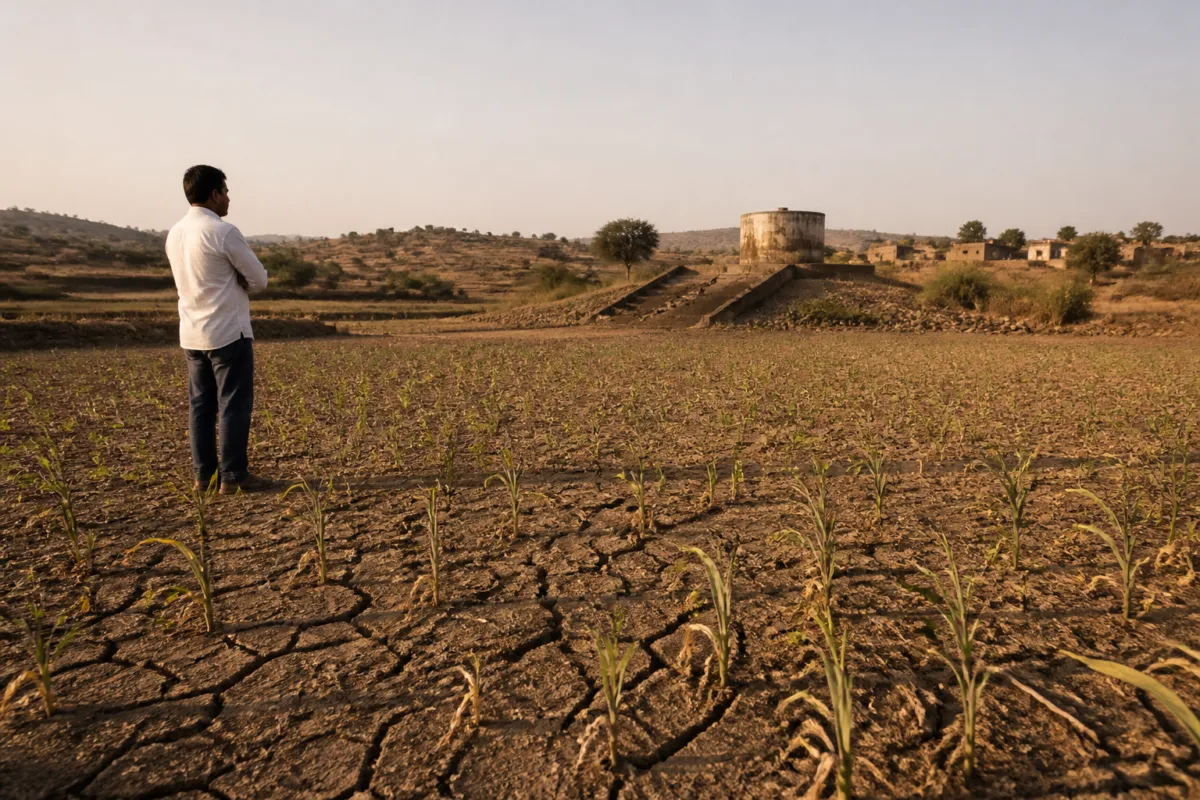
A study of 44 years of district-level data has identified Ahilyanagar, Beed, Dharashiv, Sangli and Solapur as Maharashtra’s most vulnerable areas for severe and rapidly intensifying flash droughts, highlighting the need for water managers to track soil moisture and atmospheric conditions alongside rainfall.
Researchers from the Department of Civil Engineering at Maulana Azad National Institute of Technology (MANIT), Bhopal, analysed data from all 36 districts between 1981 and 2024. Their findings, published in the journal Physics and Chemistry of the Earth in October 2026, show that soil dryness in the five interior districts worsened by six to nine percentile points every eight days during flash-drought events. In some areas, the rate exceeded nine points.
Flash droughts differ from conventional droughts because they can develop within weeks rather than over an entire season. The rapid decline leaves farmers and district administrations with less time to adjust irrigation, protect crops or manage water supplies.
“Flash droughts do not give the warning that a slow drought does, because a field can move from normal moisture to severe dryness in a matter of weeks,” said Vikas Poonia, the study’s corresponding author and an assistant professor at MANIT.
The study found that flash droughts were uncommon during the monsoon, when regular rainfall generally maintained soil moisture. Most districts recorded fewer than two such events during the monsoon months over the 44-year period. Outside the monsoon, districts averaged about 20 events, while Solapur, Dharashiv, Ratnagiri and Sindhudurg recorded more than 25.
The highest-risk period was the transition from the dry season to the monsoon. During this window, temperatures can peak before rainfall arrives. Several districts recorded their longest flash droughts in this period, with some events lasting 30 to 40 days. Events during the dry season typically lasted 20 to 25 days.
The findings are significant for district-level water planning because the triggers do not operate in isolation. Rainfall deficit was the main cause across much of Maharashtra, particularly in western and central districts such as Pune, Nashik, Satara, Kolhapur, Ratnagiri and Sindhudurg. High temperatures alone rarely triggered flash droughts, but they accelerated drying when combined with a prolonged dry spell.
In Wardha, Yavatmal and Nagpur, the study observed the role of heat in worsening moisture loss. Around Solapur, rainfall deficit, high temperatures and already-dry soil acted together. As a flash drought develops, soil moisture falls by about 17 percentile points, while hotter and drier air increases the atmospheric demand for moisture from soil and plants.
“Rain failure is usually what starts a flash drought, but it is heat and dry air on top of that dry spell that decide how bad it gets,” said Deepika Yadav, the study’s co-author. She said monitoring systems should track temperature and soil moisture as closely as rainfall, particularly in the weeks before the monsoon.
The pattern is not uniform across the state. Wetter eastern districts, including Gadchiroli, Chandrapur and Bhandara, also experienced flash droughts, but their intensity and speed were lower than in the semi-arid interior. Coastal districts such as Ratnagiri, Palghar, Thane and Sindhudurg generally recorded milder and slower events because of higher rainfall and humidity.
The researchers found statistically significant long-term increases in flash-drought frequency in Dharashiv and Washim. The rate at which events intensified increased significantly in Solapur and Sindhudurg, while most other districts did not show a statistically significant trend.
The study’s findings come after what the report describes as a weak 2026 southwest monsoon, which ended 13% below the long-period average, with drought conditions continuing in parts of Maharashtra into October. The report also says El Niño is expected to continue into early 2027. However, the researchers clarified that their study did not examine El Niño directly.
Poonia urged administrations and farmers in the identified hotspots to prepare for the possibility of a hotter and drier period before the next monsoon, noting that this was the window when the study found flash droughts to be most frequent and longest-lasting.
One potential support tool is KrishiDrought.in, a public portal launched by an IIT Bombay research group. The portal provides weekly agricultural drought forecasts at district level for up to four weeks, combining satellite-based soil-moisture observations, weather records and deep-learning models.
The portal’s indicators align with several factors identified in the MANIT study, including soil moisture, rainfall, temperature and atmospheric dryness. The researchers recommend incorporating these measures into drought preparedness, water management and climate-resilient farming strategies, particularly in Maharashtra’s semi-arid interior.
For urban and regional authorities, the findings point to a planning challenge beyond seasonal rainfall forecasts. Water systems and agricultural support programmes may need to respond to rapid changes in soil and atmospheric conditions, rather than treating drought only as a cumulative rainfall deficit. The study’s central message is that earlier detection could give district administrations and farmers a limited but valuable window to act before crop stress and water shortages deepen.

