


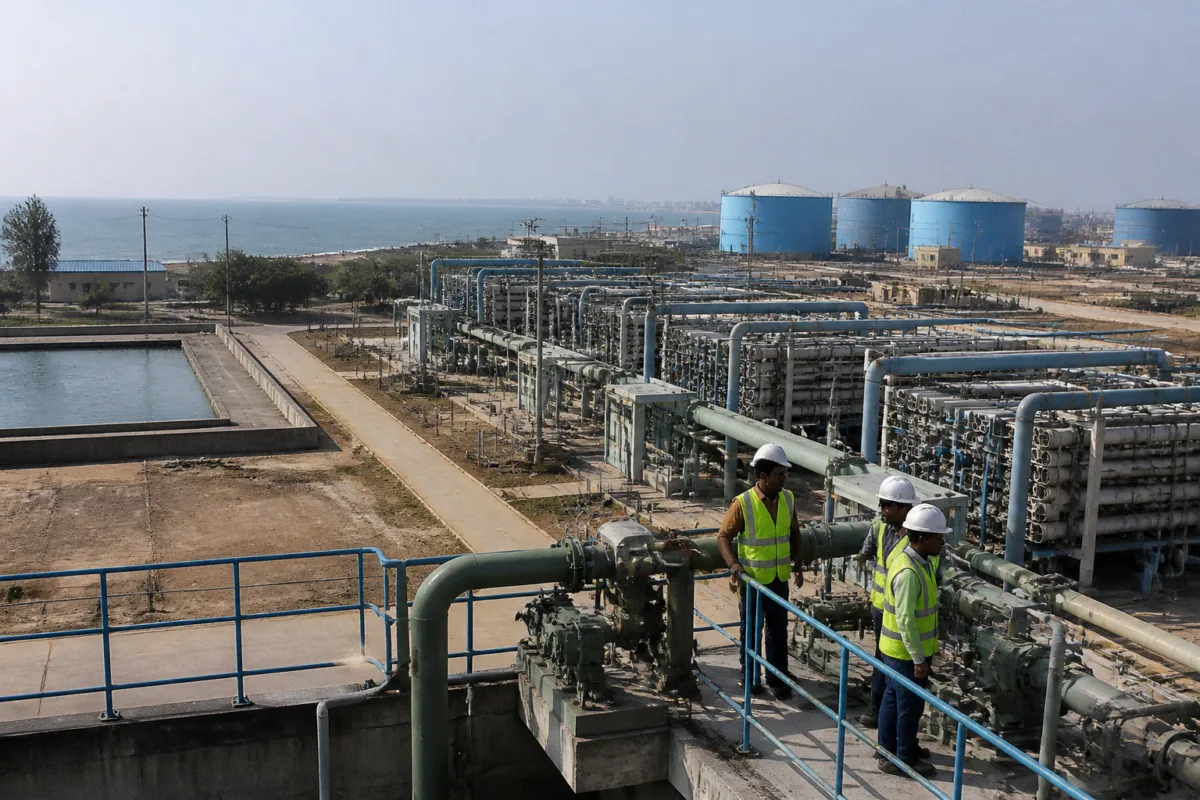
Chennai is increasing reliance on desalination as water levels in its reservoirs remain well below last year’s position, with the city’s two Nemmeli plants expected to reach their combined rated output by mid-December and work progressing to revive the defunct Minjur facility.
The four city reservoirs and the Kannankottai-Thervoykandigai reservoir together held 4,577 million cubic feet (mcft) of water, according to data cited by The New Indian Express. On the corresponding day last year, combined storage was 8,821 mcft.
Kannankottai-Thervoykandigai, which has a capacity of 500 mcft, held 244 mcft. Chembarambakkam, with a capacity of 3,645 mcft, held 1,283 mcft. Poondi had 575 mcft, Cholavaram 173 mcft and Red Hills 2,302 mcft.
The figures have prompted Chennai Metro Water to maximise production from its existing desalination infrastructure before the summer demand period. The 110 million litres a day (MLD) and 150 MLD plants at Nemmeli are currently supplying about 100 MLD each. A Metro Water official said both plants are expected to reach full production capacity by the middle of December.
Daily utility data showed that the plants produced 100.13 MLD each on November 18. Their output on the corresponding day last year was 70.92 MLD and 70.85 MLD, respectively, indicating higher current production despite the pressure on reservoir storage.
Metro Water is also working to upgrade the Minjur desalination plant, which is currently defunct. The facility is expected to resume operations by January, according to the report. The longer-term expansion includes a 400 MLD desalination plant under construction at Perur, which is scheduled for completion by September 2027 under the project contract.
Chennai’s total daily water supply stood at 1,240 MLD, including 1,182.70 MLD supplied to the city and added areas. At this rate, the monthly requirement is about 1 trillion cubic feet (TMC), according to the report.
The immediate concern is the gap between current reservoir storage and last year’s level as the northeast monsoon has yet to replenish the lakes. The Metro Water official said it was too early to predict whether Chennai would face a repeat of the severe water scarcity experienced in 2019, noting that the reservoirs had filled during a single spell of rain last year and that a similar spell could still occur this season.
The response under way combines higher output from existing desalination plants, the proposed restart of Minjur and the construction of new capacity at Perur. The sequence highlights the role of desalination as a buffer for Chennai’s water system when monsoon inflows and reservoir storage are uncertain, while also leaving the city’s near-term outlook dependent on rainfall that has not yet arrived.

