


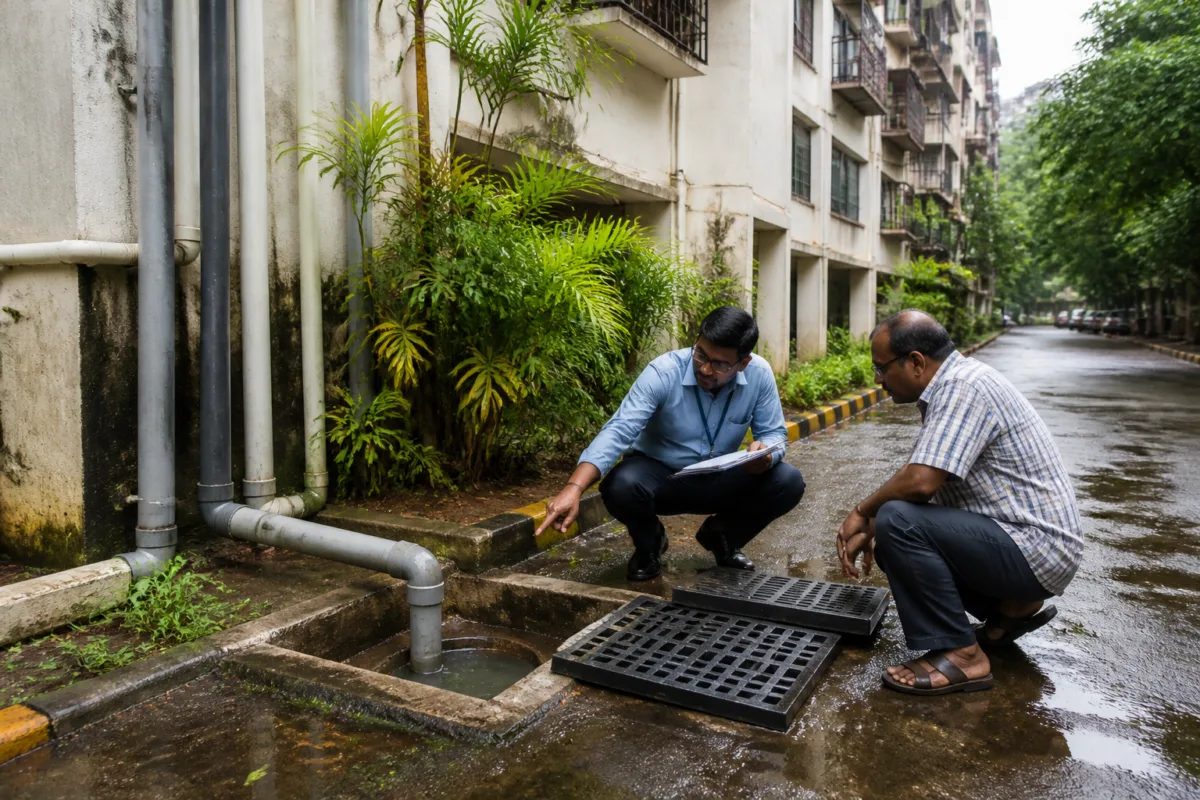
Buildings in Chennai will receive completion certificates only after civic officials verify that their rainwater harvesting (RWH) systems are functional, Greater Chennai Corporation Commissioner G S Sameeran said on Thursday.
The requirement was announced during a stakeholder meeting organised by the civic body with the Confederation of Real Estate Developers’ Associations of India, the Chennai Metropolitan Water Supply and Sewerage Board, resident welfare associations and non-governmental organisations. The meeting was held to promote rainwater harvesting through the ‘Thuli’ people’s movement.
The move shifts scrutiny from the mere presence of an RWH structure to its working condition. Sameeran said copies of Government Order 193, issued by the municipal administration and water supply department on January 2, would be distributed to resident welfare associations. Residents would also be trained to maintain and repair the structures, he said.
According to a CMWSSB survey of 10 lakh properties, six lakh had functional rainwater harvesting structures. The corporation aims to increase the number of functional systems to 13-14 lakh buildings, covering at least 70% of the 17 lakh properties assessed in the city wherever feasible, particularly in larger buildings.
Government Order 193 includes schematic diagrams and construction guidelines based on soil types, according to Sameeran. The requirement is expected to make the operation and maintenance of RWH systems a more important consideration for building owners, resident associations and developers seeking completion certification.
Chennai requires 1,246 million litres of water a day, Sameeran said. Around 80% of the supply comes from reservoirs including Poondi, Puzhal and Chembarambakkam, while desalination plants contribute about 12% and groundwater about 6%.
He said the groundwater level was recorded at 5.6 metres above the aquifer in 2026, compared with 7.9 metres during previous years of heavy rainfall. The city had received 612 mm of rain against an annual requirement of 850 mm, while reservoir storage stood at an average of 41%, compared with a usual level of about 60%. The corporation was hoping for rainfall between November 23 and 26 to replenish the reservoirs, he said.
The commissioner also acknowledged maintenance problems affecting civic rainwater harvesting infrastructure. The Greater Chennai Corporation has created facilities in 1,858 buildings, 1,013 parks and 87 major playgrounds, as well as along 30,000 stormwater drains covering 3,000 km. Some of these facilities have been damaged over time, he said.
Responding to questions about structures developed using German technology at wells in the Vadapalani and Chitrakulam temples, which were later left unattended, Sameeran said there were two types of sponge parks. He said the type using plastic eco-blocks with a honeycomb-like structure might not be suitable for every location.
The corporation is rejuvenating 245 ponds and plans to develop sponge parks using the natural gradients of the land, including at playgrounds. A sponge park at Mathur MMDA Colony was inaugurated by the chief minister on Wednesday.

