


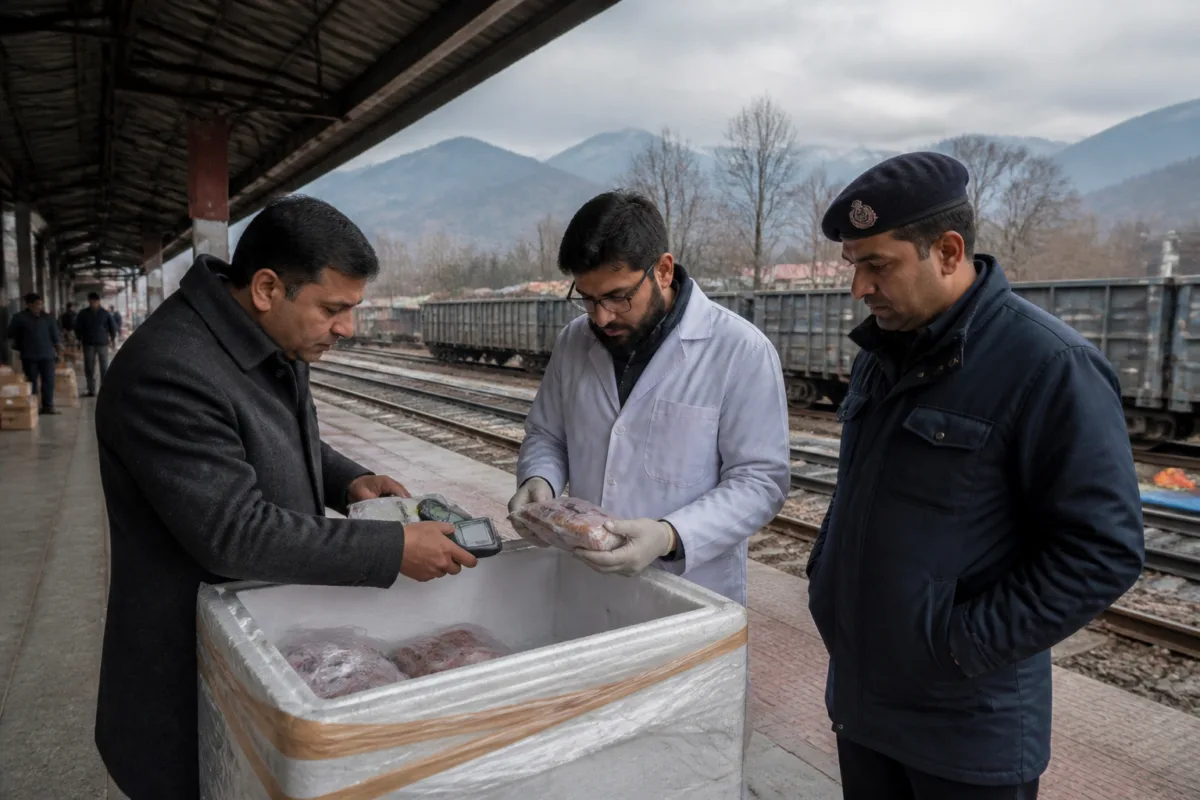
Kashmir’s frozen-meat supply chain has come under scrutiny after the Jammu and Kashmir Food and Drugs Administration (FDA) seized and destroyed approximately 1,600 kg of frozen meat at Budgam railway station, saying the consignment had been transported as “general goods” without the disclosures and temperature controls required for highly perishable food.
The FDA said its Budgam team acted on information provided by Railway Police authorities. According to the department, the consignment had been sent through railway parcel services from M/s Al Nida Foods at Ghazipur in Delhi to Ayaan Manzoor, a Bemina resident, through Tultrav Courier Agency in Bemina. The agency said the commodity’s nature had been misrepresented and that the consignment lacked proper arrangements to maintain frozen conditions.
The incident has drawn attention to how food is moved into the Valley, where rail parcel systems, courier agencies, recipients, municipal authorities and food-safety regulators intersect. The FDA said the consignment had been booked under the general parcel category, apparently to circumvent requirements governing the transport of highly perishable food products under the Food Safety and Standards Act, 2006. It also reported discrepancies in the commodity description and violations of labelling requirements.
The department said the transporter and intended recipient did not hold the mandatory Food Safety and Standards Authority of India licence required under Section 31 of the Act. It said the alleged violations attracted penal provisions under Section 63. Notices have been issued to the concerned persons and entities, while further legal proceedings are being initiated. The FDA also said it had taken up the matter with railway authorities and stressed that perishable food should be transported by licensed food business operators in temperature-controlled conditions with proper declarations and documentation.
The seized material was destroyed through the Municipal Committee, Budgam, at a designated disposal site, according to the FDA. That action placed a local civic body at the final stage of the enforcement chain, after the consignment had travelled through a regional transport network and reached a railway station. The case therefore extends beyond the condition of a single shipment: it raises questions about whether the category under which goods are booked, the declared contents, licensing and cold-chain conditions are being checked consistently at each point of transfer.
The disclosure followed a seven-day ultimatum from the Chamber of Commerce and Industry Kashmir after Railway Police recovered the consignment. CCIK president Tariq Ghani criticised food-safety and municipal authorities and described the circulation of rotten and adulterated meat as a public-health concern. Those comments are the chamber’s assessment; the specific findings about the Budgam consignment have been attributed to the FDA.
The FDA linked the latest seizure to similar enforcement activity in 2025. It said frozen meat and meat products that breached prescribed requirements were seized from five businesses: 1,200 kg from Sunshine Industries in Zakura, 500 kg from Al-Taqwa in Lasjan, 1,400 kg from M. M. Foods in Haji Bagh, HMT Srinagar, 420 kg from Niyaz Ahmad Kawa in Aali Kadal and 520 kg from Al-Azeem Enterprises in Manderbagh, Srinagar.
The department said the additional deputy commissioner, Srinagar, imposed penalties of Rs 4 lakh, Rs 5 lakh, Rs 4.40 lakh, Rs 1.25 lakh and Rs 17,500 in those cases. It added that two samples examined by the ICAR-National Meat Research Institute in Hyderabad were identified as buffalo meat. The FDA has also issued a prohibitory order restricting the transportation, storage and sale of frozen food without prescribed temperature-control arrangements and mandatory labelling under the Food Safety and Standards (Labelling and Display) Regulations, 2020.
Following the Budgam seizure, the FDA said it conducted 364 inspections, suspended nine FSSAI licences and registrations, issued 21 improvement notices and recommended 31 cases for adjudication over sanitary and hygienic violations. Across the Union Territory during 2026-27, it reported 12,778 inspections, 7,266 enforcement samples and 2,857 surveillance samples sent for analysis through NABL-accredited laboratories.
The department also said earlier funding constraints had affected the procurement of technical staff, certified reference materials, chemicals and glassware for government food laboratories. It said the Food Safety and Standards Authority of India approved its three-year action plan on October 30, 2026, covering 2026-27 to 2028-29. The plan includes recruitment of laboratory analysts, microbiologists and drivers, procurement of laboratory supplies and maintenance contracts for high-end equipment at the Srinagar and Jammu laboratories.
According to the FDA, procurement through the Government e-Marketplace portal was at the final stage, while the purchase of laboratory materials was expected to be completed within two weeks. Method validation was also in progress, with the stated aim of improving the operation of government laboratories and mobile food-testing vans across the districts.
The Budgam case shows that food safety in a city-region depends not only on inspections at shops and markets but also on accurate declarations, licensing, railway parcel controls, cold-chain infrastructure, laboratory capacity and municipal disposal systems. The FDA’s enforcement measures and planned laboratory upgrades indicate an institutional response, while the unresolved issue is whether these controls will be applied consistently before unsafe or improperly documented consignments enter the wider market.

