


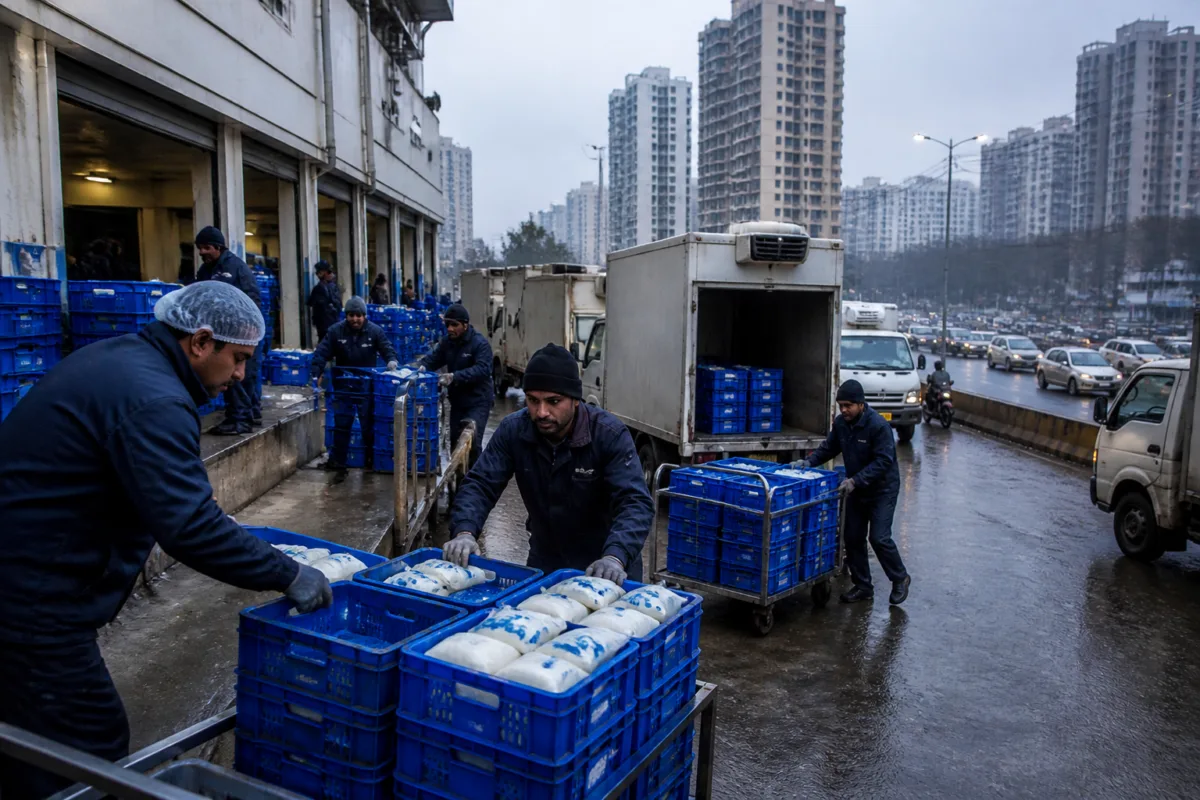
Milk prices in India have risen by Rs 4-8 per litre during FY27, but the significance of the increase lies beyond the immediate impact on household budgets. According to a November 18 report by CareEdge Ratings, leading dairy companies raised prices in May and November as procurement costs, milk availability, milk-fat content and processing expenses came under pressure. The increases have arrived during the winter flush season, a period that normally improves supply and moderates procurement costs.
The latest price movement therefore points to a more complicated problem than routine inflation. India’s dairy system is producing more milk overall, yet the supply available to organised processors is not expanding smoothly enough to absorb rising demand and operating costs. The result is a market in which the country’s large production base coexists with tight procurement conditions, lean inventories and increasing dependence on processing and distribution networks.
Gujarat Cooperative Milk Marketing Federation, which sells products under the Amul brand, and Mother Dairy raised retail milk prices by around Rs 2 per litre in May. They followed this with further increases of Rs 2-6 per litre in November. CareEdge attributed the revisions to lower-than-expected milk availability during the current winter flush season, reduced milk-fat content in some procurement regions and competition among cooperative and private dairies for raw milk.
The timing is important because October to February is usually associated with stronger milk production. Cooler temperatures, better fodder availability and improved animal productivity generally support higher procurement during these months. This seasonal pattern provides dairies with additional supply and can help contain costs. The current season, however, has not delivered the expected degree of relief.
CareEdge Assistant Director Komal Israni said the November revisions reflected higher milk procurement, processing, packaging and logistics costs. She also pointed to the cyclical dip in production associated with the biological characteristics of cattle, elevated fodder costs and relatively lean skimmed milk powder inventories. On that assessment, milk prices are likely to remain firm through the rest of FY27, although the report does not quantify future retail increases.
India remains the world’s largest milk producer, accounting for nearly 25 per cent of global output. Milk production is estimated to have risen 3.6 per cent year-on-year to 256.8 million tonnes in FY26, from 247.9 million tonnes in FY25. Per-capita milk availability also increased to around 498 grams per day from 485 grams. These figures show that the current pressure is not caused by an absolute collapse in national production.
Instead, the evidence points to a gap between aggregate output and the quantity that can be reliably collected, processed and distributed through formal channels. Production has risen from 146.3 million tonnes in FY15 to 247.9 million tonnes in FY25, representing a compound annual growth rate of around 5.4 per cent. Yet CareEdge said the pace of growth has moderated and remains sensitive to fodder availability, weather, animal productivity and disease outbreaks.
This distinction matters for cities. Urban consumers usually encounter the dairy system through packaged milk, branded products, neighbourhood vendors and organised retail. They do not directly see the procurement networks, collection centres, cooling systems, transport fleets and processing plants that determine whether fresh milk can reach them at a stable price. When any part of that chain becomes more expensive or less reliable, the pressure eventually reaches the retail packet.
The structure of the market makes the transmission of these pressures less straightforward. Around 25-35 per cent of India’s milk production is estimated to be retained or consumed at the producer level. The remaining 65-75 per cent is the marketable surplus. Of this surplus, only around 30-35 per cent is handled through organised channels, while traditional milkmen, local vendors and other unorganised participants manage the rest.
Within the organised segment, cooperative dairies account for an estimated 50-55 per cent share. Their strength comes from established farmer relationships and extensive procurement networks. Private dairies account for the remaining share and have expanded through investment in processing, branding, product innovation and distribution. This division means that the retail price response can vary according to how each operator secures milk, manages inventory and passes on input costs.
The market is gradually becoming more organised as consumers seek branded and quality-assured dairy products. The expansion of cold-chain infrastructure and organised retail is also supporting this shift. But formalisation is not simply a question of building more processing capacity. It depends on competitive procurement prices, timely payments to farmers, efficient collection networks and last-mile distribution infrastructure.
That is where the current episode becomes an institutional test. A processor may have a large plant and a strong brand, but those assets cannot ensure stable retail supply if procurement networks cannot secure sufficient raw milk at predictable quality and cost. Lower milk-fat content in some regions further complicates the calculation because dairies may need additional processing or supplementation to meet product requirements.
Skimmed milk powder prices provide a second indicator of the pressure. International SMP prices crossed USD 3,800 per tonne in October 2026, equivalent to around Rs 360 per kg and approximately 36 per cent higher than a year earlier. Domestic SMP prices are influenced more directly by local milk availability, procurement costs, demand and inventory, but CareEdge said they have broadly moved in tandem with international prices over time.
If fresh milk availability remains constrained, processors may rely more heavily on SMP to supplement supplies. That creates a cost channel separate from the farm-level procurement price. Healthy domestic demand and lower inventories can keep SMP prices firm, while dairies that depend on purchases for supplementation or manufacturing face higher input costs, margin pressure and greater working-capital requirements.
The inventory position is particularly relevant because dairy commodities can provide a buffer between seasonal production and year-round consumption. CareEdge expects inventories of key products, including SMP and butter, to remain below historical averages by the end of FY27 because the current flush season is expected to generate limited inventory build-up. A thinner buffer leaves processors with less room to absorb supply disruptions or sudden demand changes.
This does not affect all dairies in the same way. Companies holding surplus saleable inventories, especially those with a larger share of value-added products, could benefit from firm commodity prices. In contrast, processors that need to buy SMP to supplement fresh milk supplies could face a more difficult operating environment. The distribution of inventory and procurement capability is therefore as important as the headline production number.
For households, the immediate effect is a higher recurring cost for an essential product. Average retail milk prices increased from around Rs 39.6 per litre in FY16 to Rs 59.1 per litre in FY26, a compound annual growth rate of approximately 4.1 per cent. Organised dairies have historically raised prices periodically, often by nearly Rs 2 per litre annually, to recover higher procurement, cattle feed, fodder, packaging and logistics costs. The current increase is notable because it is larger than that usual adjustment and has occurred in two rounds.
For city administrations and urban planners, the episode also shows why food supply should be considered part of urban infrastructure, even when the assets are located outside city boundaries. Urban resilience depends not only on roads, water systems and power networks, but also on the collection, refrigeration, processing and distribution systems that move essential goods into dense settlements. Milk is a daily product with limited tolerance for delays or quality failures, making the reliability of this network especially important.
CareEdge Analyst Naman Jain said the outlook for organised dairy demand remains favourable because milk is a staple, packaged consumption is rising and value-added products are growing faster. At the same time, he said the near-term environment would remain shaped by constrained availability, elevated procurement costs and lean dairy commodity inventories. The report therefore describes a sector with strong demand but limited short-term flexibility.
The evidence confirms that India’s milk economy is expanding while becoming more exposed to the quality and reliability of its supply chain. Production growth, rising per-capita availability and formalisation are positive structural trends, but they do not automatically prevent retail price increases. The developments that require monitoring through FY27 are milk availability during the remainder of the flush season, procurement costs, SMP and butter inventories, fodder conditions, and the ability of organised dairies to maintain collection and distribution networks without further sharp price revisions.

