


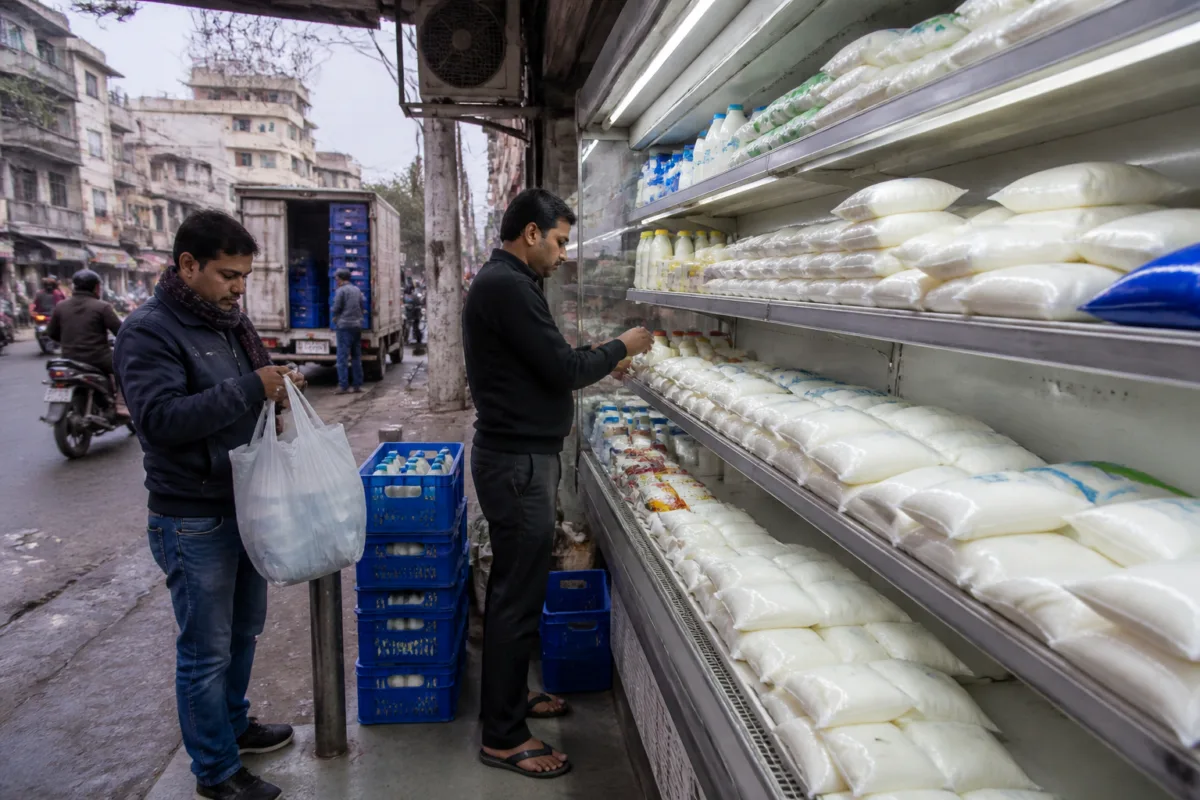
Milk prices in India are rising even as the country produces more milk than any other nation. Amul and Mother Dairy raised prices by Rs 2–4 per litre from November 12, while Karnataka’s Nandini increased prices earlier in the month. The immediate explanation is higher expenditure on farmers, fodder, cattle feed, packaging and transport. The larger urban question is more difficult: why is a country with expanding milk output still struggling to keep its most routine food purchase affordable?
The answer lies in the difference between producing more milk and producing it at a cost that farmers, dairies and consumers can sustain. India’s dairy system is simultaneously managing rising demand, higher farm-level expenses, uneven weather, seasonal supply patterns and the need to improve returns to milk producers. The latest price revisions reveal the pressure running through that entire chain.
The November increases are not a single, uniform national revision. Amul’s fresh pouch milk prices rose by 4–5% across major variants and pack sizes. Amul Taaza toned milk, with 3% fat, became Rs 2 per litre more expensive, while Amul Gold, with 6% fat, rose by Rs 4 per litre. Mother Dairy raised prices across its liquid milk variants in Delhi-NCR. Full-cream milk now costs Rs 76 per litre, compared with Rs 72 earlier, while toned milk is priced at Rs 62, up from Rs 60.
Both companies had last revised prices in May 2026, making the November increase their second revision in the financial year. Karnataka’s Nandini followed a different model. The state Cabinet approved an Rs 8-per-litre increase from November 1, with Rs 7 earmarked for milk-producing farmers and Re 1 for dairy cooperatives. The stated purpose was to improve farmer earnings.
These different revisions point to a common institutional problem. Milk is sold to consumers through brands and distribution networks, but its cost begins on farms. Farmers must feed and maintain animals before dairies can procure milk, process it and deliver it to households. If procurement prices increase, dairy companies must either absorb the additional expense or pass some of it through to consumers.
Mother Dairy said around 75–80% of its milk sales realisation goes towards procurement from farmers. That leaves a comparatively smaller share for processing, packaging, transportation and other operational expenses. The figure shows why a change in procurement costs can quickly affect retail prices: the largest component of the dairy chain is determined before milk reaches a processing facility.
Amul has also linked its price revision to the need to pay better prices to milk producers. The Gujarat Cooperative Milk Marketing Federation, which markets products under the Amul brand, said a substantial share of the additional revenue would go back to farmers. In this structure, the price increase is both a cost for consumers and a potential income adjustment for rural households that depend on milk sales to maintain livestock and meet household expenses.
The pressure on procurement is being amplified by the cost of feeding cattle. Mother Dairy said uneven monsoon conditions had affected fodder availability in several parts of the country. According to the company, green and dry fodder prices had risen by up to 20%, while cattle feed prices were around 10% higher than a year earlier.
Amul cited increases in green and dry fodder, as well as in feed ingredients such as oil cake, maize and molasses. It also referred to higher prices for milk packaging film and fuel, along with low and uneven rainfall in Gujarat and other parts of India. Mother Dairy said packaging, transportation and other operational expenses had increased by as much as 25% amid persistent inflationary pressures.
This is where weather becomes an economic factor in urban food prices. A milk packet sold in a city may appear to be a simple retail product, but its price reflects conditions far outside the city: rainfall, fodder production, feed markets, fuel costs, farm maintenance and the procurement decisions of cooperatives and private dairies. Urban consumers encounter the final price, while much of the cost accumulation occurs across rural production and distribution networks.
Seasonality adds another layer. India’s dairy sector normally benefits from a winter flush season, when milk availability increases. However, the supplied report says El Niño-linked weather shifts are delaying this seasonal increase. The delay is affecting milk collection and processing, while festive demand is adding pressure to supplies of milk, paneer and ghee.
That does not establish a national milk shortage. It does suggest that the usual seasonal relief may be arriving later or less strongly than expected. When the anticipated increase in supply is delayed, dairies face higher procurement costs at a time when demand for liquid milk and other dairy products remains firm.
India’s production numbers show why the current situation cannot be explained simply as a failure to produce enough milk. Milk production reached 247.87 million tonnes in 2024–25, up from 239.30 million tonnes in the previous year, according to the government’s Basic Animal Husbandry Statistics 2025. The country remained the world’s largest milk producer.
Per-capita milk availability also rose from 319 grams a day in 2014–15 to 485 grams in 2024–25. These figures indicate substantial long-term expansion in the dairy economy. But the pace of growth has moderated: production grew by 3.58% in 2024–25, compared with 3.78% in 2023–24.
The slowdown is modest, but it matters because demand is not determined only by population. Rising incomes, urban consumption patterns and the use of milk in tea, coffee, curd, paneer, sweets, butter and ghee all shape the market. A system can produce more milk in absolute terms while still facing tighter margins and higher prices if the cost of expanding supply rises faster than output.
For households, the arithmetic of a small increase is straightforward. A family buying two litres of milk a day would spend Rs 120 more a month after a Rs 2-per-litre increase. A Rs 4 increase would add Rs 240 to the monthly bill. The effect is larger for households that buy milk for multiple daily uses or purchase processed dairy products in addition to liquid milk.
The price impact also travels beyond the milk packet. Milk is an input for curd, paneer, tea, coffee and other everyday products. The supplied report notes that Karnataka’s Nandini raised paneer prices to Rs 485 per kg from Rs 408, while unsalted butter rose to Rs 780 per kg from Rs 700. Amul increased the price of its 500-gram butter pack from Rs 310 to Rs 325. Reports of limited Amul cow ghee stocks in parts of Gujarat point to supply pressure in some product categories, although the material supplied does not establish a nationwide shortage.
At the same time, milk is not the largest contributor to the current food inflation increase. Liquid milk inflation stood at 4.21% in September, compared with 5.54% for overall retail inflation and 7.74% for food inflation, according to the Ministry of Statistics and Programme Implementation. Milk has therefore become more expensive for households without being the single dominant driver of food inflation.
The policy challenge is to balance three objectives that can conflict in the short term. Farmers need procurement prices that cover feed, fodder and animal maintenance. Dairy cooperatives and private companies need sufficient margins to pay for processing, packaging, transport and distribution. Consumers, particularly in cities where household budgets are under constant pressure, need basic dairy products to remain affordable.
The Nandini increase illustrates a direct public policy choice: a larger share of the price rise was assigned to farmers, with a smaller share allocated to cooperatives. Amul’s and Mother Dairy’s explanations show a different but related mechanism, in which higher procurement and operating costs are reflected in retail prices. Both approaches acknowledge that stable consumer prices cannot be separated from the economic viability of milk production.
The government’s fodder and livestock measures are therefore relevant to the price question even though the immediate revisions were announced by dairy companies and a state government. The supplied report refers to a Centre advisory to states to increase fodder production and strengthen livestock infrastructure under VB-G RAM G. Such measures address the supply conditions behind milk prices rather than only the retail price itself.
For cities, the important lesson is that food affordability depends on infrastructure and production systems beyond municipal boundaries. Urban residents rely on collection networks, cold chains, roads, processing facilities, packaging supply and fuel-intensive distribution, even when the final transaction takes place at a neighbourhood retailer. Weakness or cost escalation at any point can reach the household budget.
The latest increases confirm that India’s dairy challenge is not simply a shortage of milk. The country is producing more and making more milk available per person, but growth has slowed while the cost of maintaining supply has increased. Weather variability, fodder prices, procurement payments and distribution expenses are now central to the price of a daily staple.
The developments to monitor are the timing of the winter flush season, the direction of fodder and cattle-feed prices, future procurement revisions and whether higher farmer returns translate into stronger and more stable milk collection. Those factors will determine whether the November price increases remain a short-term adjustment or become part of a longer cycle of pressure across India’s dairy economy.

