


India’s retail inflation has moved beyond the Reserve Bank of India’s upper tolerance limit, but the more consequential signal in the October data is not only that prices crossed 6 per cent. It is that inflation appears to be broadening beyond a narrow group of vegetables and cooking essentials, increasing the pressure on ordinary household budgets across both rural and urban India.
Retail inflation rose to 6.09 per cent in October from 5.54 per cent in September, according to the data cited by NDTV Business. The reading crossed the RBI’s upper tolerance limit of 6 per cent for the first time in two years. Food inflation accelerated to 8.94 per cent from 7.74 per cent, making food the largest contributor to the increase.
Yet the breadth of the price rise is the more important issue for understanding its urban impact. The number of consumer price index sub-groups recording inflation of at least 4 per cent increased from 14 in September to 19 in October. That suggests the pressure is no longer limited to a few items that households can sometimes substitute or postpone purchasing. More categories of everyday consumption are becoming expensive at the same time.
For households, inflation is not experienced as a single national percentage. It is experienced through the frequency of purchases, the importance of each category and the ability to defer spending. A family may postpone buying an appliance or reduce discretionary travel. It has much less flexibility when the increase affects food, transport, personal care, clothing, school-related expenses or medical needs.
That distinction is especially important when the inflation basket broadens. A temporary rise in the price of onions may be painful but limited. A simultaneous increase in food, transport, services and other recurring expenses can steadily reduce the amount left for rent, education, healthcare, savings and debt repayment. The October data does not show that every category is rising at the same speed, but it does indicate that the price shock is reaching beyond the grocery basket.
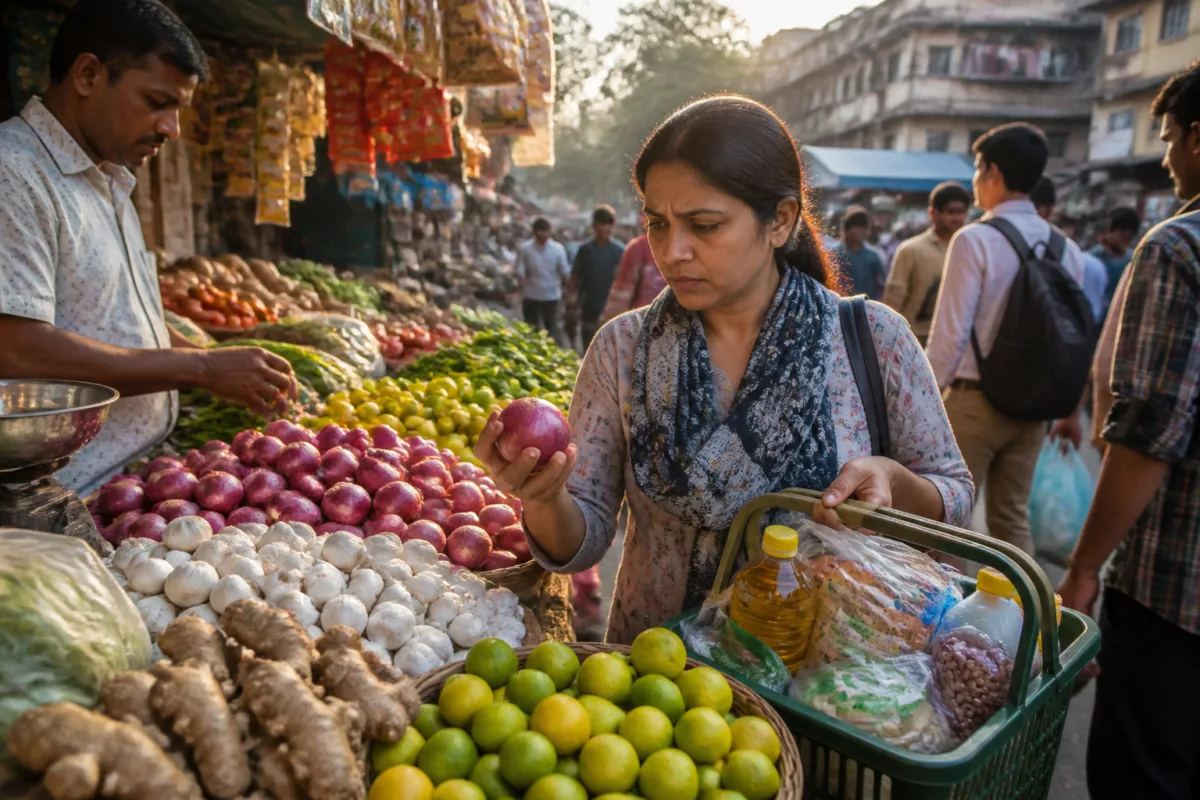
Food remains the central pressure point. Onion prices were reported to be more than twice their levels a year earlier, while garlic inflation crossed 60 per cent. Ginger and lemon also remained expensive, although inflation in ginger eased from September. These are products that households encounter frequently, which makes their effect more visible than the headline number alone suggests.
The burden is also uneven geographically. Rural inflation rose to 6.63 per cent in October, compared with 5.41 per cent in urban India. Rural food inflation stood at 9.09 per cent, while urban food inflation was 8.68 per cent. The difference matters because households with tighter budgets have fewer options to absorb higher food costs. Even within cities, the impact will vary according to income, rent, commuting requirements and the share of household earnings devoted to essentials.
Urban households, however, are not insulated by the lower overall urban rate. Cities combine food purchases with recurring costs that are often difficult to avoid, including commuting, rent or housing finance, utilities, childcare and personal services. When food inflation is high and other parts of the consumption basket also rise, households may respond by reducing discretionary spending, postponing purchases or increasing reliance on credit. The supplied data does not quantify those behavioural changes, but it establishes the pressure on the categories that shape a monthly budget.
The October figures also reveal that inflation is uneven rather than universal. Housing inflation remained at 2.90 per cent and health inflation at 2.05 per cent. This means the current episode is not a uniform increase across every part of the consumer basket. It is a combination of sharp increases in some essentials and more moderate movement in other categories.
That unevenness creates a policy challenge. Monetary policy is designed to influence demand and prevent temporary price increases from becoming embedded in broader inflation expectations. It cannot directly produce more onions, garlic or edible oil. If the primary shock is driven by food supply constraints or weather-related disruption, higher interest rates may have limited immediate effect on the original cause of the increase.
The RBI had raised the repo rate by 25 basis points to 5.50 per cent in October and shifted its policy stance to calibrated tightening, according to the NDTV report. That decision made rate cuts less likely in the near term, while leaving a further increase or a pause as the probable policy choices. Economists surveyed by Reuters were reported to expect another 25-basis-point increase in December.
The inflation breach strengthens the case for such a move because the central bank’s formal framework targets inflation at 4 per cent, with a tolerance band of 2 per cent to 6 per cent. A reading above 6 per cent does not merely represent a temporary political or media threshold; it places inflation outside the range within which the RBI is mandated to keep it.
The RBI’s own October projections had placed inflation at 6 per cent for the October-December quarter and 5.2 per cent for the full financial year. The latest reading therefore increases the importance of whether food prices begin to ease and whether non-food prices remain contained. The central question is not only how high inflation is in one month, but whether the pressure is becoming broad enough to persist.
This is where the distinction between food-led inflation and generalised inflation becomes important. Food prices can rise sharply because of disruptions in production, distribution or supply. But if higher food prices are followed by increases in transport, clothing, restaurants, personal care and other services, businesses and workers may begin adjusting their own prices and expectations. The supplied report identifies restaurants, personal care and transport as notable inflation hotspots, although it does not provide a complete breakdown of their individual rates.
For urban economies, that transmission can affect both consumption and borrowing. Higher interest rates make home loans, personal loans and business credit more expensive. Households already facing higher food and service costs may find it harder to absorb increased monthly repayments. Businesses that depend on credit may face higher financing costs and could pass some of those costs on to consumers.
The impact on housing is therefore indirect but significant. Housing inflation itself was reported at 2.90 per cent, below the headline inflation rate. But the cost of financing a home can rise even when measured housing inflation remains moderate. A repo-rate increase can affect the affordability of new borrowing and the monthly budgets of households with floating-rate loans. The available material does not establish the scale of that impact, but it identifies borrowing costs as one of the channels through which monetary tightening reaches households.
The same mechanism applies to urban investment and small businesses. Higher credit costs can influence decisions about expansion, consumption and working capital. The report does not provide data on investment outcomes or business closures, so those effects cannot be quantified from the available evidence. What can be established is that the RBI is being asked to balance price stability against the cost that tighter credit imposes on households and businesses.
The rural-urban difference also shows why a single national inflation rate can conceal unequal exposure. Rural inflation was higher overall and rural food inflation was also higher, while urban households face a different composition of recurring expenses. The challenge for policymakers is therefore not simply to lower the headline number, but to understand which categories are driving the increase and which groups have the least ability to adjust.
The October data points to three developments that merit attention. First, food inflation remains the immediate driver and is particularly severe in selected vegetables and essentials. Second, the number of CPI sub-groups with inflation of at least 4 per cent has widened, indicating broader price pressure. Third, the RBI is confronting a problem that interest rates can influence only indirectly when the initial shock is concentrated in food supply.
What happens next will depend on whether food inflation eases before increases in non-food goods and services become more persistent. The available evidence does not establish that inflation will remain above 6 per cent for a fixed period, nor does it confirm the outcome of the RBI’s December decision. It does show that the October breach has shifted the policy discussion from a narrow grocery-price shock to a wider question about the cost of maintaining an ordinary household budget.

