


The Microsoft outage that disrupted Outlook, Teams and other Microsoft 365 services across 74 countries, including India, was more than an inconvenience for office workers. It showed how deeply urban economies now depend on a small number of shared digital platforms for communication, administration, travel and everyday business operations.
The disruption began on Thursday, November 12, and continued into Friday, November 13, according to the report. At its peak, Downdetector recorded nearly 130,000 reports of Outlook problems. Users said they could not open inboxes, send or receive emails, or access workplace communication tools. Microsoft 365 services were also used by government departments, schools, businesses and airlines affected by the incident.
Microsoft said there was no indication that the outage was caused by a cyberattack or malicious activity. The available information pointed instead to infrastructure and configuration problems. Microsoft’s initial updates referred to elevated infrastructure load and connectivity difficulties, while the company investigated a configuration change that appeared to leave some servers overloaded and unavailable.
That distinction matters for how cities understand digital risk. A cyberattack is often treated as an exceptional security event requiring a defensive response. A configuration failure, by contrast, can emerge from routine operational processes. Yet its consequences can be just as extensive when one provider supports multiple layers of organisational work.
The reported sequence was technically straightforward but operationally difficult. As affected servers became unavailable, traffic was redirected to other machines. This increased pressure on the remaining infrastructure. When some servers were brought back online, they reportedly became unresponsive again after traffic returned, creating a cycle in which recovery efforts themselves risked causing another disruption.
Microsoft engineers responded by restricting traffic to affected infrastructure, rolling back certain software configurations and attempting to increase capacity. The recovery process showed why restoring a large cloud service is not equivalent to switching a system back on. Infrastructure may become available before every application reconnects, synchronises data and returns to normal operation.
The incident also revealed the breadth of the Microsoft 365 dependency. Outlook was affected alongside Teams, Word, Excel, PowerPoint, OneDrive, SharePoint and Copilot. These services cover email, meetings, document creation, storage, collaboration and AI-assisted work. For many organisations, they are not separate conveniences but interconnected parts of one operational environment.
That concentration creates a form of urban infrastructure risk that is less visible than a failed road, a power cut or a flooded rail line. A city may continue to have functioning buildings, roads and electricity while its institutions lose the ability to coordinate. An office can remain open but struggle to communicate. A school can have classrooms and staff but lose access to shared documents. A public department can retain its physical facilities but face delays because routine administrative workflows depend on online tools.
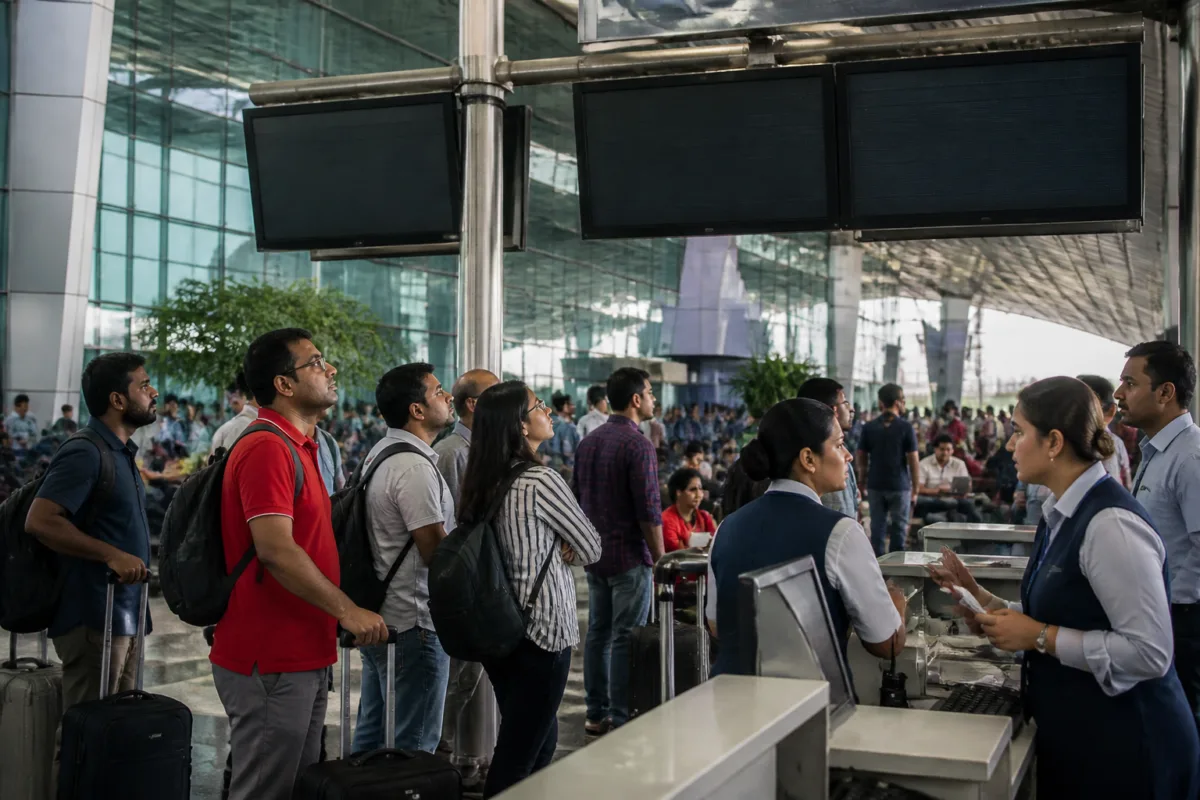
The effects reached transport operations in India. SpiceJet cancelled three flights departing from Delhi on Friday morning, with services to Pune, Leh and Mumbai among those affected. Two other SpiceJet flights, including services to Darbhanga and Mumbai, were delayed. Air India said its flight operations remained unaffected, although it temporarily rerouted email traffic for passenger communications. IndiGo and Akasa Air asked passengers to monitor flight updates, while Delhi Airport advised travellers to check their flight status before leaving for the airport.
The airline disruption demonstrates how a cloud outage can move across institutional boundaries. The affected product was office software, but airlines use digital communication and administrative systems to coordinate passengers, staff and operations. The event therefore travelled from a technology platform into a transport network, not because every part of the aviation system failed, but because a supporting communication layer became unreliable.
The same pattern appeared beyond Microsoft’s own applications. OpenAI and Anthropic reported problems involving their Microsoft 365 connectors, showing how services built on top of a common platform can inherit its weaknesses. As companies use more software integrations, the number of visible products may increase while the underlying concentration of infrastructure remains unchanged.
Govind Rammurthy, chief executive officer and managing director of eScan, told NDTV that the cause was not a cyberattack but an internal process failure. He said that when one provider supports nearly every critical workflow, a failure involving misconfiguration, overload or a network change can cascade globally. His assessment places the outage within a broader resilience problem rather than treating it as an isolated application failure.
Rammurthy also said organisations should maintain fallback communication channels, preserve minimal operational backup arrangements, provide offline or multi-provider alternatives for critical workflows and test recovery procedures before an outage occurs. Sachin Panicker, chief AI officer at Fulcrum Digital, similarly said companies need visibility into which systems depend on which provider and should ensure that AI-dependent processes can degrade without stopping altogether.
These comments point to an institutional challenge: resilience is not only a question for the cloud provider. It is also a question for every organisation that has moved communication, records, collaboration and decision-making onto the same platform. A company may have a disaster recovery plan for data while lacking a practical method for sending urgent messages when its primary email and collaboration tools fail.
For public agencies and urban service operators, the issue is especially significant because operational dependencies can be distributed across departments and vendors. A transport agency, airport, school system or municipal office may not directly control the infrastructure on which its communication tools run. Its continuity therefore depends partly on understanding external technology relationships that may not be visible in day-to-day administration.
The Microsoft outage also complicates the idea that cloud computing automatically removes infrastructure responsibility from users. Cloud platforms provide scale and centralised services, but customers still need to know what happens when access is interrupted. The relevant question is not simply whether a provider has restored its servers. It is whether an organisation can continue priority functions while access is unavailable, delayed or partially restored.
Microsoft had not provided a definitive explanation for why the disruption lasted as long as it did or established a firm timeline for complete recovery in the supplied report. That uncertainty is important. It means the incident confirms the operational consequences of platform concentration, but does not yet establish the full technical chain of events or the final corrective measures Microsoft may adopt.
What the available evidence does establish is the scale of dependence. A configuration-related infrastructure problem affected workplace communication, cloud storage, office applications, AI tools and airline-related passenger communications across multiple countries. The immediate failure was digital, but its consequences were organisational and physical: delayed decisions, disrupted coordination and cancelled or delayed flights.
For cities increasingly managed through connected digital systems, that is the larger urban question. Resilience cannot be measured only by whether physical infrastructure survives a storm, a flood or a power interruption. It must also include whether institutions can continue essential communication and coordination when a widely shared technology platform becomes unavailable. The next test for organisations will be whether they treat this outage as a temporary service interruption or as evidence that continuity planning must extend beyond the cloud provider’s own recovery process.

