


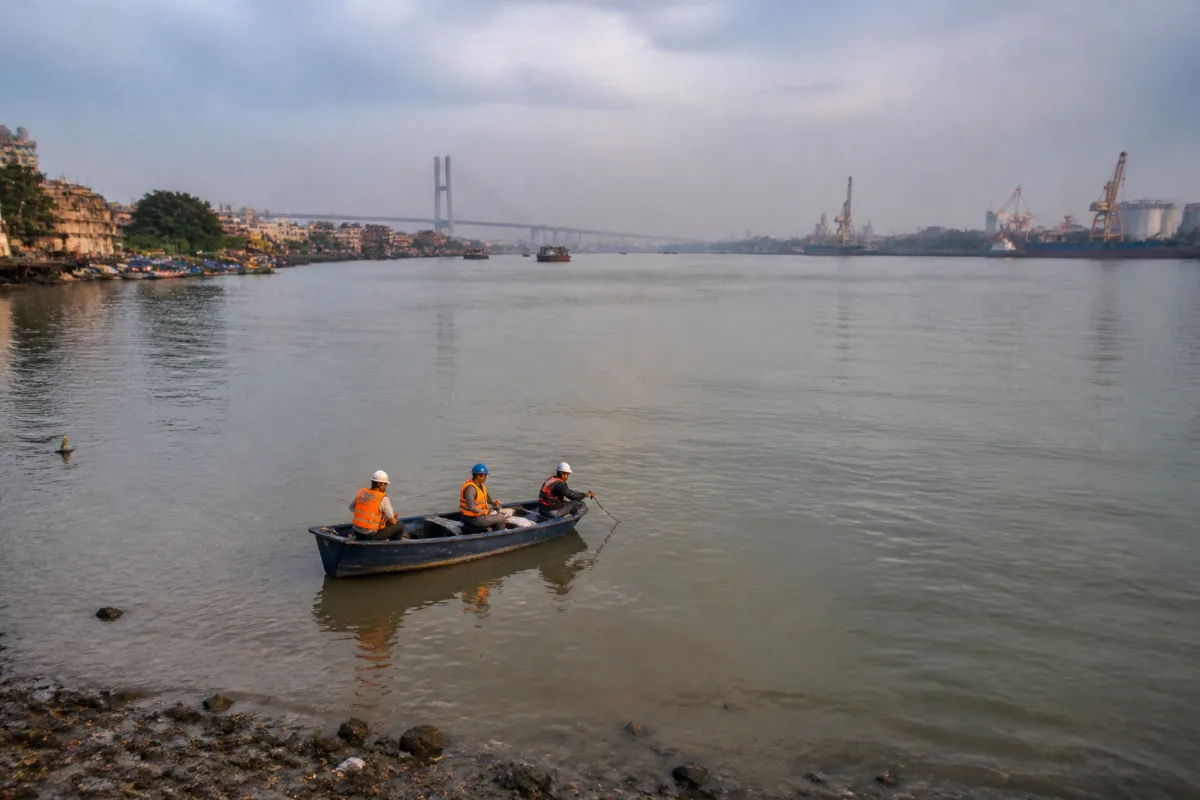
A new IIT Kharagpur study offers a rare piece of positive evidence about the Hooghly estuary: metal pollution in its sediments has declined by 37.76 per cent over the period assessed. But the same research also makes clear that a lower pollution index is not the same as a fully recovered estuary, especially for a water system receiving municipal wastewater, industrial effluents, agricultural runoff and port-related discharges from one of eastern India’s largest urban regions.
The study, published in the journal GeoHealth, recorded a latest Pollution Load Index (PLI) of 0.90 for the Hooghly estuary. The researchers said PLI values during the assessment period ranged from 0.61 to 2.66. The highest contamination was recorded in 2001, while elevated pollution levels persisted until 2012. After 2015, the index gradually declined to its lowest recorded value of 0.61 before the latest reported level of 0.90.
That chronology matters because it places the improvement within a longer urban and regulatory history rather than presenting it as the result of a single intervention. The Hooghly, also known as the Ganga estuary, is the wide mouth of the river where it meets the sea. Its sediment conditions reflect pollutants entering the water system from multiple sources and locations, including the Kolkata metropolitan region, which the study says has a population of more than 15 million, as well as several upstream cities.
The evidence therefore describes a system under pressure from a large and complex urban catchment. Pollution does not originate only at the water’s edge. Municipal wastewater, industrial discharge, agricultural runoff and port activity can all contribute to the accumulation of metals in estuarine sediments. The study’s findings connect the condition of the estuary to the performance of urban sanitation, industrial regulation, land-based runoff controls and port-related environmental management.
This is the central significance of the declining PLI. It suggests that the intensity of metal contamination in the estuary’s sediments has reduced over time, but it does not identify one definitive cause. The researchers attributed the improvement to the possible combined effects of long-term pollution-control measures, regulatory interventions and changes in anthropogenic pollutant loading over recent decades. The wording is important: the study points to a combination of factors rather than claiming that one programme alone produced the decline.
Among the initiatives identified were the Ganga Action Plan, implemented between 1986 and 1996, and the Namami Gange programme, launched in 2014, along with the Swachh Ganga Abhiyan. The time pattern in the study overlaps with these different phases of public intervention, but the supplied findings do not establish a direct causal measurement for each programme. What they do show is that pollution levels changed over a period during which pollution-control and river-cleaning efforts were being pursued.
The researchers also introduced and examined the Population Normalised Pollution Load, or PNPL. This measure assesses sediment contamination in relation to population pressure. For the Hooghly estuary, the PNPL trend declined over time, indicating a reduction in population-normalised contamination intensity. Read alongside the relatively low recent PLI, the trend suggests that the fall in contamination was not simply a consequence of considering pollution without reference to the size of the population connected to the estuary.
That distinction is particularly relevant to the Kolkata metropolitan region. A large population creates a continuing demand for wastewater collection, treatment and safe discharge. If population pressure rises while pollution-control capacity remains static, pollution intensity can increase even when individual facilities or local stretches show improvement. Conversely, a decline in PNPL indicates that contamination intensity relative to population pressure has reduced during the period studied. The finding offers evidence of improvement, but it also underlines the need to maintain the systems that produced it.
The study’s use of sediment indicators is significant because sediments can provide a record of changing contamination conditions over time. The reported peak in 2001, continued elevated pollution until 2012 and subsequent decline together describe a long-term pattern that a single water sample would not capture. However, the findings supplied do not establish that every part of the estuary has improved equally, nor do they demonstrate that all pollutants have declined. The conclusions specifically concern metal pollution in sediments and the indices used by the researchers.
That limitation prevents the result from being read as a declaration of ecological recovery. The researchers explicitly cautioned that declining pollution indices should not be interpreted as evidence of complete recovery. They called for sustained environmental monitoring, effective wastewater management and consistent implementation of pollution-control policies. The caution is not a minor qualification; it defines what the study can and cannot prove.
For urban governance, the implication is that river and estuary health depends on coordination across administrative boundaries and pollution sources. The Hooghly receives the cumulative effects of activity in the metropolitan region and upstream cities. This means that monitoring only one discharge point, municipal boundary or industrial cluster would provide an incomplete picture of the estuary’s condition. The study’s population-normalised measure also points to the need to assess environmental performance against the scale of the urban population placing pressure on the system.
The policy landscape described in the study contains both older and newer layers of intervention. The Ganga Action Plan represents an earlier phase of organised river pollution control, while Namami Gange and the Swachh Ganga Abhiyan represent later efforts. The reported improvement cannot be assigned conclusively to one of these initiatives from the supplied evidence. It can, however, be understood as part of a longer policy effort in which pollution control, regulatory action and changes in pollutant loading may have operated together.
The study also reveals why programme announcements alone are an insufficient measure of environmental progress. The most useful evidence comes from the trend in contamination indicators across time. In this case, the measured PLI range of 0.61 to 2.66, the peak in 2001, persistence of elevated contamination until 2012 and decline after 2015 provide a more substantive picture than a one-time claim that the river is cleaner. The trend supports cautious optimism, while the remaining pressures require continued measurement.
For citizens and institutions connected to the Hooghly, the question is not simply whether pollution has fallen. It is whether the decline can be sustained while the estuary continues to receive wastewater and other urban discharges. The study identifies those continuing sources but does not provide, in the supplied material, a current source-by-source breakdown or a forecast of future conditions. Those gaps make regular monitoring important, particularly when the region contains a population of more than 15 million and multiple upstream urban centres.
The evidence therefore supports a measured conclusion. The Hooghly estuary has recorded a substantial long-term decline in metal pollution in its sediments, and both PLI and PNPL trends indicate lower recent contamination intensity. Yet the estuary remains part of a heavily urbanised and industrially influenced system, and the study does not establish complete ecological recovery. The next measure of progress will be whether monitoring, wastewater management and pollution-control enforcement remain consistent enough to preserve the improvement documented by the IIT Kharagpur researchers.

