


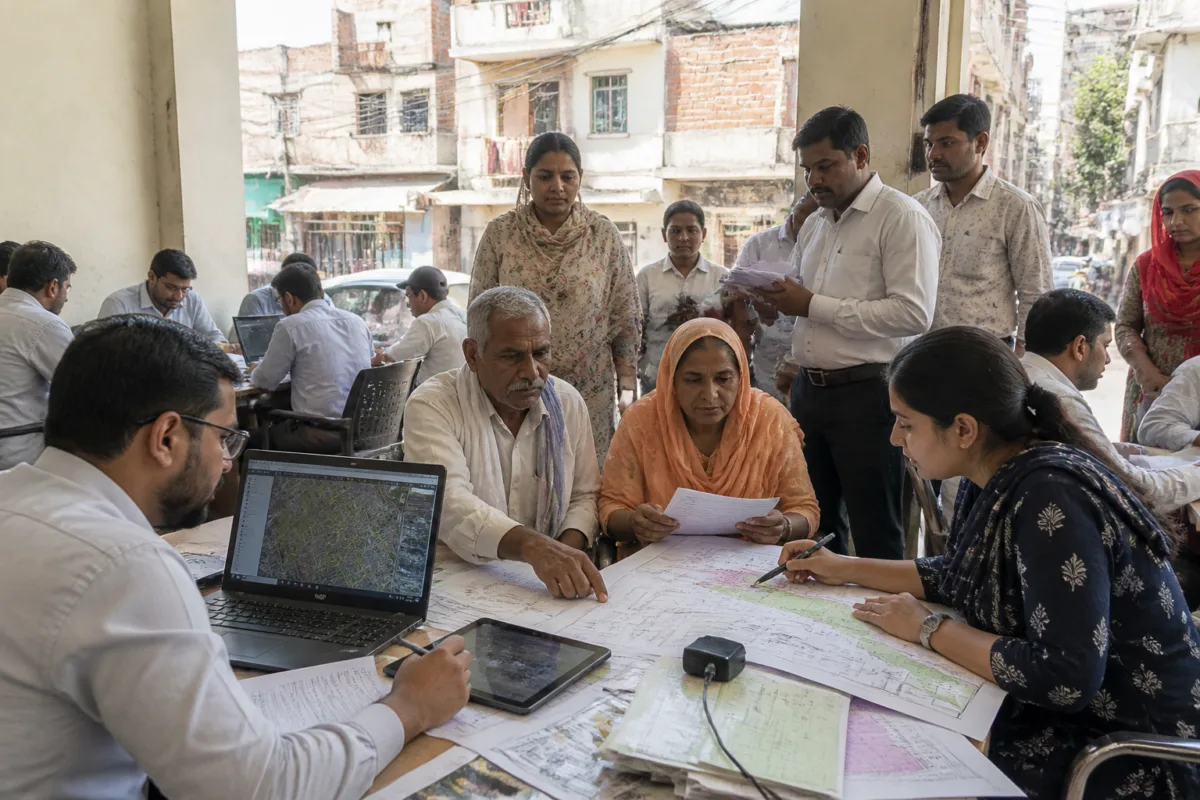
Delhi’s proposed overhaul of the PM-UDAY ownership process is an attempt to solve a problem that is larger than paperwork. The plan would remove the immediate burden of preparing and uploading individual house maps, deploy government-led GIS surveys and bring form-filling, document preparation, notarisation and uploads into special camps. The objective is to make ownership rights accessible to residents of unauthorised colonies who have struggled to navigate a fragmented administrative process.
The proposal, reported by Live Hindustan – NCR, comes against a stark implementation gap. The scheme covers around eight lakh families living in 1,511 unauthorised colonies, but only 32,000 applications have been received and ownership documents have reportedly been issued to just 3,300 people. The application deadline, initially set for 31 October, has been extended to 31 January 2027. The numbers suggest that the legal promise of regularisation has not yet translated into a process that most eligible households can complete.
That gap matters because property rights in unauthorised colonies are not only a question of registration. They determine whether a household can convert long-term occupation into a formally recognised claim, complete transactions through approved channels and participate in a more predictable urban land system. The source report does not establish the wider economic consequences for individual families, but it shows that the present application pathway is failing at the point where residents must convert documents, maps and property details into an administratively acceptable application.
The PM-UDAY scheme began in 2019. Despite efforts by the Delhi Development Authority, it did not achieve the expected level of success, according to the report. Responsibility for the process was transferred from the DDA to the Delhi government in April. That transfer is significant because it changes the institutional location of the programme without automatically resolving the underlying delivery problem. A new department or agency can inherit a process, but residents still face the same practical barriers unless the process itself is redesigned.
Under the existing system, an applicant must register the property on the Swagat portal, obtain a house map from an authorised agency, upload the drawing and provide documentation. The property information is then placed on the government website so objections can be raised. Government employees inspect the property, seek additional documents if deficiencies are found and, after the records are considered satisfactory, the additional district magistrate issues the ownership documents.
Each step has a legitimate administrative purpose. A property map can help establish the location and physical extent of a structure. Public disclosure allows objections to be raised. Inspection provides a verification mechanism, while documentary scrutiny is intended to prevent incorrect or ineligible claims. The difficulty, as described in the report, is that these safeguards are experienced by applicants as separate procedural hurdles rather than as one coordinated public service.
The government’s proposed camps are designed to compress those hurdles into a single location. A public-sector company would be appointed through a tender to manage the camps. Trained personnel would help applicants fill forms, prepare or upload maps, arrange notarisation and upload documents. The stated purpose is to reduce errors and prevent residents from visiting different offices or service providers for each part of the application.
This is an important shift in the design of the service. The current approach places much of the responsibility for technical preparation on the applicant. A resident must know which map is acceptable, where it should be prepared, which documents are required and how the information should be uploaded. When an application is rejected because a form is incorrectly completed or because a document is missing, the burden of correction returns to the resident. The report says that many applications are getting stuck or rejected because of such errors.
The proposed camps therefore treat the problem as one of assisted compliance. Instead of assuming that applicants can independently manage a complex property process, the government would provide the administrative support at the point of application. That may improve the quality of submissions, but it also places greater responsibility on the agency running the camps. The tender, staffing, training and supervision arrangements will determine whether the camps become reliable facilitation centres or simply another layer between residents and the approving authority.
The most consequential proposal is for the government to conduct GIS surveys and identify houses itself. At present, applicants are required to upload a map and establish that the house existed before 1 June 2014 and falls within the government’s prescribed limits. The proposed GIS-based approach would allow the administration to identify properties through a common survey framework rather than requiring each applicant to commission a separate drawing.
This could standardise one of the most technically difficult parts of the process. A government-led survey may reduce duplication, limit dependence on private drafting services and make it easier to compare applications across a colony. It could also make the process more accessible for households that cannot readily arrange a technical drawing. However, the source report does not specify the survey methodology, the agency that would carry it out, the accuracy standards or the process for correcting errors. Those details will be central to whether GIS simplifies ownership claims or creates a new category of disputes.
The proposed change requires permission from the Union Ministry of Housing and Urban Affairs. The Delhi government plans to seek approval for conducting government-led GIS surveys and for temporarily allowing anyone to conduct such surveys, according to the report. It also plans to seek a complete ban on sale deeds in these colonies so that residents pursue ownership rights through the scheme.
The proposed restriction on sale deeds indicates that the government sees the existing transaction environment as part of the problem. If property changes hands through instruments that do not provide the form of ownership recognition sought under PM-UDAY, residents may continue to accumulate documents without reaching a clear legal endpoint. The report does not provide the legal details of the proposed ban, its duration or how existing transactions would be treated. Those issues will need to be clarified before the proposal can be assessed as an enforceable policy change.
The programme’s institutional structure is already layered. The DDA was responsible for the process earlier, the Delhi government now handles it, and the Union ministry’s approval is required for proposed modifications. The ownership documents are to be issued by the additional district magistrate after scrutiny. A public-sector company may manage the camps, while government employees would conduct inspections or verification. This division of responsibilities can distribute expertise, but it can also make accountability difficult for residents if an application is delayed or rejected.
The proposal attempts to address that fragmentation through a single-window experience, but it does not remove the need for verification. The government would still publish property details for objections, examine documents and issue ownership papers only after the required process is completed. The change is therefore not a decision to grant ownership automatically. It is a redesign of how applicants are assisted and how property information may be collected.
The available figures reveal the scale of the administrative challenge. Against a potential beneficiary base of around eight lakh families, 32,000 applications represent roughly 4 per cent of the households covered by the scheme. The 3,300 ownership documents issued amount to less than half of 1 per cent of the stated beneficiary base. These calculations are based on the rounded figures in the source report and should be read as an indication of scale rather than a formal programme audit.
The difference between applications and completed ownership documents also shows that increasing applications alone will not be enough. The system must move cases from registration to scrutiny, correction, objection handling and final issuance. If the camps only help residents submit forms but do not improve processing capacity after submission, the backlog may move from the front end of the system to the verification stage.
The extension of the deadline to 31 January 2027 creates additional time for residents, but the report’s figures suggest that time has not yet solved the access problem. The administration is now proposing to change the service model before the extended deadline expires. Its success will depend on whether the new model addresses the specific reasons applications fail, whether government-led maps are accepted consistently and whether applicants receive clear decisions when records are incomplete or contested.
The larger urban question is how a city converts long-standing occupation into secure and administratively recognised property rights. Delhi’s unauthorised colonies are being approached through a formal scheme, but the low number of completed ownership documents shows that legal eligibility and practical access are different conditions. A process can exist on paper while remaining difficult to use at street level.
For now, the evidence confirms an implementation problem and a proposed administrative response. The government is considering assisted camps, GIS-based identification, easier map requirements and restrictions on sale deeds, but the changes still require approval from the Union housing ministry. The next developments to monitor are that approval, the tender for the public-sector implementing agency, the design of the GIS survey and whether applications and issued ownership documents rise before the 31 January 2027 deadline.

