


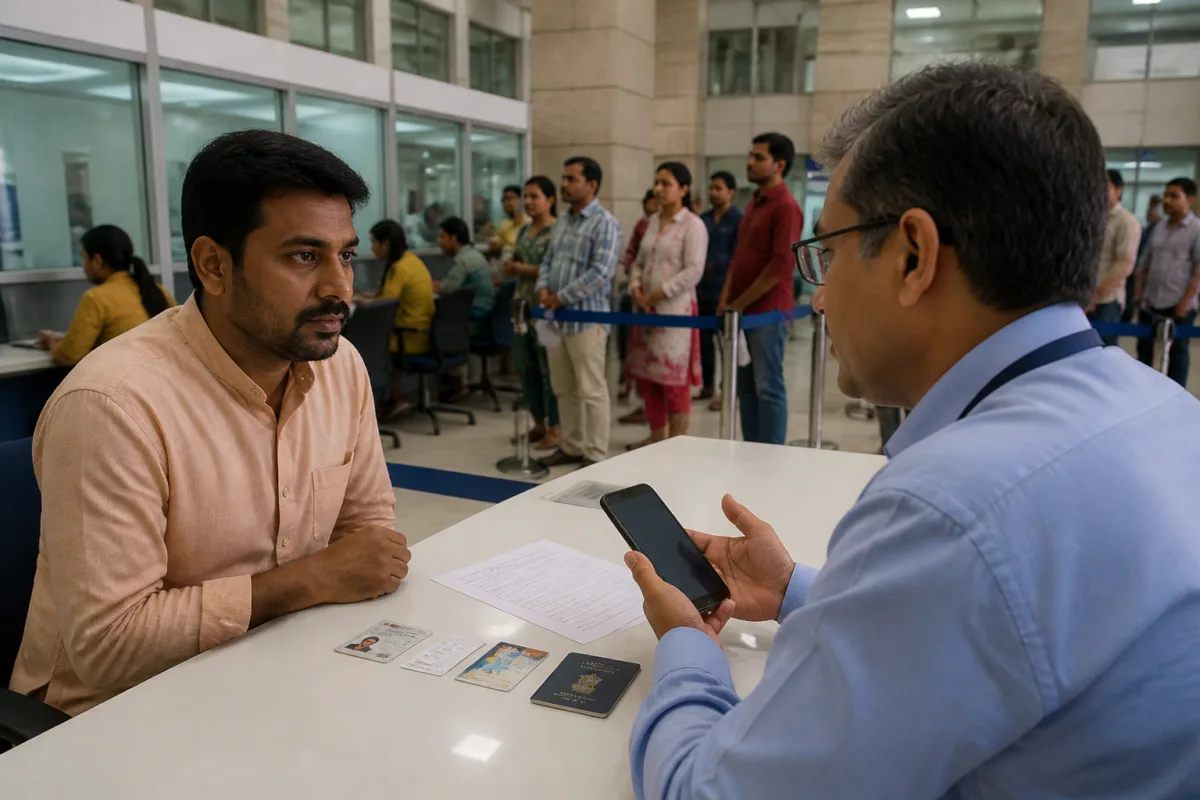
The Delhi government’s decision to make Aadhaar authentication voluntary for government services changes the default relationship between residents and the administration: a person who does not possess Aadhaar, cannot complete Aadhaar verification or declines it must not be denied access solely for that reason. The notification also recognises voter identity cards, driving licences, passports and other government-issued photo identity documents as alternatives.
The decision, reported by Live Hindustan – NCR on the basis of a notification issued by the Delhi government’s Information Technology Department, is not simply a change in the list of accepted documents. It establishes a choice-based approach to identity verification in the delivery of government services. That makes implementation—how departments inform residents, verify alternative documents and record consent—as important as the notification itself.
According to the report, Aadhaar authentication will remain voluntary for the Unified Citizen Data Platform, or UCDP. The notification was issued under Rule 5 of the Aadhaar Authentication for Good Governance, Social Welfare, Innovation, Knowledge Rules, 2020. The report says the department will inform Aadhaar holders about alternative and practical means of establishing identity, while ensuring that people who cannot or do not want to undergo Aadhaar authentication are not deprived of government services.
This places two obligations on the administration. The first is substantive: an alternative route must actually be available. The second is procedural: residents must be told about that route before they are asked to authenticate. If an alternative document is technically permitted but frontline offices do not accept it, or if residents are not informed that they have a choice, the formal right created by the notification would be difficult to exercise in practice.
The notification therefore shifts attention from the existence of an identity document to the design of the service interface. In a digital or increasingly digitised government system, authentication is often the point at which a resident either completes a transaction or is stopped. Delhi’s stated position is that Aadhaar may be used for this purpose, but it cannot be the only route where the notification applies.
The documents identified in the report are voter identity cards, driving licences, passports and any other photo identity document issued by the Central or state government. These documents do not all serve the same administrative purpose, and the report does not specify whether every department will apply an identical verification process for every service. That makes department-level operating procedures a critical next step. The notification establishes the principle of alternatives, while the practical details will determine how consistently residents experience it.
The consent requirement is another important part of the change. The report says that the department must obtain the Aadhaar holder’s consent before carrying out authentication. This means authentication is not meant to be treated as an invisible or automatic back-end step. At the service counter or within an online workflow, the resident must be made aware that Aadhaar authentication is being sought and must agree to it.
That requirement has implications for how government services are designed. A resident should be able to understand what is being requested, why it is being requested and what can be done if Aadhaar authentication is unavailable or refused. The report does not provide the text of the consent form, the wording to be used by officials or the technical process for recording consent. Those details will matter because a general declaration of voluntariness is different from a functioning alternative pathway.
The government has also acknowledged the administrative convenience of Aadhaar. The notification, as reported, says Aadhaar can make it easier to establish identity, reduce the need for several documents and support access to subsidies, benefits and services. It also states that authentication may be used for purposes such as improving access to services and preventing misuse of social welfare schemes.
The policy position is therefore not a rejection of Aadhaar. It is a distinction between using Aadhaar as a convenient authentication tool and making it a condition for receiving a service. The first can remain available to residents who choose it. The second is restricted by the requirement that people who do not authenticate through Aadhaar must not be denied service for that reason.
That distinction is significant for public administration because identity verification has two separate functions. One is to establish that a person is who they claim to be. The other is to decide whether the person qualifies for a particular service or benefit. The notification described in the report addresses the first function by allowing several identity documents. It does not, on the evidence available, change eligibility rules for any specific scheme or service.
This boundary is important. A voter identity card, driving licence, passport or other government-issued photo identity document may provide an alternative means of verification, but the report does not say that possessing any one of these documents automatically qualifies a resident for every government service. The new arrangement concerns authentication and access to services where the notification applies; it should not be read as a blanket change to all eligibility conditions.
The Unified Citizen Data Platform adds another layer to the decision. The report identifies the UCDP as an area where Aadhaar authentication will be voluntary, but it does not describe the platform’s full architecture, the departments connected to it or the categories of data processed through it. That means the notification’s immediate significance can be established, while the wider operational and data-management implications remain dependent on information not supplied in the report.
For residents, the most direct change is the availability of a non-Aadhaar route. Someone without Aadhaar, someone unable to complete authentication or someone who declines it should not be turned away solely because Aadhaar verification did not take place. The practical benefit will depend on whether alternative documents can be checked quickly and whether citizens are given clear instructions before visiting an office or using an online service.
For departments, the change requires more than a circular to staff. Service portals, forms, counters and helpdesks may need to show the alternative options clearly. Officials may need instructions on which documents can be accepted, how those documents should be checked and how consent should be recorded. The source report does not confirm whether such implementation guidelines have already been issued, so that remains an open administrative question.
The notification also raises a question about uniformity across Delhi’s government services. If the principle applies to services connected to the UCDP, departments will need to align their authentication processes with it. A resident’s experience should not depend entirely on whether an application is made online, at a department office or through another government service channel. The report, however, does not provide a department-wise list of services covered by the decision.
This is where the urban governance dimension becomes visible. Access to government services is shaped not only by policy but also by administrative design. A rule can be inclusive on paper and restrictive in practice if the alternative route is poorly communicated, unavailable on a portal or treated as an exception by frontline staff. Conversely, a clear and usable alternative can reduce the risk that an authentication problem becomes a service-access problem.
The evidence currently establishes four core points. Aadhaar authentication in the stated Delhi government framework is voluntary. Residents must not be denied government services merely because they cannot or do not want to authenticate through Aadhaar. Alternative government-issued photo identity documents are to be accepted for verification. Aadhaar authentication requires the holder’s consent.
The evidence does not yet establish the detailed implementation protocol, the complete list of affected services, the time required for alternative verification or the mechanism for complaints when an eligible resident is denied access. These are not minor details. They will determine whether the notification functions as a real administrative safeguard or remains primarily a statement of policy intent.
The next stage is therefore likely to be operational rather than legislative: departments and service-delivery offices will have to communicate the alternatives and integrate them into their procedures. The notification’s success will be visible in whether residents can use those routes without additional uncertainty, repeated visits or informal pressure to choose Aadhaar authentication.
Delhi’s decision makes Aadhaar available as an option while formally preserving access through other government-issued identity documents. What remains to be established is how consistently that choice will be implemented across the city’s service systems, particularly through the Unified Citizen Data Platform and frontline delivery channels.

