


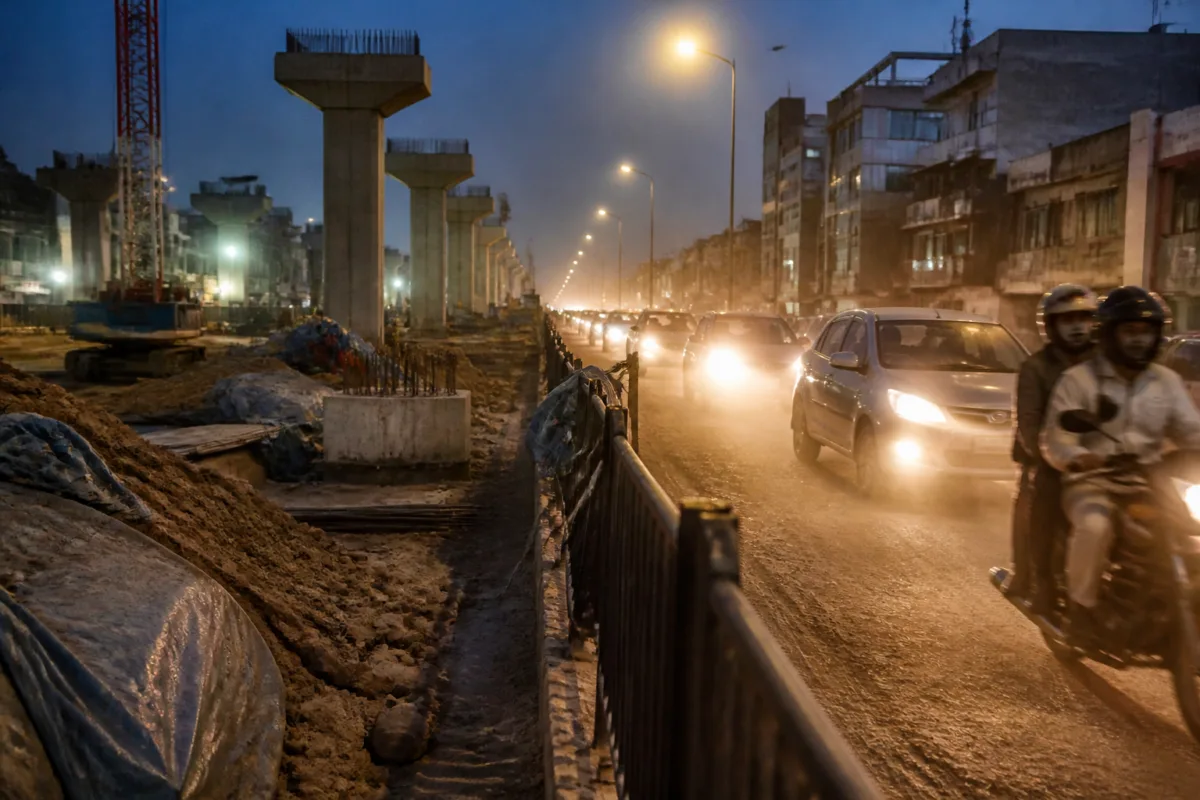
Lucknow’s construction dust problem is not simply a matter of untidy worksites. A ground-level inspection across new Pakka Pul, Hari Nagar in Balaganj and the Sarfarazganj–Thakurganj stretch found uncovered construction material, loose soil on roads, inadequate dust suppression and weak separation between active works and moving traffic. The immediate result is a familiar urban failure: infrastructure is being built, but the public space around it is becoming harder and less safe to use.
The inspection, reported by the Times of India, found residents and commuters dealing with clouds of dust after sunset. At Hari Nagar, an important approach to the Green Corridor was covered with loose earth, while excavated soil remained exposed along the edges. No water sprinkling was seen during the inspection. Passing cars and two-wheelers disturbed the soil and sent dust across the road, turning construction activity into a recurring source of roadside pollution.
The Sarfarazganj road towards Thakurganj Chowk presented a related problem. A metro line is under construction along the stretch, where tin barricades narrowed the carriageway and construction silt covered the road surface. Commuters said dust remained suspended under streetlights and mixed with vehicle headlights in the restricted road space. The difficulty was most pronounced in the evening, when traffic, construction activity and poor visibility interacted.
This matters because urban construction is not confined to a project boundary. A road, bridge or metro corridor is built within an operating city, where people continue to travel, trade and live beside the work. When excavated soil reaches a public carriageway or a stockpile is left uncovered, the resulting exposure is transferred from the contractor’s site to residents, pedestrians, motorists and roadside businesses.
The Uttar Pradesh Pollution Control Board’s consent documents already set out controls intended to prevent this transfer. They require stored construction material to be fully covered, wind-breaking walls around construction sites and water sprinkling on approach and internal roads to suppress fugitive emissions. The board’s self-declaration framework also identifies mandatory and desirable dust-control measures.
The gap revealed in Lucknow is therefore not necessarily a lack of rules. It is a gap between conditions written into regulatory documents and conditions experienced on the ground. The inspection found that several basic safeguards were either absent or not visibly operating at the locations examined. No site-specific particulate or visibility measurements were available, so the report does not establish a quantified pollution exceedance. It does, however, document visible dust emissions and conditions that raise questions about housekeeping, supervision and inspections.
At new Pakka Pul, excavators, rollers and concrete mixers were operating close to moving traffic. Uncovered heaps of aggregate and excavated earth stood next to the construction area, while loose soil extended onto the paved carriageway. Continuous barricading separating construction activity from public traffic was missing along the inspected stretch. Exposed reinforcement bars and shuttering added another layer of risk in an environment where workers and commuters were sharing a constrained space.
The inspection also observed workers without visible helmets, reflective jackets or dust masks. These observations connect dust management to a broader worksite-control question. Barricades, protective equipment, road cleaning and water sprinkling are often treated as separate compliance tasks, but together they determine whether construction can proceed without exposing the public and workers to avoidable hazards.
For nearby households, the issue has become part of daily domestic life. Hari Nagar resident Ramesh Chandra Verma said grey silt had to be wiped from furniture and kitchen counters three times a day. He also said his mother, who has asthma, needed her nebuliser more frequently. The report does not provide a medical assessment linking her condition to construction dust, and that limitation is important. Yet the account illustrates how a public-works problem can become a household burden when dust enters homes repeatedly.
The effects extend to local commerce. Shopkeeper Anoop Rastogi said customers avoided stopping along the dusty Sarfarazganj stretch. This is a reminder that construction disruption is measured not only in traffic delays or engineering milestones. Narrowed roads, poor visibility and an unpleasant roadside environment can affect the ability of small businesses to receive customers, even when no formal closure has been announced.
Commuters face a different form of exposure. Mohd Tariq, who travels between Balaganj and Chowk, described the Sarfarazganj–Thakurganj route as difficult to cross in the evening despite using a helmet visor and mask. His account is not a substitute for air-quality monitoring, but it identifies the practical consequences of dust on a live corridor: eye and throat irritation, reduced comfort and increased difficulty navigating beside construction barriers.
The institutional response described in the report suggests that responsibility is distributed across project agencies, contractors and pollution-control authorities. AK Sengar, in charge of the Green Corridor, said the Gaughat Harinagar sites were inspected from time to time. He added that if pollution-control rules were not being followed, officials would be asked to ensure compliance and submit an implementation report.
A senior official at the Uttar Pradesh Bridge Corporation said an inspection would be carried out and that the agency would be fined if a violation was found. That response establishes a possible enforcement pathway, but it also highlights the importance of what happens after an inspection. A rule is meaningful to residents only when non-compliance leads to a documented correction, a responsible agency and a mechanism for checking whether the correction remains in place.
The report does not establish how frequently each site was inspected, whether contractors had received written notices, or whether any previous penalties had been imposed. It also does not provide measurements comparing dust levels before and after sprinkling, nor does it identify the individual contractors responsible for each location. These are not minor omissions in an infrastructure system where several agencies and work packages may operate within the same corridor. They are the information needed to understand whether the problem is isolated, repeated or systemic.
Lucknow’s current construction landscape makes coordination particularly important. The inspected locations include a bridge project, Green Corridor-related works and a metro construction stretch. Each project may have its own contractor, engineer, traffic-management plan and reporting chain, while residents experience the corridor as one continuous public environment. A failure at the junction between agencies can be invisible in project files but obvious to someone travelling through dust beside a narrowed road.
The regulatory model described by the UPPCB places the first operational responsibility close to the worksite: cover stored material, contain dust, sprinkle water and manage approach and internal roads. The public authority’s role is to set conditions, inspect compliance and act when those conditions are breached. Project agencies, meanwhile, must manage traffic and safety around works that they control or supervise. The effectiveness of this arrangement depends on clear allocation of responsibility and regular verification rather than occasional assurances.
Water sprinkling alone cannot resolve every construction-related problem. If loose soil continues to spill onto a carriageway, if stockpiles remain exposed or if barriers do not fully separate traffic from machinery, dust control becomes a recurring emergency response instead of routine site management. The inspection’s findings point to the need to view housekeeping, barricading, material storage and worker protection as one operational system.
The evidence currently supports a precise conclusion rather than a sweeping one. Lucknow’s major work zones are creating visible dust and safety problems at the locations inspected, despite dust-control requirements contained in UPPCB consent documents. The report does not quantify citywide exposure or prove a medical link to any individual illness. It does show that the public is absorbing the everyday costs of construction where basic controls are not consistently visible.
The next test is whether the promised inspections produce verifiable changes at new Pakka Pul, Hari Nagar and Sarfarazganj–Thakurganj. Covered stockpiles, regular sprinkling, removal of deposited soil, continuous barriers and protective equipment would be visible indicators. The more significant institutional measure will be whether agencies record responsibility, identify violations and report implementation instead of treating dust as an unavoidable by-product of building the city.

