


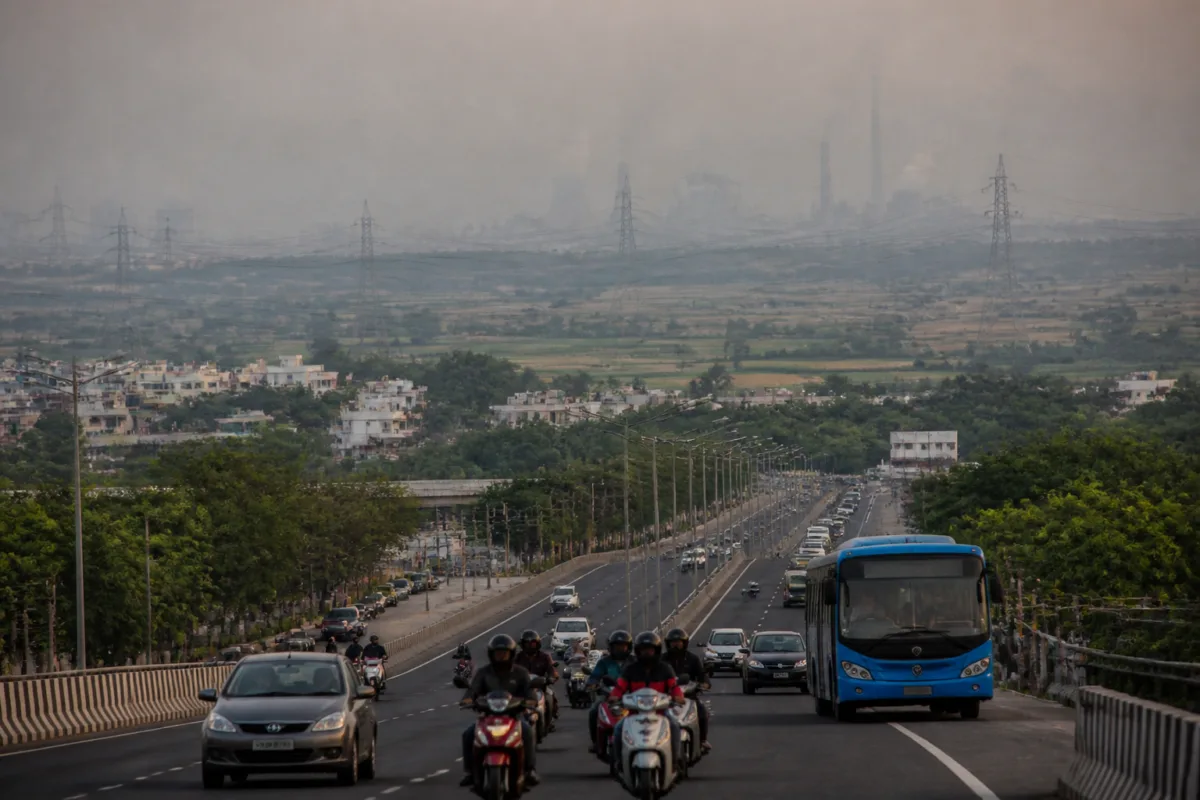
The latest evidence on air pollution in India challenges a familiar assumption in clean-air policy: that the greatest health risks are concentrated inside cities. A review by the Centre for Research on Energy and Clean Air (CREA) found that 169 of 184 epidemiological studies reported increased health risks associated with pollution, while research involving rural populations also recorded widespread adverse health associations. The findings point towards a policy problem that is larger than urban monitoring networks or municipal boundaries.
The review examined peer-reviewed studies published between 1975 and 2025. It assessed the health outcomes, pollutants, exposure settings and geographical spread covered by the research. Eight studies came from Karnataka, placing the state seventh nationally by the number of studies reviewed, behind Delhi, Punjab, Maharashtra, Uttar Pradesh, West Bengal and Tamil Nadu.
That ranking is not a measure of which states are most polluted. It is a measure of research coverage. The distinction matters because a lower number of studies can reflect limited research attention rather than lower exposure or lower health risk. The review therefore raises two issues at once: what existing evidence shows about pollution and health, and how unevenly that evidence has been produced across India.
The most frequently studied health outcome was respiratory disease, appearing in 86 studies. Mortality was examined in 16 studies and cardiovascular disease in 11. Other reported outcomes included diabetes, pregnancy-related complications, low birth weight, impaired child growth, neurological and mental health disorders, kidney disease and sleep disorders.
This spread of outcomes changes the way air pollution has to be understood within the built environment. Pollution is not only an issue of roadside concentrations or visible haze. Its consequences, as represented in the reviewed research, extend across health systems, households and the everyday functioning of communities. The evidence also indicates that exposure cannot be understood only through the geography of large urban centres.
The rural evidence is particularly significant. Of the 40 studies that examined rural populations, 38 reported at least one adverse health association. CREA analyst Manoj Kumar said the findings underline the need to move beyond a city-centric approach and include rural areas through a regional, airshed-based strategy in the next phase of the National Clean Air Programme.
An airshed-based approach treats air as a connected regional system rather than as a problem contained within an administrative boundary. The review’s findings make that approach relevant because pollutants and their precursors can affect people in different settlement types, while the source of emissions and the location of health impacts may not be the same. The supplied evidence does not establish a specific airshed boundary or prescribe a detailed institutional structure, but it does show why city-only planning may not capture the full exposure pattern.
For Bengaluru and Karnataka, the review’s findings are relevant without establishing a separate state-specific health conclusion beyond the eight studies included. Karnataka’s position in the national research count shows that the state has a body of evidence, but also that research coverage is considerably larger in some other states. The review does not provide a city-level or district-level breakdown of Karnataka’s findings in the supplied material. That limitation is important: the evidence supports a broader regional policy question, but not a new numerical estimate of health risk for Bengaluru or any particular rural district.
The review also points to a second weakness in the way air pollution is often measured and managed: the focus on a single pollutant. Of the studies examined, 32 looked at PM2.5, four examined PM10 alone, 16 considered both PM2.5 and PM10, and 45 studied particulate matter alongside gaseous pollutants.
These categories show that the research itself is increasingly concerned with more than particulate matter in isolation. CREA noted that sulphur oxides and nitrogen oxides contribute to the formation of secondary PM2.5 through atmospheric reactions. The review said such particles account for about one-fourth of India’s PM2.5 concentrations. That finding connects the health discussion to the sources and processes that produce pollution, rather than limiting policy to the measurement of particles after they have formed.
The implication is not that PM2.5 has become less important. Instead, the evidence presented by CREA suggests that reducing particulate exposure may require action on gaseous precursors as well. Kumar called for a multipollutant approach addressing the emissions that contribute to secondary PM2.5 and ground-level ozone formation. The major sources identified in the review include industries, power plants, residential cooking and other combustion activities.
This has direct implications for institutional responsibility. A city administration may oversee local roads, construction activity, waste management or some urban services, but the pollutant mix affecting residents can also be linked to sources beyond municipal control. Industrial facilities, power plants, household cooking and other combustion activities may fall under different departments, regulators or levels of government. The review therefore exposes a coordination problem: the health outcome is experienced by people in a particular place, while the sources and atmospheric processes may be distributed across a wider region.
The same issue applies to rural communities. If clean-air programmes are designed primarily around cities, monitoring and mitigation may follow municipal lines even when people outside those limits are also exposed to pollution-related risks. The finding that 38 of 40 studies involving rural populations reported at least one adverse health association strengthens the case for expanding the geographical frame of the programme. It does not, by itself, show that rural communities face the same exposure levels or the same sources as urban residents. It does show that rural populations cannot be treated as absent from the health evidence.
The review’s findings are also notable because adverse associations were reported strongly in research connected to public institutions. Of 46 government-funded studies, 44 reported increased health risks. Among 81 studies involving government-affiliated institutions, 77 reported adverse health associations. These institutions included the Indian Council of Medical Research, the Central Pollution Control Board, the All India Institute of Medical Sciences and the Ministry of Health and Family Welfare.
The presence of government-funded and government-affiliated research does not automatically resolve questions about causality, exposure measurement or differences between studies. The supplied account does not provide the individual methodologies or effect sizes of the 184 studies. However, the pattern is significant within the review’s own scope: evidence of health risks was not limited to privately produced or isolated research. It appeared across studies linked to public research and health institutions as well.
That makes the policy question more specific than a general call for awareness. The review calls for a revision of the National Clean Air Programme, including PM2.5-specific targets and revised National Ambient Air Quality Standards. It also seeks a multipollutant framework and stronger emission controls. These proposals connect three separate parts of air-quality governance: the target being measured, the standard used to judge air quality and the sources regulated to achieve improvement.
A target focused on one pollutant may not fully represent the exposure created by a mixture of particulate and gaseous pollutants. Similarly, a city-level target may not capture pollution generated or transported across a wider airshed. The review does not provide a proposed replacement framework in the supplied material, but its recommendations indicate that the next phase of clean-air policy is being asked to address both the pollutant mix and the geography of exposure.
The data story is therefore not only that 169 of 184 studies found increased health risks. It is also that the evidence is distributed unevenly across places, outcomes and pollutant types. Respiratory disease dominates the research, while other outcomes appear less frequently. Rural populations are studied less often than urban populations, but most of the rural studies included in the review reported adverse associations. Karnataka has eight studies in the review, fewer than Delhi’s 26 and Punjab’s 13, as well as the totals for Maharashtra, Uttar Pradesh, West Bengal and Tamil Nadu.
These numbers should not be read as a ranking of health danger between states or as proof that one pollutant is responsible for every recorded outcome. They show the shape of the available evidence. They also reveal where policy interpretation must remain cautious. The review aggregates studies conducted across five decades, from 1975 to 2025, and the supplied material does not explain how exposure levels, study designs or monitoring practices changed over that period.
For cities, the larger urban question is whether air-quality governance can continue to follow the same boundaries as local administration. The evidence presented by CREA suggests that health risk extends across settlement types and that the pollutants involved may include both particulate matter and gases that contribute to secondary pollution. A framework limited to city limits, single-pollutant measurements or isolated agencies could therefore leave part of the problem outside the policy frame.
The review confirms a broad and multi-dimensional association between air pollution and adverse health outcomes across the research it examined. It also identifies a clear policy direction: wider regional coverage, multipollutant controls, PM2.5-specific targets, revised ambient standards and tighter emission curbs. What remains uncertain from the supplied material is how those changes would be designed, funded, monitored and assigned across institutions. Those implementation questions will determine whether the next phase of clean-air policy reflects the evidence beyond city limits.

