


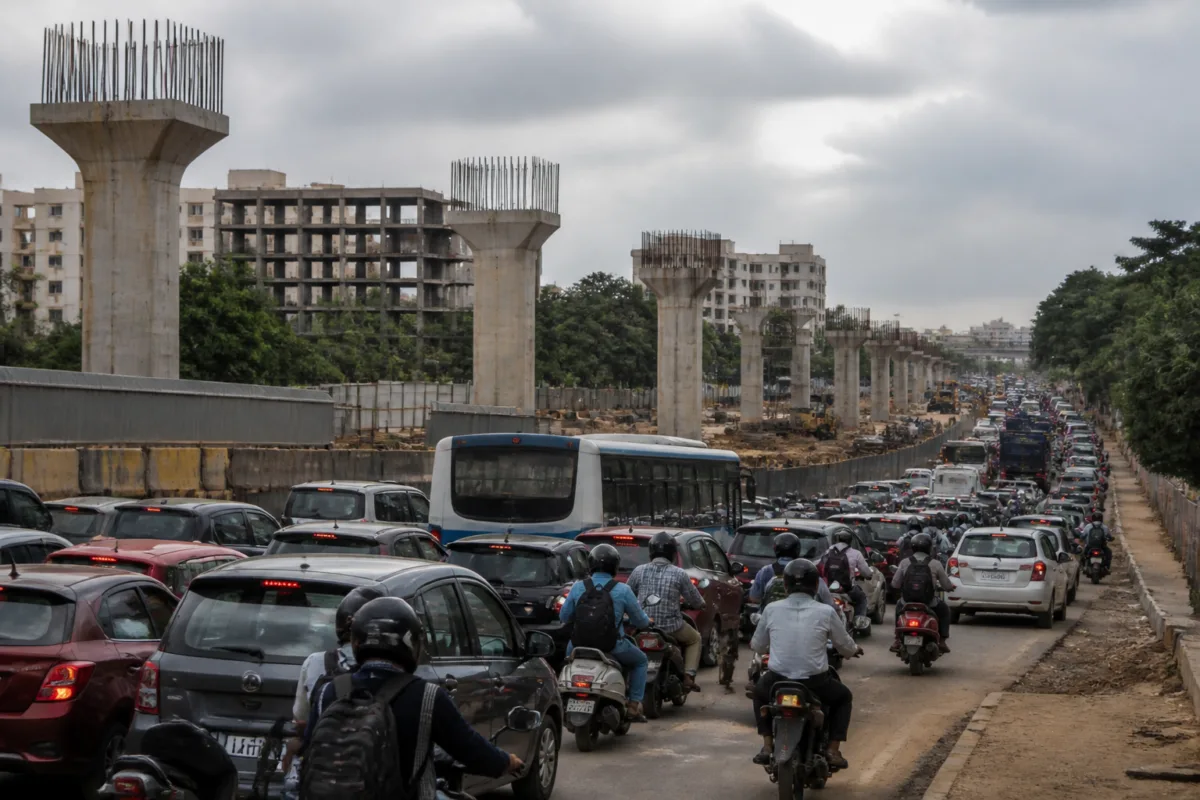
The traffic anxiety in Kogilu is not being caused by one road project alone. It is the result of a fragile north Bengaluru network in which a major Ballari Road corridor is set for at least 18 months of construction while a planned alternative route remains incomplete. The situation shows how the sequencing of urban infrastructure can determine whether a project improves mobility or transfers congestion to already pressured neighbourhoods.
The Bangalore Development Authority is undertaking a four-lane elevated corridor on Ballari Road between UAS Staff Quarters and Mehkri Circle. The project is expected to involve closure or disruption of lanes on a route that residents regard as a key arterial connection. For people travelling towards the airport and other parts of north Bengaluru, the concern is not simply that construction will slow traffic. It is that the road network may not have enough completed alternatives to absorb diverted vehicles.
That concern has directed attention to the Kogilu CDP Road, a proposed 3.3-km link connecting Kogilu Road with Sampigehalli, Jakkur, Gasti Kempanahalli and Railway Parallel Road. The project was launched in 2025 at an estimated cost of Rs 5 crore, but work has not yet been completed, according to Bangalore Mirror’s report. Residents are now asking authorities to clarify why the project remains stalled and when it will restart and finish.
The underlying issue is the difference between planning a network and delivering a network. A road shown as a proposed connection can provide relief only after land, contracts, construction and junction-level integration are completed. Until then, it remains an intended route rather than usable capacity. In Kogilu, the timing of the incomplete CDP Road has become particularly important because construction on Ballari Road is expected to continue for at least 18 months.
Residents’ accounts indicate that congestion is already affecting daily routines. Raksha, a Kogilu resident, told Bangalore Mirror that reaching the office by 9 am requires planning the day from 6 am, and that missing this routine can make punctual travel almost impossible. She attributed the problem to poor road infrastructure and mismanaged junctions, and argued that Bengaluru needs multiple roads that connect with one another rather than dependence on a single arterial route.
Another resident of Adarsh Greens in Prakruthi Nagar said the school journey for his children, which previously took around 30 minutes, now takes between 45 minutes and an hour. These figures are not a citywide traffic survey, but they illustrate how network delays are experienced at household level. A rise of 15 to 30 minutes on a school commute affects work schedules, school drop-offs and the time available for other daily activities.
The concern is also linked to the pace of development around Kogilu. Nitin, a resident of Adarsh Green Apartments near Kogilu Cross, told the newspaper that nearly 2,000 families currently live in the area and that more than 5,000 additional families are expected over the next two to four years. The report does not provide an official development projection or clarify the basis of that estimate. However, the residents’ account points to a basic planning question: whether road capacity and junction management are being delivered in step with housing growth.
The proposed CDP Road matters because its alignment would create connections across several neighbourhoods rather than merely widening one existing corridor. It is intended to link Kogilu Road with Sampigehalli, Jakkur, Gasti Kempanahalli and Railway Parallel Road. Such a connection could offer another route for local trips and potentially reduce pressure on Ballari Road. But the supplied report does not establish the project’s current physical progress, the reason for the delay, the agency responsible for the stalled work or the remaining construction and land requirements.
That missing institutional clarity is central to the problem. Residents have asked authorities to explain the delay and announce a clear timeline for restarting and completing the road. Without that information, people living along the corridor cannot assess whether the CDP Road will be available during the Ballari Road construction period or whether they should expect traffic to be diverted elsewhere. The absence of a publicly known schedule also makes it difficult to coordinate road construction with school travel, residential expansion and airport-bound movement.
The report identifies Nagawara as another possible pressure point if traffic is diverted. It does not provide traffic counts or modelling to establish how much additional traffic could move through Nagawara. The concern nevertheless reflects the interconnected nature of Bengaluru’s congestion. When an arterial route is disrupted, vehicles do not disappear; they seek other links, junctions and neighbourhood streets. If those routes are not designed or managed for additional volume, congestion can spread beyond the original work zone.
This is why the Ballari Road project should be understood as an implementation and coordination challenge as much as a construction project. The corridor itself may be important, but its effects will depend on traffic management during construction, the availability of parallel connections and the performance of junctions at either end. The supplied report does not state what diversion plan, lane-management system or public consultation process has been finalised. Residents say major infrastructure decisions should involve proper public consultation, indicating that the communication process is itself part of the dispute.
The institutional arrangement adds another layer. The elevated corridor is being undertaken by the Bangalore Development Authority, while the proposed CDP Road is also discussed in the context of BDA-led urban development. The report does not specify whether the same project authority, another civic agency or a contractor is responsible for each stage of the CDP Road. It also does not identify a revised budget, tender status, contractual deadline or formal reason for the delay. Those are not minor administrative details: they determine whether a promised alternative can be delivered before the main corridor enters its most disruptive phase.
The Rs 5 crore estimate attached to the CDP Road provides a project cost, but not a measure of what remains to be spent. Nor does it reveal whether the estimate has changed since the project was launched in 2025. A useful public update would need to distinguish between the original sanction, funds released, work completed and liabilities still pending. Without those figures, residents are left with a launch announcement but no reliable delivery benchmark.
The timeline is equally important. An 18-month construction period is long enough to affect multiple school terms, office cycles and residential travel patterns. If the alternative road is completed before major disruptions begin, it may support a more orderly traffic arrangement. If it remains unfinished, the construction period could expose the weaknesses of the existing network. The report does not establish the exact start date for the elevated corridor’s disruptive works, so the relationship between the two timelines remains unclear.
Kogilu’s experience also highlights the limits of measuring mobility only through major corridors. A project can be designed around a prominent road while the daily burden is felt on smaller connecting roads and at junctions. Residents’ references to mismanaged junctions and longer school commutes suggest that local network quality may be as important as the headline infrastructure project. The report does not provide junction designs, traffic volumes or enforcement details, so it cannot establish which specific interventions would reduce congestion. It does show, however, that a corridor-level project has neighbourhood-level consequences.
The citizen petition, which Nitin said had collected around 1,200 signatures, indicates organised local concern. A petition is not an independent assessment of traffic demand or project feasibility, but it is evidence that the issue has moved beyond individual complaints. Residents are seeking three forms of accountability: an explanation for the delay, a clear completion schedule and adequate arrangements for the Ballari Road construction period.
The larger urban question is whether Bengaluru’s infrastructure agencies are coordinating projects as parts of one mobility system. The Ballari Road elevated corridor, the Kogilu CDP Road, the surrounding neighbourhoods and routes towards the airport are being experienced together by commuters, even if they are planned, funded or executed through separate administrative processes. For residents, the distinction between agencies does not reduce the daily effect of a stalled link or a disrupted arterial road.
The evidence currently confirms a serious coordination risk, not a completed traffic impact assessment. Bangalore Mirror’s report records the expected duration of the Ballari Road construction, the proposed alignment and cost of the CDP Road, residents’ travel experiences, the petition’s reported support and fears about diversion through Nagawara. It does not establish the official reason for the CDP Road delay, the final traffic diversion plan or the exact construction schedule. Those are the next facts that authorities need to place in the public domain as north Bengaluru prepares for a prolonged period of road work.

