


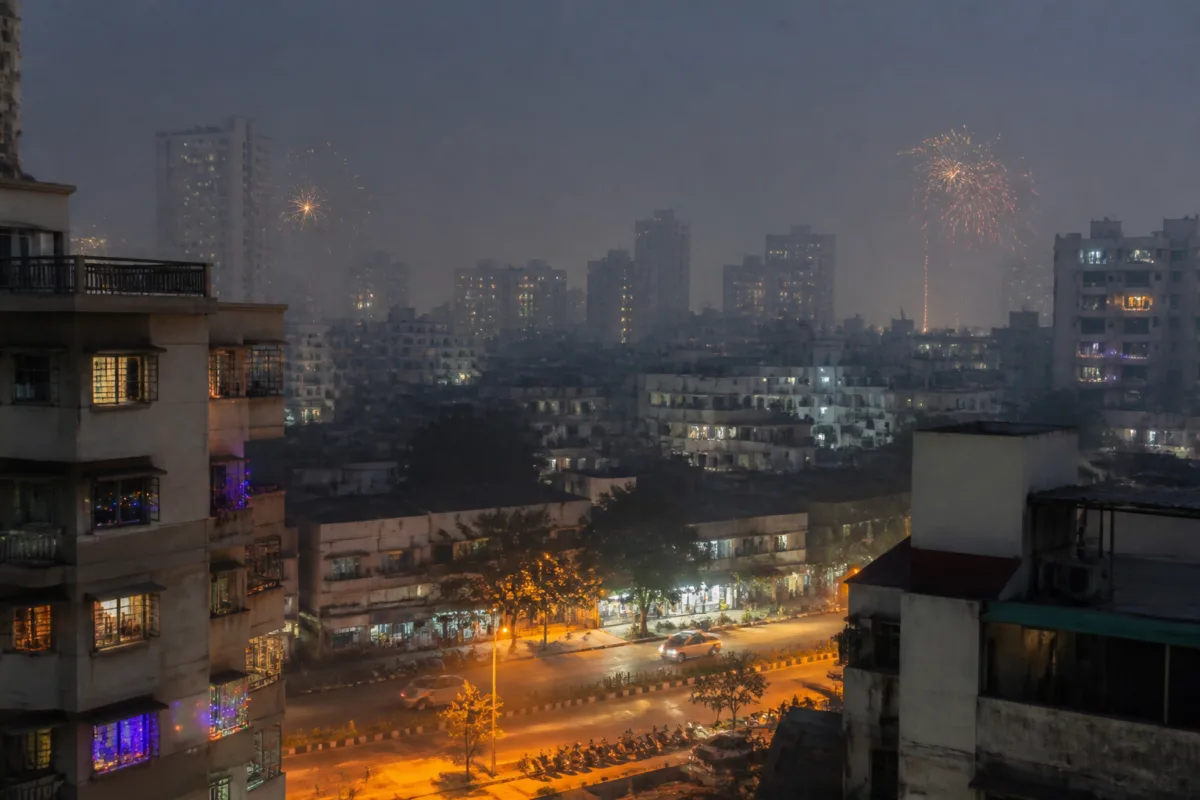
Pune’s average Air Quality Index (AQI) rose to 288 on Sunday while Pimpri Chinchwad’s average reached 301, with firecracker activity during Diwali celebrations coinciding with severe readings across several locations in the two urban areas, according to data cited from the Central Pollution Control Board’s SAMEER app by Punekar News.
Bhosari recorded the highest reading in the twin cities at 326, while Dhanakwadi registered Pune’s highest AQI at 310. The readings placed several neighbourhoods in the two cities above 300, indicating that the deterioration was spread across multiple monitoring locations rather than confined to one localised pocket.
In Pimpri Chinchwad, Savta Mali Nagar recorded an AQI of 320. Bhumkar Nagar and Transport Nagar in Nigdi each recorded 305, while Park Street in Wakad registered 301. Thergaon recorded 291 and Gavlinagar 256.
Pune’s monitoring locations also reported elevated readings. Mhada Colony recorded an AQI of 304, followed by Hadapsar at 300. Panchwati in Pashan recorded 289, while the Katraj Dairy area and the Savitribai Phule Pune University area recorded 275 and 252 respectively.
The increase followed relatively better air quality during the first two days of November. Pune’s average AQI stood at 90 on November 1 and 91 on November 2, before rising to 114 on November 3. It increased further to 157 on November 7 and 163 on November 8, reaching 288 on Sunday.
Pimpri Chinchwad recorded a sharper increase over the previous two days. Its average AQI had generally remained between 100 and 140 during the preceding period, although it rose to 211 on November 7 and stood at 202 on November 8. The average was 93 on November 1 and 146 on November 6 before reaching 301 on Sunday.
The deterioration coincided with widespread firecracker bursting during Diwali celebrations. The report attributed the worsening air quality to the contribution of firecracker emissions, with high readings recorded across residential and commercial areas in both cities. The pattern indicates that the impact extended beyond isolated neighbourhoods and affected the wider urban airshed shared by Pune and Pimpri Chinchwad.
The latest readings add an acute pollution episode to the cities’ existing challenge of managing air quality across a geographically connected urban region. The data cited in the report shows that the sharpest increase occurred over a short period, particularly in Pimpri Chinchwad, where the average rose from 202 on November 8 to 301 on Sunday.
The report did not provide details of any new restrictions, emergency measures or official response following the elevated readings. The next air-quality readings from the CPCB SAMEER monitoring network will indicate whether the spike recedes after the festival-related activity or remains elevated across the two cities.

