


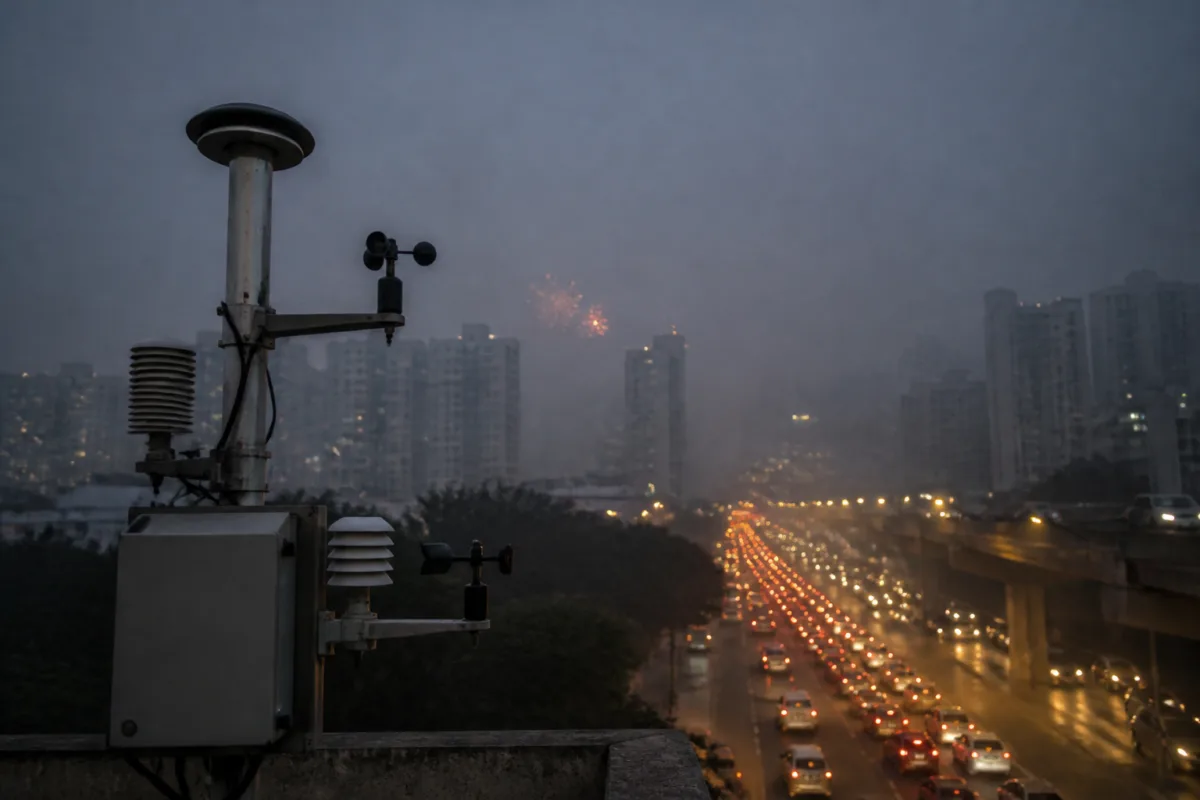
Delhi’s air-quality monitoring network recorded major data gaps during the peak pollution period on Diwali night, with 36 of the city’s 59 stations not reporting readings at 1 am, raising fresh questions about the reliability of official AQI data during a public-health emergency.
The missing readings increased sharply as Diwali night progressed. According to an analysis by the Centre for Research on Energy and Clean Air, one station had missing data at 7 pm on Sunday, but the number rose to seven by 10 pm, 23 by 11 pm and 29 by midnight. At 1 am on Monday, only 23 stations were reporting readings.
The gap remained significant at 2 am, when 35 stations were not reporting data. The number gradually declined to 30 at 3 am, 20 at 4 am, 19 at 5 am and 16 at 6 am. By 9 am, only two stations were offline, although one continued to have missing readings until 11 am.
The disruption coincided with the period when firecracker use and overnight emissions were expected to place the greatest pressure on Delhi’s air. The report said Delhi recorded its most polluted Diwali in five years, while readings from private monitoring platforms showed significantly worse conditions than the official figures.
Anumita Roychowdhury, executive director of the Centre for Science and Environment, said the failure of the monitoring network during peak pollution was inexplicable given the public investment in establishing and maintaining the system. She said credible real-time data was necessary for public-health advisories, institutional accountability and mitigation measures.
“Losing data does not reduce the public health emergency,” Roychowdhury said, while calling for reliable official readings during the period of maximum exposure.
The data reported by government and private agencies differed substantially on Monday morning. Official data showed Delhi’s AQI at 370 at 8 am. Swiss air-quality platform IQAir recorded an AQI of 245 on the US scale at 8.30 am, placing the air in the “very unhealthy” category, and reported a PM2.5 concentration of 170 micrograms per cubic metre. AQI.in reported a reading of 637, categorised as “hazardous”, and said the city’s AQI had peaked at 2,283 after Diwali.
The differences reflect variations in monitoring coverage, measurement parameters and averaging methods, but the simultaneous loss of official station data has intensified scrutiny of the system. At 4 pm on Monday, Delhi’s average AQI was reported at 344, compared with 376 at the corresponding time on Diwali day. However, only 47 stations were reporting at that point. Of these, 40 were in the “very poor” category and seven were in the “poor” category. Bawana recorded the highest AQI at 396, followed by Burari at 393.
Delhi cabinet minister Kapil Mishra asked reporters to share details of stations that were reportedly non-functional and said he would seek action. Opposition leader Saurabh Bharadwaj accused the authorities of “data fraud” and alleged that air-quality readings were being manipulated, claims that were not independently established in the report.
The episode has placed the reliability and availability of Delhi-NCR’s air-quality data at the centre of the response to severe pollution. Authorities are expected to examine the station outages and establish why so many readings were unavailable during the critical overnight period.

