


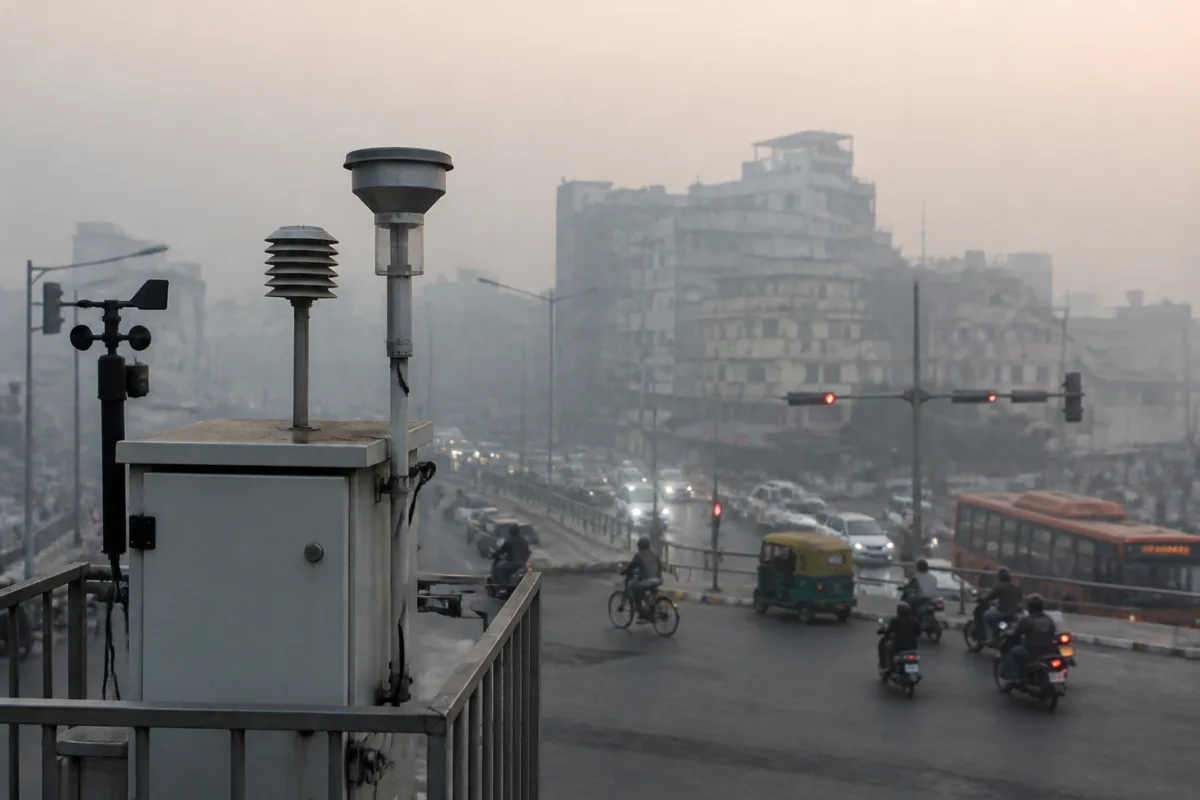
Delhi’s latest Diwali pollution episode has exposed a problem more consequential than a single extreme AQI reading: the city’s public air-quality monitoring system stopped providing readings at the very time residents most needed reliable information. A Centre for Research on Energy and Clean Air (CREA) analysis found that 36 of Delhi’s 59 monitoring stations were not reporting data at 1 am on Monday, leaving less than half the network available during the peak smog hours.
The official average AQI for Delhi reached 376 on Diwali, described in the report as the city’s worst Diwali reading in five years. But that figure was produced against a background of substantial missing data. The number of stations without readings rose from one at 7 pm on Sunday to seven at 10 pm, 23 at 11 pm and 29 by midnight. At 2 am, 35 stations were still not reporting.
The missing readings did not occur during a routine operating period. They coincided with a sharp deterioration in air quality, widespread alleged violations of the Supreme Court’s restrictions on firecracker use and the period when residents were likely to face the highest exposure. That timing has turned a technical failure—or, as some political leaders allege, deliberate interference—into a question of public accountability.
The central fact established in the supplied report is the scale and timing of the data gap. Its cause remains disputed. Anumita Roychowdhury, executive director of the Centre for Science and Environment, said the failure was difficult to explain given the public investment in Delhi-NCR’s monitoring network and the presence of active operation and maintenance contracts. She said the absence of real-time readings also affected the authorities’ ability to issue timely health warnings and respond to the emergency.
“Losing data does not reduce the public health emergency,” Roychowdhury said, arguing that credible official information was necessary for institutional accountability, public awareness and mitigation. Her point goes to the difference between an environmental crisis and the administrative ability to measure it. Pollution does not become less severe because a monitoring station stops transmitting. But without reliable readings, the scale, location and duration of exposure become harder to establish.
The CREA analysis provides a detailed picture of how quickly the network’s visibility narrowed. Missing readings began to increase in the evening, reached 29 stations by midnight and peaked at 36 stations at 1 am. The number then declined gradually: 30 stations were missing at 3 am, 20 at 4 am, 19 at 5 am and 16 at 6 am. By 7 am, 13 stations were not reporting, falling to seven at 8 am and two at 9 am. One station continued to report no data until 11 am.
That pattern matters because a citywide average can conceal severe local variation. Delhi’s official average AQI was 344 at 4 pm on Monday, compared with 376 at the same time on Diwali. But readings were available from only 47 of the 59 stations. Of those reporting stations, 40 recorded air quality in the very poor category and seven in the poor category. Bawana recorded the highest AQI at 396, followed by Burari at 393.
The figures also show why the debate cannot be reduced to a disagreement over one citywide number. Private platforms reported substantially different readings. At 8 am on Monday, the official Delhi AQI was 370. Swiss platform IQAir recorded 245 on the US scale at 8.30 am, classifying the air as very unhealthy, while AQI.in reported 637 and classified conditions as hazardous. AQI.in also recorded a post-Diwali peak AQI of 2,283.
These numbers are not directly interchangeable. Radhey Shyam Sharma, head of the Department of Environmental Studies at Delhi University, said private and government agencies might use different methods to calculate average AQI readings. He said official data should clearly specify the location and time of readings, while exposure levels should be explained more clearly. The distinction is important: a citywide average, a station-level peak and a platform using a different index may each describe different aspects of the same pollution episode.
At the same time, methodological differences do not explain away missing official readings. Sharma said accurate information was essential for policy decisions, assessing the severity of pollution and ensuring accountability during what he described as a severe emergency. He also pointed out that average AQI values might not represent peak exposure, particularly when residents encounter the worst conditions at specific locations and times.
This is the institutional weakness at the centre of the controversy. Delhi’s air-quality network is described by CSE as the densest in the country and has been built with substantial public investment. Such a network is not merely a collection of sensors. It is part of the city’s emergency-response infrastructure, used to communicate risk, assess regulatory action and support decisions affecting schools, workers, traffic, construction and public health.
When a significant share of that network goes offline, authorities lose more than a number. They lose the ability to compare neighbourhoods, identify hotspots, verify whether pollution-control measures are working and communicate the severity of conditions in real time. The missing data also weakens any later assessment of the episode because the most important hours cannot be reconstructed through a complete set of observations.
The report does not establish why the stations stopped reporting. Delhi cabinet minister Kapil Mishra, asked about the missing readings at a press conference, requested details of the stations reportedly not working and said he would seek action. That response indicates that the issue had entered the government’s administrative field of responsibility, but the supplied material does not record the outcome of any technical or official investigation.
The political dispute has added a second layer to the data question. Senior AAP leader Saurabh Bharadwaj accused the Delhi government of manipulating pollution figures and called the alleged practice “data fraud”. He also claimed that water was being sprayed near the Jahangirpuri monitoring station to bring down its average reading, and alleged that stations were switched off during Diwali night. These are political allegations and are not independently established in the supplied report.
Bharadwaj further alleged that 20 new monitoring stations had been installed in open and green areas with lower traffic and population density, claiming that this could reduce the city’s average AQI. Again, the report presents these as allegations rather than verified findings. Their significance lies in the need for transparent station-selection criteria and publicly available technical explanations, not in treating the claims as proven.
The controversy is also not entirely new. The report recalls that after Diwali the previous year, the AAP had accused the BJP-led Delhi government of switching off stations operated by the Central Pollution Control Board, Delhi Pollution Control Committee, India Meteorological Department and Indian Institute of Tropical Meteorology. The party made similar claims about stations resuming operation the following morning, while experts monitoring readings in real time also reported gaps. The recurrence of such accusations shows that confidence in the monitoring system has become an institutional issue rather than a one-day dispute.
For residents, the practical consequence is uncertainty at precisely the moment when information should guide behaviour. People deciding whether to exercise outdoors, send children to school, protect elderly family members or limit exposure need to know not only the average AQI but also where readings were taken, when they were recorded and whether the network was complete. A partial network can make an apparently precise citywide figure look more authoritative than the underlying evidence allows.
The governance responsibility is distributed across a network of agencies and contractors, as reflected in the report’s references to CPCB, DPCC, IMD, IITM and operation and maintenance contracts. That distribution can support specialised monitoring, but it can also make accountability difficult when readings disappear. A credible response would require the authorities to identify which stations failed, explain the technical cause, publish downtime records and clarify how official averages were calculated during the affected hours. The supplied material records calls for action and accountability but does not establish that these steps have occurred.
The episode also exposes the difference between having monitoring infrastructure and having dependable public data. A sensor network may be dense on paper, yet its public value depends on continuity, maintenance, calibration, transparent methodology and timely disclosure of failures. The most important test is not how many stations exist under normal conditions, but whether the system remains reliable during predictable pollution events such as Diwali night.
The evidence currently confirms three things: Delhi experienced severe pollution, a substantial portion of its monitoring network stopped reporting during the most critical hours, and official and private platforms published sharply different AQI figures. It does not, on the material supplied, confirm that the outages or station locations were manipulated. The next important development is therefore not another competing AQI number, but an accountable explanation of the missing readings and the safeguards in place to ensure that Delhi’s pollution data remains complete when public-health decisions depend on it.

