


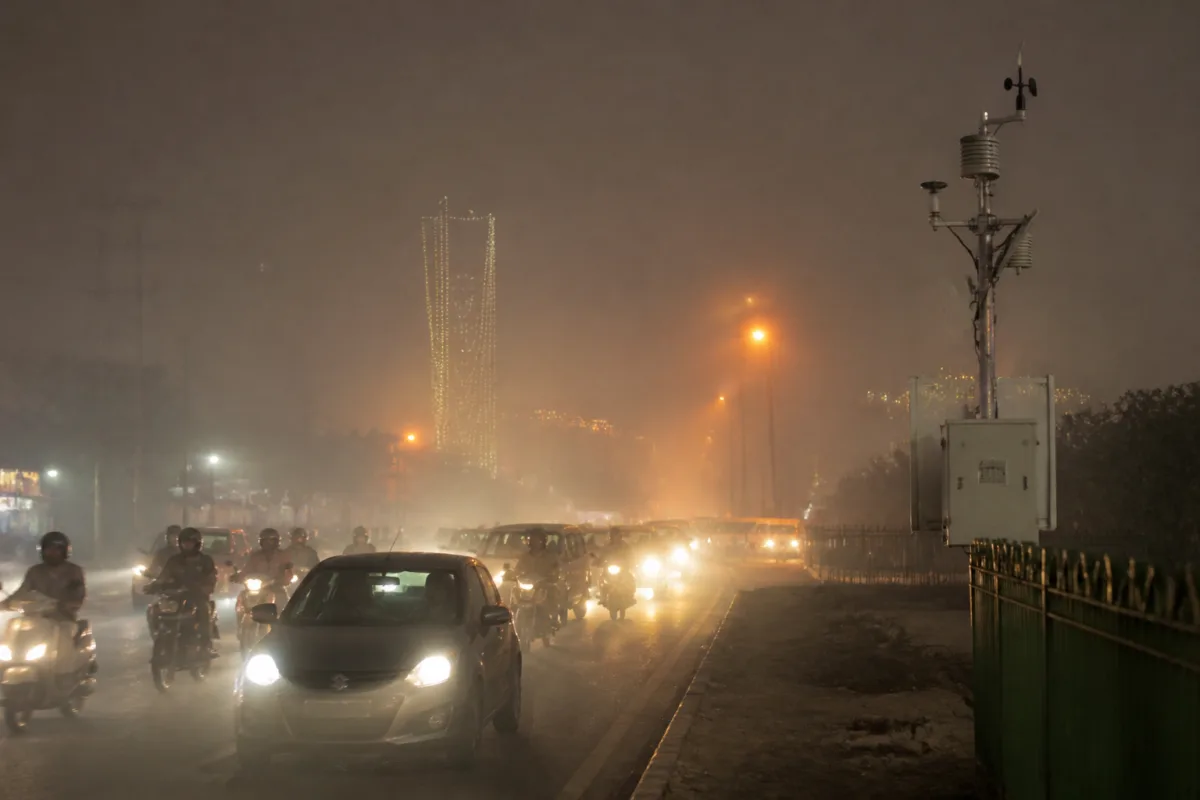
Delhi Diwali pollution levels reached extreme highs at several monitoring stations after updated readings showed particulate matter concentrations running many times above prescribed limits, while gaps in both DPCC and CPCB records continued to raise questions about the completeness of the capital’s air-quality data.
At RK Puram, PM2.5 reached 2,389 micrograms per cubic metre at midnight, against the prescribed limit of 60 micrograms per cubic metre. PM10 at the station rose to 2,881 micrograms per cubic metre, compared with the permissible limit of 100 micrograms per cubic metre.
Other stations also recorded severe spikes. At Anand Vihar, PM10 peaked at 3,490 micrograms per cubic metre at 2 am, while PM2.5 reached 1,670 micrograms per cubic metre around the same time. Ashok Vihar recorded a PM10 peak of 3,425 micrograms per cubic metre and PM2.5 of 2,589 micrograms per cubic metre at approximately 2 am.
The Commonwealth Sports Complex station recorded PM10 of 2,928 micrograms per cubic metre at 5 am and PM2.5 of 2,471 micrograms per cubic metre at 4 am. At Dwarka Sector 8, PM10 peaked at 2,196 micrograms per cubic metre at midnight, while PM2.5 reached 1,996 micrograms per cubic metre at 6 am.
The updated figures followed the restoration of much of the data that had initially been missing from Delhi Pollution Control Committee monitoring stations during the peak pollution period on Diwali night. However, some gaps remained. PM10 data for one hour at the RK Puram station was still unavailable, while data from Central Pollution Control Board monitoring stations for the night had not been released, according to the report.
The scale of the missing data had earlier been substantial. An analysis of hourly PM2.5 readings from Delhi’s 59 monitoring stations found that only one station was not reporting at 7 pm, but the number of non-reporting stations rose to 36 by 1 am. This left readings available from only 23 stations during a period when firecracker use was at its peak.
Manoj Kumar, an analyst at the Centre for Research on Energy and Clean Air, said CPCB data for the night was still unavailable. Sunil Dhaiya, founder and lead analyst at Envirocatalysts, said DPCC stations had recorded PM2.5 concentrations above 1,000 micrograms per cubic metre at 20 stations for a cumulative 126 hours. The highest reading, he said, was 3,744 micrograms per cubic metre at Mundka.
Dhaiya said incomplete records could understate the worst pollution hours and make it harder to assess health risks or determine whether pollution-control measures were working. The continued absence of some readings therefore affects not only public reporting but also the administrative evaluation of enforcement during a high-risk pollution episode.
Neurologist Rahul Chawla said PM2.5 can pass through the lungs and reach other parts of the body. He said exposure can trigger inflammatory changes and increase the risk of conditions including heart attack, stroke and neurological disorders. Children, older people and those with asthma or chronic obstructive pulmonary disease were particularly vulnerable, while he also flagged concerns over prolonged exposure during pregnancy.
The updated station data provides a clearer picture of the pollution peaks recorded across Delhi, but the remaining gaps mean the complete citywide record for Diwali night is still unavailable. CPCB data and the outstanding station readings remain the next key elements required to establish the full extent of the episode.

